Last updated: October 2026
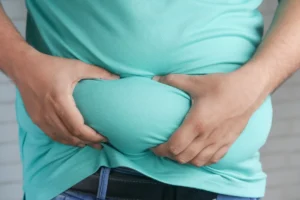
An apron belly is a fold of skin and fat that hangs down over the lower abdomen, sometimes as far as the pubic area or thighs. Doctors call it a pannus or abdominal panniculus. The honest answer to how to get rid of apron belly has two parts. The fat in it shrinks with overall weight loss, so diet, walking and strength training make it smaller. The excess skin does not respond to exercise, so if a large fold is left after you have lost the weight, only surgery removes it.
This guide covers how to tell an apron belly from a FUPA, diastasis recti or visceral fat, what causes it, what exercise can and can’t do (with the evidence), a realistic non-surgical plan, how to look after the skin under the fold, and when surgery makes sense.
What Is an Apron Belly?
An apron belly forms when the lower abdomen carries more fat and skin than the abdominal wall can hold flat, so the tissue folds over and hangs. It sits in front of your abdominal muscles. It is mostly subcutaneous fat (the soft fat under the skin you can pinch) plus stretched skin, not the deeper fat around your organs.
Clinicians grade a pannus from 1 to 5 by how far it hangs. In the StatPearls review of panniculectomy, grade 1 reaches the mons pubis and grade 5 extends to or past the knees [1]. The scale comes from a bariatric surgery series by Igwe and colleagues, who found that people with grades 3 to 5 had more back pain and more skin-hygiene problems [2].
| Grade | How far the fold hangs | What usually helps most |
|---|---|---|
| 1 | Reaches the pubic hairline (mons pubis) | Fat loss, strength training, skin care |
| 2 | Covers the genital area | Fat loss; support garments; skin care |
| 3 | Covers the upper thighs | Fat loss plus a medical review; surgery often discussed |
| 4 | Reaches the mid thighs | Medical care; panniculectomy commonly considered |
| 5 | Reaches or passes the knees | Medical care; panniculectomy commonly considered |
Grades 1 and 5 are the defined end points in the StatPearls review. The middle grades are the commonly used descriptions of the same scale.
Apron Belly vs FUPA, Diastasis Recti and Visceral Fat
Several different things get called an apron belly online. They respond to different fixes, so it is worth knowing which one you have.
| What you have | Where it is | How it looks and feels | What changes it |
|---|---|---|---|
| Apron belly (pannus) | Lower abdomen, folding down over the pubic area | A soft fold you can lift; skin crease underneath | Fat loss shrinks it; leftover skin needs surgery |
| FUPA | The mons pubis, below the belly line | A soft mound of fat over the pubic bone; doesn’t fold over | Overall fat loss; it’s often one of the last areas to change |
| Diastasis recti | Midline, from the breastbone to below the navel | A gap or soft ridge down the middle, often “coning” when you sit up | Targeted core rehab, often with a physiotherapist |
| Visceral fat | Deep, around the organs | A firm, round belly that sticks out rather than hangs | Fat loss and activity; responds relatively well |
| Bloating | Whole abdomen | Changes through the day; flatter in the morning | Diet, digestion, not fat loss |
A quick self-check: stand side-on to a mirror. If tissue folds over and you can lift it to reveal a crease, it’s a pannus. If the belly is round and firm and you can’t pinch much, more of it is visceral fat, the kind often called a cortisol belly online. If you see a ridge down the middle when you lift your head from lying down, check for diastasis recti. Many people have more than one of these at once, especially after pregnancy.
Apron belly vs FUPA: a FUPA is fat on the mons pubis itself and stays in place when you lift your belly. An apron belly is a fold that hangs over that area. A large pannus can hide a FUPA underneath.
What Causes an Apron Belly?
- Weight gain: the most common cause. As fat accumulates in the lower abdomen, the skin stretches to hold it and gravity does the rest.
- Large weight loss: after losing a lot of weight, especially quickly or after bariatric surgery, the fat shrinks but stretched skin doesn’t fully retract. StatPearls lists dramatic weight loss as the most common reason people have a panniculectomy, with the risk higher in older people and those who started at a higher BMI [1].
- Pregnancy and C-section: pregnancy stretches the skin and abdominal wall. A C-section scar can tether the skin so tissue above it folds over the scar line (sometimes called a “C-section shelf”).
- Diastasis recti: when the two halves of the abdominal muscle separate, the wall pushes forward and the belly hangs further. It’s common: in a Norwegian study of 300 first-time mothers, 60% had diastasis recti at 6 weeks after birth and 32.6% still had it at 12 months [3].
- Age and menopause: skin loses elasticity with age. In a 4-year study of 156 women, all of them gained subcutaneous belly fat with age, and those who went through menopause also gained visceral fat and total body fat [4].
- Genetics: where your body stores fat is partly inherited. Some people store fat low on the abdomen first and lose it there last.
Can Exercise Get Rid of an Apron Belly?
Exercise helps, but not the way most “apron belly workout” videos suggest. You can’t burn fat from one spot by working the muscle underneath it.
The clearest test of this is a 2011 trial in which 24 adults did 7 abdominal exercises, 2 sets of 10, five days a week for six weeks, while keeping their calories the same. Their abdominal endurance improved a lot. Their belly fat didn’t change: there was no significant effect on body fat percentage, android (belly) fat, waist circumference or abdominal skinfolds [5].
So crunches, leg raises and “lower belly” routines don’t shrink an apron belly on their own. What does:
- Overall fat loss (a calorie deficit) shrinks the fat in the fold along with fat everywhere else.
- Strength training keeps muscle while you lose fat, so more of the weight you lose is fat.
- Daily movement, especially walking, adds to the deficit without adding much fatigue.
- Core training improves posture and how your midsection holds itself. It won’t remove the fold, but it can make it sit flatter.
What no exercise can do is remove excess skin. If the fold is mostly skin, you’ll notice the fat part shrinking for a while, and then progress stops even though your weight keeps going down. That’s the point where surgery becomes the only way to remove what’s left.
How to Get Rid of Apron Belly Without Surgery
1. Track your waist, not just your weight
Measure your waist at the same point once a week (how to do this: waist measurement guide). Waist size tracks belly fat better than the scale does, and it shows progress in the area you care about even in weeks when your weight stalls. Your waist-to-height ratio also tells you whether your belly fat is a health risk, not only a cosmetic one.
Check your waist-to-height ratio
Enter your waist and height to see where your belly fat sits on the health-risk scale, and track it as it comes down.
Calculate your waist-to-height ratio →2. Eat in a moderate calorie deficit
Fat loss is the only non-surgical way to make the fold smaller. Aim to eat about 300 to 500 calories a day below your maintenance level. That usually works out to around 0.5 to 1% of body weight a week, which is fast enough to see the change and slow enough to keep muscle and stick with. Your TDEE gives you the maintenance number to start from.
3. Eat enough protein
Protein keeps you full in a deficit and protects muscle. A common target while losing fat is about 1.6 to 2.2 grams per kilogram of body weight a day (or per kilogram of goal weight if you have a lot to lose). See how much protein you need for weight loss to work out your number.
4. Lift weights two to three times a week
Full-body strength training (squats or leg presses, a push, a pull, a hinge such as a deadlift or hip thrust) is what tells your body to keep muscle while you lose fat. Two or three sessions a week is enough. It doesn’t need to be heavy at first; it needs to be consistent and gradually harder.
5. Walk more
Walking is the easiest way to raise your daily calorie burn without making you hungrier or more tired. If you’re starting from a low base, add 2,000 to 3,000 steps a day to what you do now rather than jumping straight to 10,000. Here’s how many steps a day to lose weight by starting point.
6. Train your deep core (for support, not fat loss)
Core work won’t burn the fold away, but a strong deep core (the transverse abdominis, which wraps around your trunk like a corset) holds your abdominal contents in and improves posture, which makes the belly sit flatter. If you’ve had a baby or see coning down the middle of your stomach, start with diastasis-safe exercises and consider a pelvic-health physiotherapist.
7. Be patient with the timeline
A small apron belly (grade 1) can shrink noticeably in three to six months of steady fat loss. A larger one takes longer, and the lower belly is often one of the last places to lean out. If you’ve reached a stable, healthy weight and the fold hasn’t changed for six months or more, what remains is likely to be mostly skin.
Best Exercises for an Apron Belly
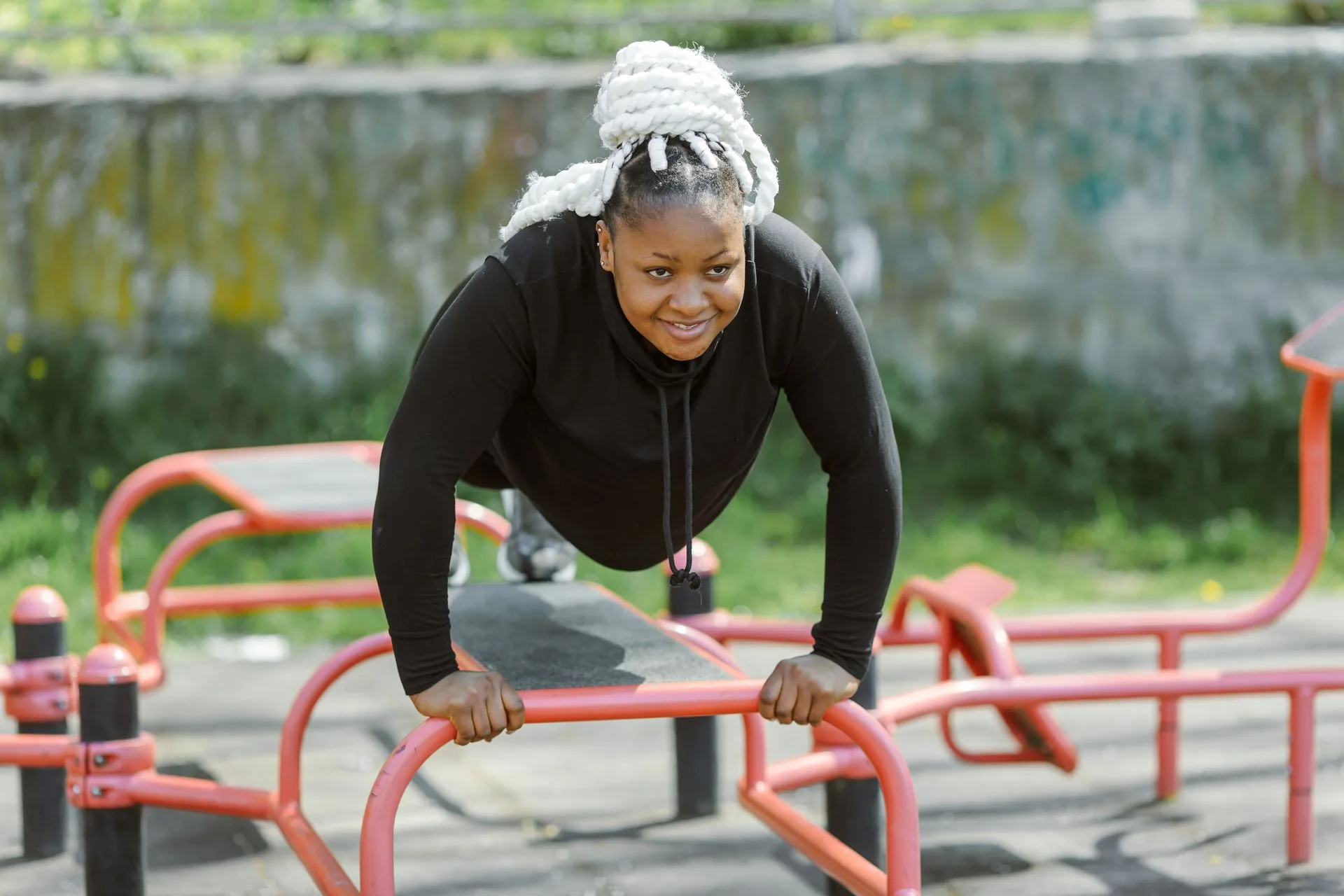
These help in the ways that matter: burning calories, keeping muscle, and building a core that supports your midsection. Do them alongside the calorie deficit, not instead of it. (Ab exercises are no exception: here’s whether planks burn belly fat, with the numbers.)
| Exercise | Why it helps | Start with |
|---|---|---|
| Brisk or incline walking | Burns calories with low fatigue and joint stress | 20–30 min, most days |
| Goblet squat or leg press | Big muscles, high calorie cost, keeps muscle | 3 sets of 8–12, 2–3× a week |
| Romanian deadlift or hip thrust | Glutes and hamstrings; supports posture | 3 sets of 8–12 |
| Rows and push-ups (or incline push-ups) | Upper-body muscle and posture | 3 sets of 8–15 |
| Dead bug | Deep-core control, safe with diastasis recti | 3 sets of 6–8 per side, slowly |
| Bird dog | Core and back stability with little load | 3 sets of 6–8 per side |
| Pelvic tilts and heel slides | Gentle start after pregnancy or if core work hurts | 2 sets of 10–15 |
| Forearm plank (knees first) | Bracing strength; only once you can hold a flat back | 3 holds of 15–30 s |
If your belly hangs a lot when you plank, that’s normal with a pannus and not a sign you’re doing it wrong. Here’s why your belly hangs when you plank and how to tell form problems from skin and fat.
Skin Care Under an Apron Belly
The crease under a pannus traps heat, moisture and friction, which is a recipe for intertrigo: an inflamed rash in skin folds. StatPearls describes it as being triggered by warmth, friction, moisture and poor ventilation, and notes that it often becomes infected, commonly with Candida yeast [6]. Simple habits prevent most of it:
- Wash the fold daily with a mild cleanser and dry it thoroughly, including lifting the fold to air it.
- Wear breathable or moisture-wicking underwear; some people tuck a soft cotton or wicking cloth into the fold on hot days.
- Change out of sweaty gym clothes soon after training.
- Don’t put plain moisturiser into the crease; it can keep it damp.
See a doctor or pharmacist if the fold becomes red, raw, smelly, weeping, or itchy for more than a few days, if you see red satellite spots at the edges, or if the skin breaks down. These are signs of infection that need treatment, and repeated documented infections can matter if you later apply for surgery.
Surgery: Panniculectomy vs Tummy Tuck
When the fold is mostly skin, two operations remove it:
- Panniculectomy removes the hanging skin and fat only. The abdominal muscles are not tightened [1]. Its aim is to relieve rashes, infections, back pain and difficulty walking, so it’s often treated as a medical rather than a cosmetic procedure.
- Abdominoplasty (tummy tuck) removes skin and fat and also tightens the abdominal wall, which repairs diastasis recti, and repositions the navel. It’s usually considered cosmetic.
Who is a good candidate: surgeons want your weight to be stable first. After bariatric surgery, weight loss typically stabilises within 12 to 18 months [1]. Smoking harms blood supply and wound healing, so surgery is avoided in active smokers, and conditions such as diabetes and heart or lung disease need to be well controlled.
Risks: wound problems are the most common complications: cellulitis, wounds opening (dehiscence), tissue loss and fluid collections (seromas) [1]. In Igwe’s series of 577 panniculectomies, wound problems occurred in 15.1% [2]. Risk is higher with a higher BMI and other health conditions.
Insurance: in the US, insurers often cover a panniculectomy (not a tummy tuck) when it’s medically necessary. That typically means a fold that hangs below the pubic area and documented skin problems or infections that haven’t cleared with treatment. Criteria vary by insurer, so ask your doctor what records to keep.
Living With an Apron Belly
While you work on fat loss, or if you decide surgery isn’t for you, the right clothes make a real difference to comfort:
- Support garments: a belly band or high-waisted support underwear lifts the fold and reduces skin-on-skin friction.
- High-rise bottoms: jeans and leggings with a waistband that sits above the fold, rather than cutting into it.
- Anti-chafe shorts under dresses and skirts to stop thigh and fold rubbing.
- Breathable fabrics such as cotton and moisture-wicking blends, especially in hot weather.
Related Reading
Visceral Fat: What It Is, Why It Matters, and How to Lose It →Frequently Asked Questions
What is an apron belly?
An apron belly (pannus) is a fold of skin and fat that hangs down from the lower abdomen over the pubic area, and in larger cases over the thighs. It’s caused by weight gain, large weight loss, pregnancy, ageing or genetics. Doctors grade it from 1 (reaches the pubic area) to 5 (reaches the knees).
Can you get rid of an apron belly without surgery?
Partly. The fat in the fold shrinks with overall weight loss through a calorie deficit, strength training and daily walking, and a small apron belly can largely disappear. Excess skin left after the fat is gone doesn’t respond to exercise or diet; only surgery removes it.
Do exercises target apron belly fat?
No. You can’t burn fat from one area by training the muscle beneath it. In a six-week trial, daily abdominal exercises improved muscle endurance but didn’t reduce belly fat or waist size. Exercise helps an apron belly by adding to overall fat loss and keeping muscle, not by spot reduction.
What is the difference between an apron belly and a FUPA?
A FUPA is fat on the mons pubis, the area over the pubic bone, and it stays in place when you lift your belly. An apron belly is a fold of skin and fat from the lower abdomen that hangs over that area. You can have both, and a large apron belly can cover a FUPA.
Does an apron belly go away after weight loss?
The fat part does, gradually. How much of the fold remains depends on your skin: younger skin and smaller, slower weight losses retract better. After large or rapid weight loss, or bariatric surgery, a fold of loose skin often remains and needs a panniculectomy or tummy tuck to remove.
How do you get rid of an apron belly after a C-section?
Combine gradual fat loss with core rehab that’s safe for diastasis recti, such as dead bugs, heel slides and pelvic tilts, and see a pelvic-health physiotherapist if you see coning. A C-section scar can tether the skin so a shelf forms above it; if it remains at a stable weight, a tummy tuck can revise it.
How long does it take to reduce an apron belly?
For a small apron belly, expect visible change in three to six months of steady fat loss at about 0.5 to 1% of body weight a week. Larger folds take longer, and the lower belly is often among the last areas to slim down. If nothing changes for six months at a stable weight, what remains is likely skin.
Sources: [1] Panniculectomy. StatPearls. NCBI Bookshelf NBK499822. [2] Igwe D Jr, et al. Panniculectomy adjuvant to obesity surgery. Obes Surg. 2000;10(6):530-9. [3] Sperstad JB, et al. Diastasis recti abdominis during pregnancy and 12 months after childbirth: prevalence, risk factors and report of lumbopelvic pain. Br J Sports Med. 2016;50(17):1092-6. [4] Lovejoy JC, et al. Increased visceral fat and decreased energy expenditure during the menopausal transition. Int J Obes. 2008;32(6):949-58. [5] Vispute SS, et al. The effect of abdominal exercise on abdominal fat. J Strength Cond Res. 2011;25(9):2559-64. [6] Intertrigo. StatPearls. NCBI Bookshelf NBK531489.