Last updated: October 2026
Waist Measurement: How to Measure Your Waist and What the Numbers Mean
Your waist measurement is one of the most useful numbers you can track for health. Unlike the scale — which can’t distinguish between fat and muscle — waist circumference tells you something specific: how much fat you’re carrying around your midsection. That matters because abdominal fat, and specifically the visceral fat that wraps around your organs, is directly linked to cardiovascular disease, type 2 diabetes, and metabolic syndrome. Here’s how to measure your waist correctly and how to interpret the result.
Track Your Waist-to-Height Ratio
Enter your waist and height measurements to instantly see your waist-to-height ratio and how it compares to health benchmarks.
How to Measure Your Waist: Step-by-Step
Waist measurement is straightforward, but technique matters. Measuring in the wrong spot — or pulling the tape too tight — can give a reading that’s off by several centimetres, enough to change how you interpret the result.
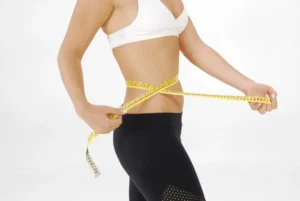
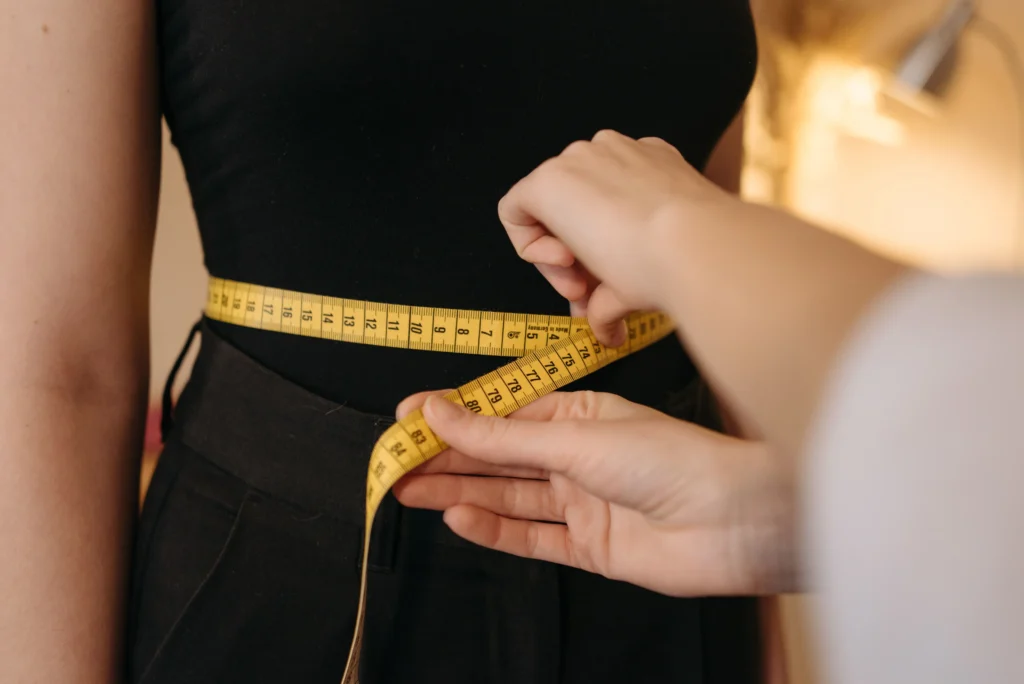
- Find the right spot. Locate the bottom of your ribcage and the top of your hip bone (iliac crest). Your waist is the midpoint between these two landmarks — roughly in line with your navel, but use the midpoint rather than just defaulting to belly-button level.
- Use a soft, flexible tape measure. A fabric sewing tape works perfectly. Metal rulers and rigid measuring tapes won’t conform to your body and will give an inaccurate result. If you don’t own one, a soft, flexible tape measure is a cheap, one-time purchase that works for this and every other body measurement.
- Wrap the tape around your bare skin. Remove bulky clothing. The tape should sit directly against the skin, or over a single thin layer at most.
- Keep the tape level. Make sure it’s parallel to the floor all the way around — check the back using a mirror if you’re measuring alone.
- Breathe out naturally, then measure. Don’t suck in your stomach. Exhale normally, then take the reading at the end of that exhale. Don’t let the tape dig into the skin — it should be snug but not compressing.
- Measure twice. Record both readings. If they differ by more than 0.5 cm (0.25 inches), measure a third time and use the average.
Healthy Waist Measurement by Sex
Health organisations including the World Health Organization (WHO) and major cardiovascular bodies use waist circumference thresholds to identify elevated health risk. These are population-level screening tools — they indicate rising risk, not a personal diagnosis.
| Sex | Low Risk | Increased Risk | High Risk |
|---|---|---|---|
| Women | Under 80 cm (31.5 in) | 80–88 cm (31.5–34.6 in) | Over 88 cm (34.6 in) |
| Men | Under 94 cm (37 in) | 94–102 cm (37–40 in) | Over 102 cm (40 in) |
These thresholds are derived from research linking waist circumference to visceral fat accumulation and its downstream health effects, including type 2 diabetes, hypertension, and heart disease. A waist measurement above the “high risk” threshold doesn’t mean you have or will develop any condition — but it is a signal worth acting on.
Why Waist Measurement Predicts Health Risk Better Than Weight
Two people can weigh exactly the same while carrying radically different amounts of abdominal fat. The difference comes down to where the body stores fat.
Fat stored in the abdomen exists in two forms. Subcutaneous fat sits just under the skin and is relatively metabolically inert — it’s the fat you can pinch. Visceral fat sits deeper, surrounding the liver, kidneys, pancreas, and digestive organs. Visceral fat is metabolically active in ways that are damaging: it promotes chronic low-level inflammation, disrupts insulin signalling, raises triglycerides, and drives down HDL cholesterol. This is why a person can have a “healthy” BMI but carry significant metabolic risk because of where their fat is located — a pattern researchers call TOFI (thin outside, fat inside).
Waist circumference doesn’t distinguish between subcutaneous and visceral fat directly, but it is the most accessible proxy for visceral fat volume. The bigger the waist, the more likely visceral fat is the driver.
Waist-to-Height Ratio: A Simpler Rule
A widely cited 2010 systematic review of 78 studies found that waist-to-height ratio, with a boundary of 0.5, predicts cardiovascular disease and diabetes risk well in both men and women across different ethnic groups [1]. A 2012 meta-analysis of 31 studies confirmed this finding across multiple countries, showing waist-to-height ratio outperformed both BMI and waist circumference alone as a screening tool [2].
The practical rule: your waist should be less than half your height.
| Waist-to-Height Ratio | Health Interpretation |
|---|---|
| Under 0.40 | Underweight range (rare) |
| 0.40–0.49 | Healthy range |
| 0.50–0.59 | Increased cardiometabolic risk |
| 0.60 or above | High risk — consult a healthcare provider |
To calculate yours: divide your waist measurement by your height, using the same unit for both. A woman who is 170 cm tall with a 79 cm waist has a waist-to-height ratio of 79 ÷ 170 = 0.46 — within the healthy range. The same woman with a 90 cm waist gets 0.53 — elevated risk.
Waist-to-Hip Ratio (WHR)
Waist-to-hip ratio adds context by comparing your waist to your hips. It captures whether fat distributes more toward your midsection (android or “apple” pattern) or toward your hips and thighs (gynoid or “pear” pattern). The pear pattern carries a significantly lower health risk because fat stored in the hips and thighs is subcutaneous, not visceral.
| Sex | Low Risk WHR | High Risk WHR (WHO) |
|---|---|---|
| Women | Below 0.80 | Above 0.85 |
| Men | Below 0.90 | Above 0.90 |
To measure: divide your waist circumference by your hip circumference at its widest point. WHR is particularly useful for people whose overall weight is in the normal range but whose fat distribution leans toward the midsection.
Common Measurement Mistakes
- Measuring at the navel by default. The navel’s position varies from person to person and doesn’t reliably mark the anatomical waist. Always use the midpoint between your lowest rib and iliac crest.
- Measuring over clothing. Even a single layer of moderate fabric can add 1–2 cm to the reading.
- Holding your breath or sucking in. This artificially reduces the reading. Breathe out naturally, then measure.
- A drooping tape at the back. The tape must stay level all the way around. A tape that drops at the back will give a lower reading than your actual circumference.
- Measuring at different times of day. The body retains slightly more fluid in the evening. Consistent morning measurements provide the most comparable data over time.
Who Should Use Waist Measurement With Caution
Standard waist circumference thresholds are designed for non-pregnant adults from European backgrounds. They apply with reduced accuracy for people who are pregnant, have conditions that cause abdominal distension, or come from South Asian, East Asian, or certain other ethnic backgrounds — populations that may carry higher metabolic risk at lower absolute waist measurements. If any of these apply to you, discuss appropriate thresholds with your healthcare provider.
How Often Should You Measure?
For fitness and health tracking, measuring every 2–4 weeks is sufficient. Waist circumference doesn’t change meaningfully week to week — it reflects longer-term shifts in body composition. Taking your measurement at the same time of day under the same conditions (morning, after using the bathroom, before eating) ensures you’re comparing like with like.
Related Reading
Body Measurements: Complete Guide to What to Track and Why →
Related Reading
Body Measurement Chart: Average Measurements by Height and Sex →
Related Reading
Women Body Types: The 5 Shapes and 3 Somatotypes Explained →
See Your Full Measurement Profile
Enter your bust, waist, and hip measurements to calculate your body shape, key health ratios, and clothing size in one step.
Sources: [1] Browning LM, Hsieh SD, Ashwell M. A systematic review of waist-to-height ratio as a screening tool for the prediction of cardiovascular disease and diabetes: 0.5 could be a suitable global boundary value. Nutr Res Rev. 2010. [2] Ashwell M, Gunn P, Gibson S. Waist-to-height ratio is a better screening tool than waist circumference and BMI for adult cardiometabolic risk factors: systematic review and meta-analysis. Obes Rev. 2012.