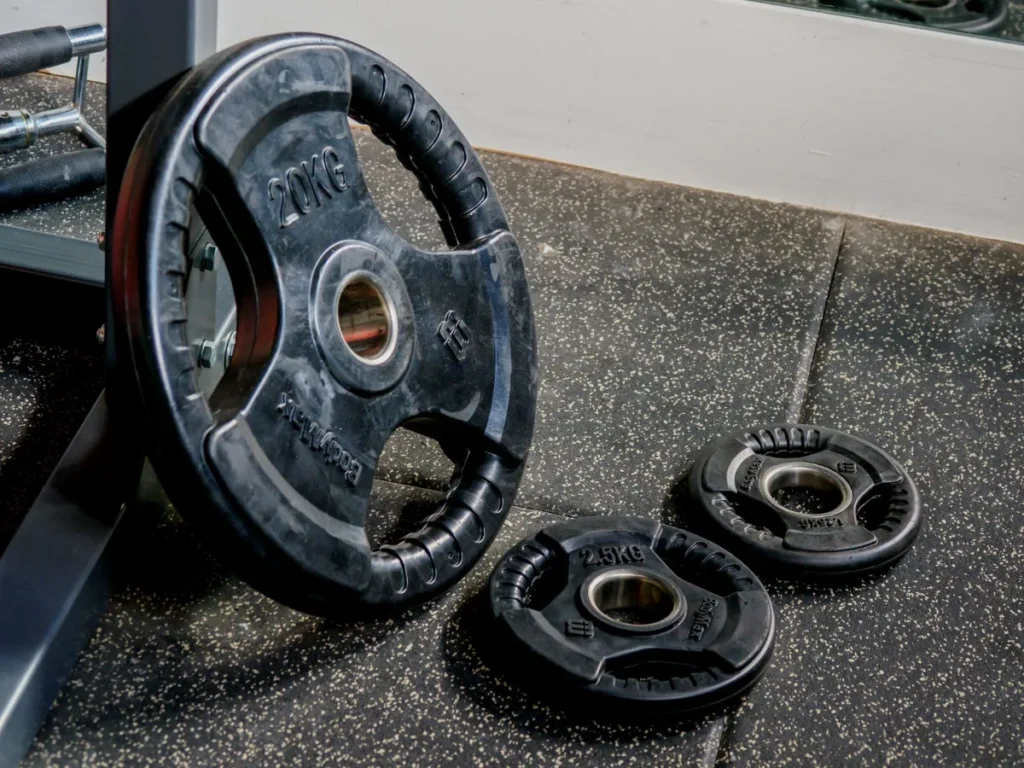
Building a plate collection for a home gym is straightforward once you know what actually matters. The decisions are: rubber or iron, Olympic or standard, and what order to buy. Most people overthink the first two and underthink the third.
First Decision: Rubber (Bumper) or Iron?
For a home gym, bumper plates are the right default. Here’s why:
Floor protection: Bumpers are designed to be dropped. Iron plates are not — dropping iron on a garage floor or rubber mat can crack the plate, dent the floor, and damage the barbell. Even if you plan to always lower the bar slowly, mistakes happen. Bumpers eliminate that risk.
Noise: Iron on a hard surface is loud. If you train early in the morning or late at night, or if anyone else is home, bumpers significantly reduce the sound of racking, clanking, and accidental drops.
Rust: Bumpers are rubber — they don’t rust. Bare iron in an unheated garage or humid environment will rust over time without regular maintenance. Rubber-coated iron plates resist rust, but cost more than standard iron.
The tradeoff: Bumpers are thicker per pound than iron, so at very heavy loads (500+ lbs) you’ll run out of sleeve space faster. Most home gym lifters never hit this limit. If you eventually do, you can add iron plates for rack-only exercises like bench press and squat, where the bar never touches the floor.
Second Decision: Olympic or Standard?
Buy Olympic (50 mm center hole). Here’s the short version:
- Standard plates (25 mm hole) max out at 45 lbs per plate and are incompatible with Olympic barbells
- Olympic plates fit all serious barbells and are available as bumpers, calibrated, and urethane-coated versions
- All bumper plates are Olympic size — if you want bumpers, you need Olympic
- If you ever upgrade your barbell, standard plates become useless
Standard plates cost slightly less and are fine for very light home use, but for any real training program, Olympic is the correct choice.
Your First Plate Purchase: The Starter Set
A complete starter set that gets you from bar weight up to 185 lbs in 5 lb increments:
| Plates | Quantity | Why |
|---|---|---|
| 45 lb | 1 pair | Gets you to 135 lbs (one plate per side) |
| 25 lb | 1 pair | Fills gap between 135 and 185 |
| 10 lb | 1 pair | 10 lb increments for warmups and working sets |
| 5 lb | 1 pair | 5 lb increments between standard jumps |
| 2.5 lb | 1 pair | Smallest standard increment (5 lbs total) |
This set gives you every weight from 45 lbs (bar only) to 185 lbs in 5 lb steps. It also handles warmup sets for most beginner to intermediate lifters.
If you’re starting from scratch, a bumper plate starter set is a solid way to cover your first plate purchase in one order.
What to Skip
35 lb plates: A pair of 25 + 10 does the same job and gives you more flexibility in between. 35s take up sleeve space without adding combinations you couldn’t already make.
15 lb plates: Same problem — a 10 + 5 covers 15 lbs and keeps more loading options available. 15s are dead weight in the plate collection.
What to Add Next (In Order)
Second pair of 45 lb plates: Gets you to 225 lbs — two plates per side. This is the next major milestone for most lifters and usually the first addition after the starter set.
Second pair of 10 lb plates: Lets you load two different weights simultaneously, which speeds up warmup progressions. Useful once you’re working at 185+ regularly.
A fractional plate set: Once your overhead press or bench press starts stalling on 5 lb jumps — which typically happens after 6–18 months of training — fractional plates (0.25 lb to 1.25 lb pairs) become the difference between continued progress and a plateau. Get these before adding more 45s.
Third pair of 45 lb plates: Gets you to 315 lbs (three plates per side). Only relevant once you’re actually approaching that range consistently.
How Much Total Weight Do You Need?
A rough guide based on experience level:
| Level | Total Plate Weight | Covers Up To |
|---|---|---|
| Beginner (first year) | 200–250 lbs of plates | ~225 lbs on bar (two plates per side) |
| Intermediate (1–3 years) | 350–450 lbs of plates | ~315 lbs on bar (three plates per side) |
| Advanced (3+ years) | 550–700 lbs of plates | ~405–500 lbs on bar |
Don’t buy ahead of where you are. A beginner who buys 600 lbs of plates has money sitting on a storage peg for years. Buy what you need now, add as your lifts grow.
Find Out Exactly How Much Your Plates Weigh
Use the plate weight calculator to verify exact plate weights for any combination in your collection.
Use the Plate Weight Calculator →Related Reading
Fractional Weight Plates: What They Are and When to Use Them →Related Reading
How Much Does a Barbell Weigh? Every Bar Type Explained →Related Reading
Types of Weight Plates: Every Plate Style Explained →Related Reading
Standard vs Olympic Weight Plates: What’s the Difference? →