Walk into any well-equipped gym and you’ll see at least four or five different types of weight plates. They’re not interchangeable — each is optimized for specific training styles, loading requirements, and environments. Here’s what each type is, what it’s for, and when you’d choose one over another.
Cast Iron Plates
The original and still the most common plate in commercial gyms. Cast iron plates are solid metal, painted or powder-coated black. Because iron is dense, they’re compact — a 45 lb iron plate is about 1.25 inches wide, which means you can fit a lot of them on a barbell sleeve.
The tradeoffs: bare iron rusts if exposed to moisture. They’re not designed to be dropped — dropping iron plates on a hard floor can damage the floor, the plates, and the barbell. Their diameter decreases with weight, so lighter iron plates (5 lb, 10 lb) are noticeably smaller than 45 lb plates. This isn’t a functional problem for most lifters, but it does mean bar height off the floor isn’t consistent across weights.
Best for: Powerlifting, bodybuilding, any rack-based training where the bar isn’t dropped. Commercial gyms on a budget.
Rubber-Coated Iron Plates
Cast iron with a thin rubber outer shell. The coating adds floor protection, reduces noise when plates knock together, and resists rust. The iron core stays the same, so these plates are nearly as compact as bare iron. Most commercial gyms use rubber-coated iron as their standard plate — it’s the best everyday balance of cost, durability, and floor protection.
Best for: Commercial gyms, home gyms that want iron-level loading without floor concerns. Not designed to be dropped from overhead.
Bumper Plates
Solid rubber (or urethane) plates with a steel center ring. Their defining feature is a standardized outer diameter of 450 mm (17.7 inches) regardless of weight — a 10 lb bumper plate is the same diameter as a 45 lb bumper plate. This standardized height ensures the bar sits at the correct position for pulling movements from the floor, and allows the bar to be safely dropped from overhead without damaging the floor or the plates.
Four types of bumper plates:
Training bumpers: Standard black rubber. The most common type in home gyms and CrossFit boxes. Durable, moderate bounce. This is what most people mean when they say “bumper plates.”
Competition bumpers: Color-coded per IWF standards (red = 25 kg, blue = 20 kg, yellow = 15 kg, green = 10 kg) and calibrated to tight tolerances. Lower bounce than training bumpers — important when dropping heavy bars overhead so the bar doesn’t skid away.
Hi-temp bumpers: Made from recycled rubber. Highly durable and suitable for outdoor or garage use. More bounce than standard bumpers.
Crumb rubber bumpers: Softest and quietest option. Made from crumb-recycled rubber. Best for home gyms where sound is a concern. Highest impact absorption of the four types.
Best for: Olympic lifting, CrossFit, home gyms (noise + floor protection), any training that involves dropping the bar.
Urethane-Coated Plates
Urethane is more durable than rubber — it’s harder, odorless, and doesn’t scratch or chip easily. Urethane-coated plates are the commercial gym standard in high-end facilities. They look cleaner, last longer under heavy daily use, and don’t have the mild rubber smell that standard bumpers can develop when new.
The downside is cost — urethane plates are significantly more expensive than rubber-coated iron or standard bumpers.
Best for: High-use commercial gyms, serious home gym owners who want the best long-term durability.
Calibrated / Competition Plates
Calibrated plates are precision-manufactured to within ±10–20 grams of their stated weight. They’re used in powerlifting competitions (IPF/USAPL) and weightlifting competitions (IWF) where exact weight is required by the rules. Calibrated plates are color-coded by international federation standards, thinner than standard plates (allowing more to fit on the bar), and more expensive than any other type.
For most training purposes, the weight accuracy of standard iron or bumper plates is sufficient. Calibrated plates become relevant for competition use, for high-level athletes testing true maxes, or for coaches tracking precise loading protocols.
Best for: Competition lifting, high-level training facilities, athletes who need exact weight verification.
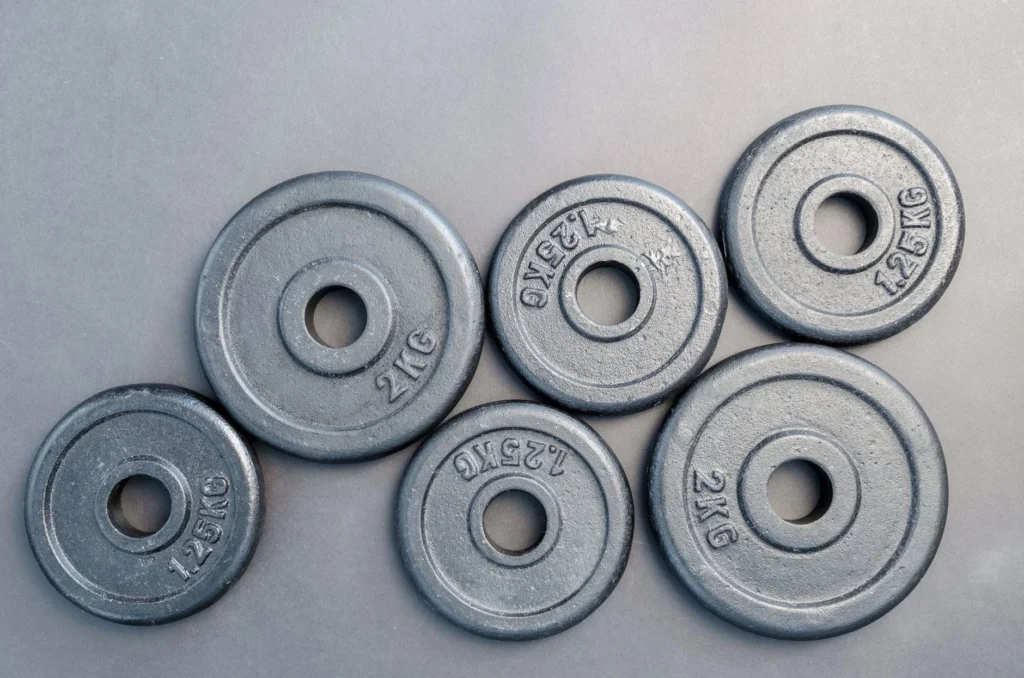
Fractional / Change Plates
The smallest plates in the lineup: typically 0.25 lb to 2.5 lbs (or 0.125 kg to 1.25 kg). Designed for micro-loading — adding weight in increments smaller than the standard 2.5 lb plates allow. Made of steel or rubber-coated steel, with the standard 50 mm Olympic hole.
Fractional plates become essential for intermediate and advanced lifters who can no longer make 5 lb jumps session-to-session, particularly on upper body and overhead movements. They allow progress to continue where it would otherwise stall. A pair of 0.5 lb fractional plates adds just 1 lb total to the bar — exactly what some lifters need to keep moving forward.
Best for: Intermediate to advanced lifters, overhead press, bench press progression. Anyone who has hit a plateau from standard increment jumps.
Grip / Tri-Grip Plates
Iron or rubber-coated plates with three or four ergonomic cutout handles around the circumference. The handles make loading and unloading plates much easier, especially with heavier weights when your hands are sweaty. The extra grip also allows these plates to be used for standalone exercises — farmer carries, lateral raises, plate-loaded movements — without a barbell.
Tri-grip plates are not designed to be dropped. They’re a practical choice for anyone doing lots of plate swapping or who uses plates for exercises beyond barbell loading.
Best for: General strength training, high-rep sessions, anyone who wants plates that double as standalone training tools.
Which Type Should You Buy?
| Situation | Recommended Type |
|---|---|
| Home gym, general training | Bumper plates (training) |
| Olympic weightlifting or CrossFit | Bumper plates (competition or training) |
| Powerlifting, heavy rack training | Cast iron or rubber-coated iron |
| Competition powerlifting or weightlifting | Calibrated plates |
| Intermediate/advanced — stalled on small jumps | Fractional / change plates |
| Commercial gym — high daily use | Urethane-coated plates |
Find Out Exactly How Much Your Plates Weigh
Use the plate weight calculator to check exact weights for any plate type or combination.
Use the Plate Weight Calculator →Related Reading
Standard vs Olympic Weight Plates: What’s the Difference? →Related Reading
Fractional Weight Plates: What They Are and When to Use Them →