Last updated: October 2026
How to Measure Body Fat at Home: 4 Methods That Actually Work
You don’t need a lab, expensive equipment, or a clinic appointment to get a useful body fat estimate. Four methods work reliably at home — provided you understand what each one measures, where it falls short, and how to use it consistently. Here’s exactly how to do each one correctly.
Calculate Your Body Fat Percentage
Take your measurements, then plug them into our body fat calculator to get your estimated percentage and category instantly.
Method 1: Navy Tape Method (Most Recommended)
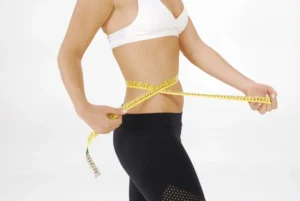
The Navy circumference method estimates body fat percentage using a tape measure and height. Developed at the Naval Health Research Center in 1984, it carries a margin of error of approximately 3–4% — comparable to many gym-based assessments that cost far more. It is the formula used in our body fat calculator.
What you need: A flexible, non-stretch tape measure
Men — Measure:
- Neck: Just below the larynx (Adam’s apple), tape angled slightly downward in front. Round up to the nearest 0.5 inch.
- Waist: Horizontal around the navel. Round down to the nearest 0.5 inch.
- Height: Standing barefoot.
Women — Measure:
- Neck: Just below the larynx. Round up to the nearest 0.5 inch.
- Waist: At the narrowest point of the abdomen (usually 1–2 inches above the navel). Round down.
- Hips: At the widest point of the buttocks, tape horizontal. Round to the nearest 0.5 inch.
- Height: Standing barefoot.
Take each circumference measurement three times and use the average. Enter your values into the calculator above.
Key mistake to avoid: Pulling the tape too tight or letting it sag. The tape should sit snug against the skin without indenting it.
Related Reading
Method 2: Skinfold Calipers
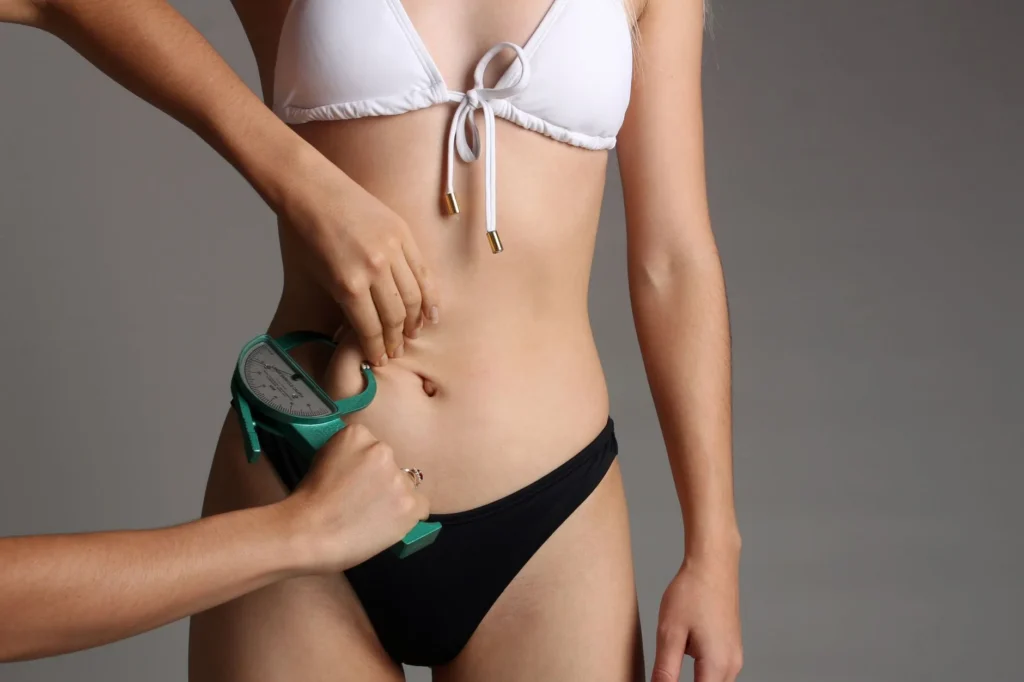
Skinfold calipers measure the thickness of subcutaneous fat (fat directly under the skin) at specific body sites. With consistent technique, they can be more sensitive than the tape method for detecting small changes in body composition over time.
What you need: Skinfold calipers ($10–$30 online); ideally someone to help with back-side measurements
A basic pair of skinfold calipers is all you need to get started — no need to spend more than $10-$30 for reliable home use.
The 3-Site Method (Best for Home Use)
Men: Chest, abdomen, thigh
Women: Triceps, suprailiac (above the hip bone), thigh
For each site: pinch a vertical fold of skin firmly between your thumb and forefinger, pulling it away from the underlying muscle. Place the caliper jaws in the middle of the fold, approximately 1 inch from your fingers. Release the caliper’s pressure lever fully before reading. Take two readings at each site and average them.
After measuring, add the three values together (sum of skinfolds in mm) and use that sum with a body fat estimation chart or online calculator.
Key mistake to avoid: Measuring after a workout or when hot — fluid shifts beneath the skin inflate readings temporarily. Measure in the morning before exercise.
Method 3: BIA Scales (Bioelectrical Impedance)
Smart scales and handheld BIA devices send a small electrical current through the body and estimate body fat based on how easily the signal passes through you. Muscle conducts electricity more easily than fat because of its higher water content — the device uses this difference to estimate body composition.
What you need: A BIA scale ($30–$100 for consumer models). If you don’t already own one, a BIA smart scale is a reasonable starting point.
How to Get the Most Accurate BIA Readings
- Weigh yourself at the same time every day — ideally first thing in the morning, after using the bathroom, before eating or drinking.
- Don’t test immediately after exercise. Sweating dehydrates you and artificially inflates body fat readings.
- Don’t test after high-sodium meals — water retention from salt artificially deflates body fat readings.
- Use readings as a trend indicator over weeks and months, not as an accurate single-day number.
Main limitation: A 1–2% change in body water (from a long workout or a salty dinner) can shift BIA readings noticeably. This makes BIA poorly suited for week-to-week tracking. The tape method and calipers are more consistent for monitoring progress.
Method 4: Waist Circumference
Waist circumference doesn’t give you a body fat percentage, but it is one of the most clinically validated indicators of dangerous abdominal fat — specifically visceral fat, the fat stored around your abdominal organs.
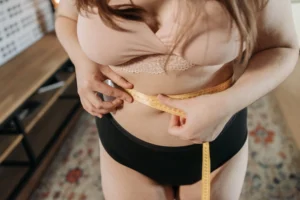
How to measure: Find the midpoint between the bottom of your lowest rib and the top of your hip bone, usually just above the belly button. Wrap the tape horizontally. Breathe out naturally, relax your abdomen without sucking in, then take the measurement.
| Risk Level | Men (waist) | Women (waist) |
|---|---|---|
| Low risk | Below 37 inches (94 cm) | Below 31.5 inches (80 cm) |
| Elevated risk | 37–40 inches | 31.5–34.6 inches |
| High risk | Above 40 inches (102 cm) | Above 34.6 inches (88 cm) |
Rules for Consistent, Useful Measurements
Whichever method you choose, consistency matters more than which one it is. Apply these rules every time:
- Same time of day: Morning measurements are most consistent — hydration, glycogen levels, and food intake haven’t shifted yet.
- Same conditions: Same clothing (or none), same hydration level, before eating or exercise.
- Never mix methods: Don’t compare tape method results to BIA results — they use different principles and will always differ. Choose one and stick with it.
- Track monthly, not daily: Your actual body fat barely changes from one day to the next, but home readings (especially BIA) can swing by a few points with hydration and glycogen. Monthly comparisons are far more meaningful than daily readings.
Related Reading
Army Body Fat Calculator: How the One-Site Tape Test Works →
Frequently Asked Questions
Which at-home method is most accurate?
The Navy tape method and skinfold calipers are roughly equivalent in accuracy at home (3–4% error for the tape method; 3.5–5% for calipers). Calipers can be more sensitive for detecting small changes in subcutaneous fat, while the tape method is easier and doesn’t require assistance. BIA scales are generally the least reliable due to their hydration sensitivity.
How do I know if my measurements are improving?
Use the same method and the same conditions once every four weeks. If the tape method shows your waist circumference decreasing while weight stays stable, you are likely gaining muscle and losing fat simultaneously. If all circumferences are shrinking, you are in a fat-loss phase.
Can I measure my own skinfolds?
Yes, but accuracy is lower than when someone else measures you. The triceps and thigh are the easiest sites for self-measurement. Abdominal and suprailiac measurements can also be done alone but require practice to get consistent placements. Chest, subscapular, and midaxillary sites are difficult to measure accurately without assistance.
Get an Instant Estimate
Take your measurements and plug them into our body fat calculator. You’ll get your estimated body fat percentage and see exactly which category you fall into.