Last updated: October 2026
Best Way to Measure Body Fat: Every Method Compared by Accuracy and Cost
The scale tells you how much you weigh. It doesn’t tell you how much of that weight is fat versus muscle. Two people at identical height and weight can look completely different and have very different health risk profiles. Body fat percentage is the metric that fills that gap — but measuring it accurately depends entirely on which method you use and how you use it.
Get Your Body Fat Estimate
Our body fat calculator uses the Navy tape method to give you an instant estimate — no equipment beyond a tape measure needed.
All Methods Compared at a Glance
| Method | Error Range | Cost | At Home? |
|---|---|---|---|
| Multi-compartment model | <1% | Very high | No |
| DXA scan | 2.5–3.5% | High ($100–$200+) | No |
| Hydrostatic weighing | ~2% | High | No |
| Bod Pod (air displacement) | 2–4% | Moderate ($40–$100) | No |
| Navy tape method | 3–4% | Free | Yes |
| Skinfold calipers | 3.5–5% | Low ($10–$30) | Yes |
| BIA scales/devices | 3.8–5%+ | Low to moderate | Yes |
| 3D body scanner | ~4% | Moderate to high | Rare |
The Gold Standard: Multi-Compartment Models
Multi-compartment models divide the body into three or four components — fat mass, lean mass, bone density, and body water — and combine data from multiple devices to produce estimates with error rates under 1%. This is the method all other approaches are calibrated against. It is not available outside research and clinical settings and costs several hundred dollars per assessment.
DXA Scan: Best Accessible High-Accuracy Option
DXA scans use two X-ray beams at different energies to differentiate bone, muscle, and fat. A single session takes 10–15 minutes and delivers detailed regional data — trunk fat vs. limb fat, android vs. gynoid fat distribution. Error rate is 2.5–3.5%. Private clinics in most major cities offer DXA for $100–$200 per scan.
One limitation: results can vary slightly between different DXA machines and software versions. For tracking progress over time, always use the same machine.
Related Reading
How to Measure Body Fat at Home: 4 Methods That Actually Work →
Hydrostatic Weighing
Hydrostatic (underwater) weighing calculates body density by comparing your weight on land against your weight while fully submerged in water. Fat is less dense than muscle and bone, so a higher-fat body floats more easily. Error rate can be as low as 2%, making it one of the most accurate methods outside of multi-compartment models. The drawback: you must fully exhale and hold still while submerged — not feasible for everyone. Found primarily at universities and research facilities.
Bod Pod (Air Displacement Plethysmography)
The Bod Pod works on the same density principle as hydrostatic weighing but uses air displacement instead of water. You sit inside a sealed egg-shaped chamber while the device measures how much air your body displaces. Error rate is 2–4%. It’s more comfortable than underwater weighing and available at many university health centers and sports performance clinics, typically for $40–$100 per session.
Navy Tape Method: Best Free Option
For most people, the Navy circumference method is the best balance of accuracy, cost, and convenience. It requires only a tape measure, uses validated formulas developed at a military research facility, and produces consistent results when measurements are taken correctly. At 3–4% error, it performs similarly to or better than many paid fitness assessments.
Main weakness: the formula can underestimate body fat in people with large, muscular necks, since a bigger neck measurement lowers the estimate. For muscular athletes, skinfold calipers or DXA will be more accurate.
Related Reading
Skinfold Calipers
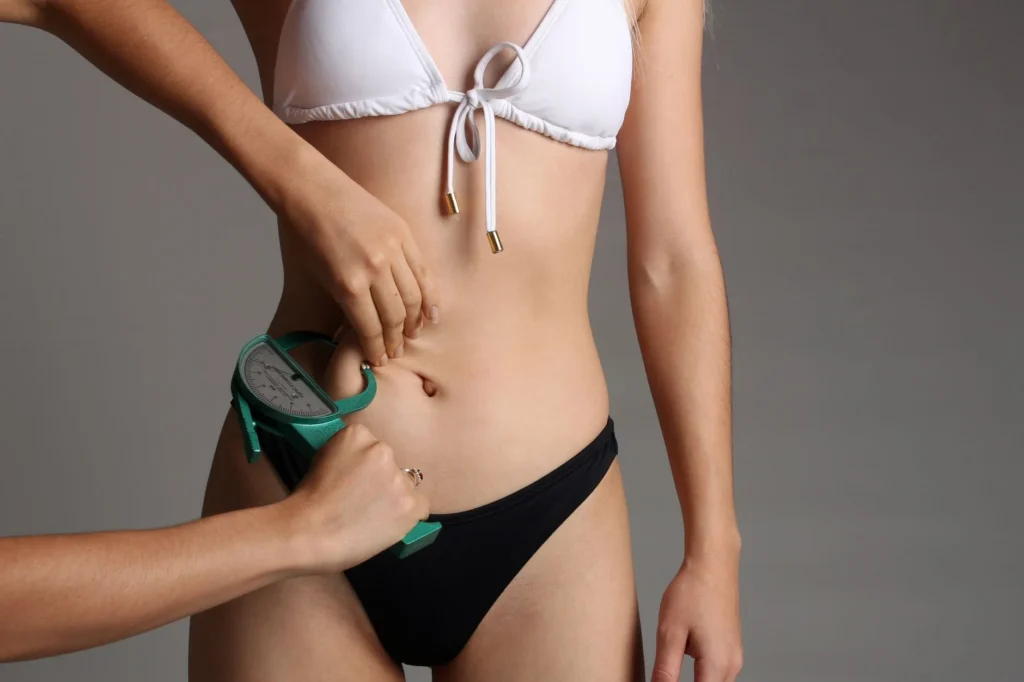
Skinfold calipers measure the thickness of subcutaneous fat at specific body sites and use a formula to estimate total body fat. The 7-site method (chest, abdomen, thigh, triceps, subscapular, midaxillary, suprailiac) is the most accurate; the 3-site method is practical for home use with minimal assistance. Error rate is 3.5–5%, but this drops significantly with consistent technique and the same practitioner performing measurements each time.
Calipers excel at detecting small changes in subcutaneous fat over weeks — often before the scale shows any movement. For tracking a fat loss phase month to month, they are the most sensitive home tool available. A set of skinfold calipers costs little and, with consistent technique, can be as useful as far more expensive tools for spotting gradual change.
BIA Scales and Devices
Bioelectrical impedance sends a small electrical current through the body and measures resistance. Muscle conducts electricity more easily than fat due to its higher water content — the device uses this difference to estimate body composition.
The critical problem: hydration changes the result dramatically. A 1–2% shift in body water (easily caused by a workout, a salty meal, or inadequate hydration) can noticeably shift a BIA reading. This makes BIA unreliable for tracking week-to-week changes. Use it as a rough baseline tool, not a precision tracker.
Related Reading
Army Body Fat Calculator: How the One-Site Tape Test Works →
Which Method Should You Use?
| Your Situation | Best Method |
|---|---|
| Want a free, reliable home estimate | Navy tape method |
| Track fat loss progress month to month | Tape method or skinfold calipers |
| Competitive athlete needing precision | DXA (1–2 times per year) |
| Military fitness requirement | Army or Navy tape formula |
| Quick ballpark, precision not required | BIA scale |
| Research or clinical-level accuracy | Multi-compartment model or DXA |
Whatever method you choose, consistency matters more than which one you pick. Running the same test under the same conditions every four weeks gives you reliable trend data — which is what actually drives useful decisions about diet and training.
Ready to Measure Yours?
Our body fat calculator uses the Navy tape method — the best free option available. Enter your measurements and see your result in seconds.