Last updated: June 2026
Rowing Machine Exercise: What Muscles It Works and How to Structure a Session
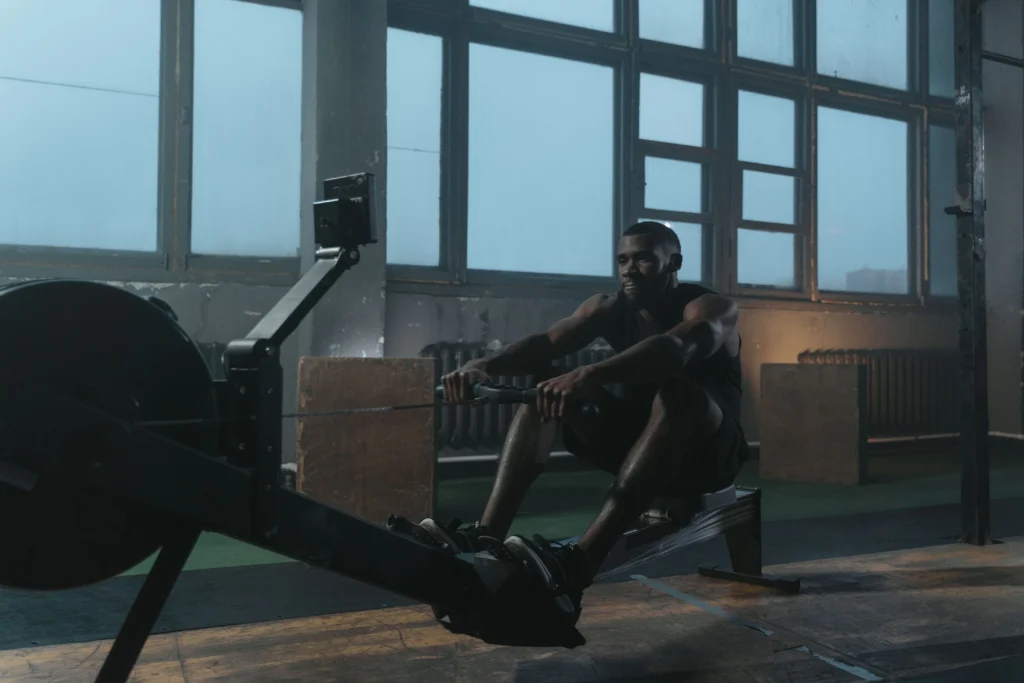
A rowing machine exercise session is one of the most complete workouts available on a single piece of equipment. It stimulates nearly all of the major muscle groups in your body — legs, back, core, and arms — simultaneously, while generating almost no joint impact. A 155 lb person burns 245–420 calories in 30 minutes depending on intensity. For people who want significant cardiovascular training and meaningful muscle engagement without the wear of high-impact cardio, rowing covers more in one session than running, cycling, or elliptical work alone.
Calculate Calories for Your Rowing Session
Enter your body weight, intensity, and session duration for a personalised calorie estimate.
What Muscles Does a Rowing Machine Work?
Rowing is driven approximately 60% by the legs and 40% by the upper body. The major muscles involved:
| Muscle Group | Muscles Worked | Phase |
|---|---|---|
| Legs | Quadriceps, hamstrings, glutes | Drive — pushing through the footrests |
| Upper back | Latissimus dorsi, rhomboids | Drive — pulling the handle in |
| Core | Abdominals, obliques, spinal erectors | Throughout — stabilising the torso |
| Arms | Biceps, forearms | Finish — completing the arm pull |
| Shoulders | Posterior deltoids | Drive and finish |
| Calves | Gastrocnemius, soleus | Drive — pressing through the footrests |
The only major muscle groups not significantly worked by rowing are the chest (pectoralis major and minor) and the triceps. All other major groups across the body are engaged in every stroke. Compared to running, which is predominantly a lower-body exercise, or cycling, which is almost entirely lower-body, rowing distributes the effort broadly, which is why its calorie burn per minute is high relative to the perceived effort.
Rowing Machine Benefits
Low impact on joints
Rowing is a seated exercise that eliminates the repetitive ground-contact forces of running. There is no footstrike impact on the knees, hips, or ankles. This makes it viable for people with joint issues, those returning from lower-body injuries, or anyone who needs high-calorie-burn cardio without the structural load of running. For people who are overweight and find running painful, rowing offers comparable calorie output with significantly less physical toll on the joints.
Cardiovascular fitness
Rowing is an aerobic exercise that elevates heart rate and trains the cardiovascular system in the same way running and cycling do. Regular aerobic training improves the heart’s efficiency, lowers resting heart rate and blood pressure, and increases the muscles’ ability to extract oxygen from the blood. Five 30-minute rowing sessions per week easily meets or exceeds the standard recommendation of 150 minutes of moderate-intensity aerobic exercise per week.
Strength and muscle engagement
While rowing is not a substitute for dedicated resistance training, it provides a level of muscle stimulus — particularly in the back, core, and legs — that other cardio equipment does not. Rowing at higher resistance and lower stroke rates can increase the muscular demand per stroke and develop meaningful back and leg strength over time. Many training programmes (including CrossFit) combine rowing intervals with resistance exercises to build both aerobic fitness and strength simultaneously.
Mental focus
The rowing stroke requires continuous attention to sequence and rhythm — catch, drive, finish, recovery — which provides a meditative quality that reduces mental distraction during sessions. Counting strokes or focusing on maintaining a target split time keeps attention anchored to the present. This focused quality makes rowing sessions feel shorter than equivalent-duration treadmill or cycling work for many people.
Types of Rowing Machines
Four main types are available:
- Flywheel (air resistance): The most common type. A fan blade spins when you pull the handle, creating more resistance the harder you row. The Concept2 RowErg is the standard in gyms and competitive rowing. Feels most like on-water rowing.
- Hydro rower (water resistance): Resistance comes from a water-submerged flywheel. Provides a sensation closer to actual boat rowing and a distinctive water sound. WaterRower is the most widely known brand.
- Magnetic resistance: A magnetic brake adjusts resistance via a dial. Resistance is preset rather than effort-dependent. The quietest type — suitable for home use where noise is a concern.
- Hydraulic (piston): Resistance via a piston filled with liquid or air. The most compact and affordable type, but may not produce a natural rowing motion. Best for very limited spaces with smaller budgets.
For most home setups, a magnetic-resistance rower is the practical choice — quiet enough for apartments and shared spaces, with resistance you set on a dial rather than needing to build speed to feel it. A magnetic rowing machine in this category typically costs a fraction of a flywheel or water rower.
Four Rowing Machine Workouts to Get Started
Workout 1: Beginner — 20-Minute Steady Row
Focus on technique throughout. Do not increase intensity until the four-phase stroke sequence is automatic.
| Phase | Duration | Stroke Rate |
|---|---|---|
| Warm-up | 5 min | 18–20 spm |
| Main work | 10 min | 22–24 spm |
| Cool-down | 5 min | 18–20 spm |
Workout 2: 40 Seconds On / 20 Seconds Off
A time-efficient interval format that works well when you only have 20 minutes. Warm up 5 minutes, then alternate 40 seconds of hard rowing with 20 seconds of easy rowing for 10 minutes, then cool down 5 minutes.
Workout 3: Power Strokes
Row at a comfortable 20 strokes per minute for the full session. Every three minutes, take 10 strokes at maximum effort — legs driving hard, strong hip swing, controlled arm pull — then return to the easy pace. Repeat for 20–30 minutes. This develops power per stroke without extending total session duration.
Workout 4: 1-Minute On / 1-Minute Off (Intermediate)
Row hard for one minute at 30–35 strokes per minute, then rest for one minute. Complete 12 rounds. The goal is to cover the same distance in each one-minute effort. Start at a perceived effort of 7 out of 10 and hold that output across all 12 rounds — by the final rounds you should be working near your limit to maintain the same distance.
See How Many Calories Your Session Burns
Enter your body weight, workout intensity, and session duration for a personalised calorie total for any of the workouts above.