Why the Long Head Needs Special Attention
Last updated: October 2026
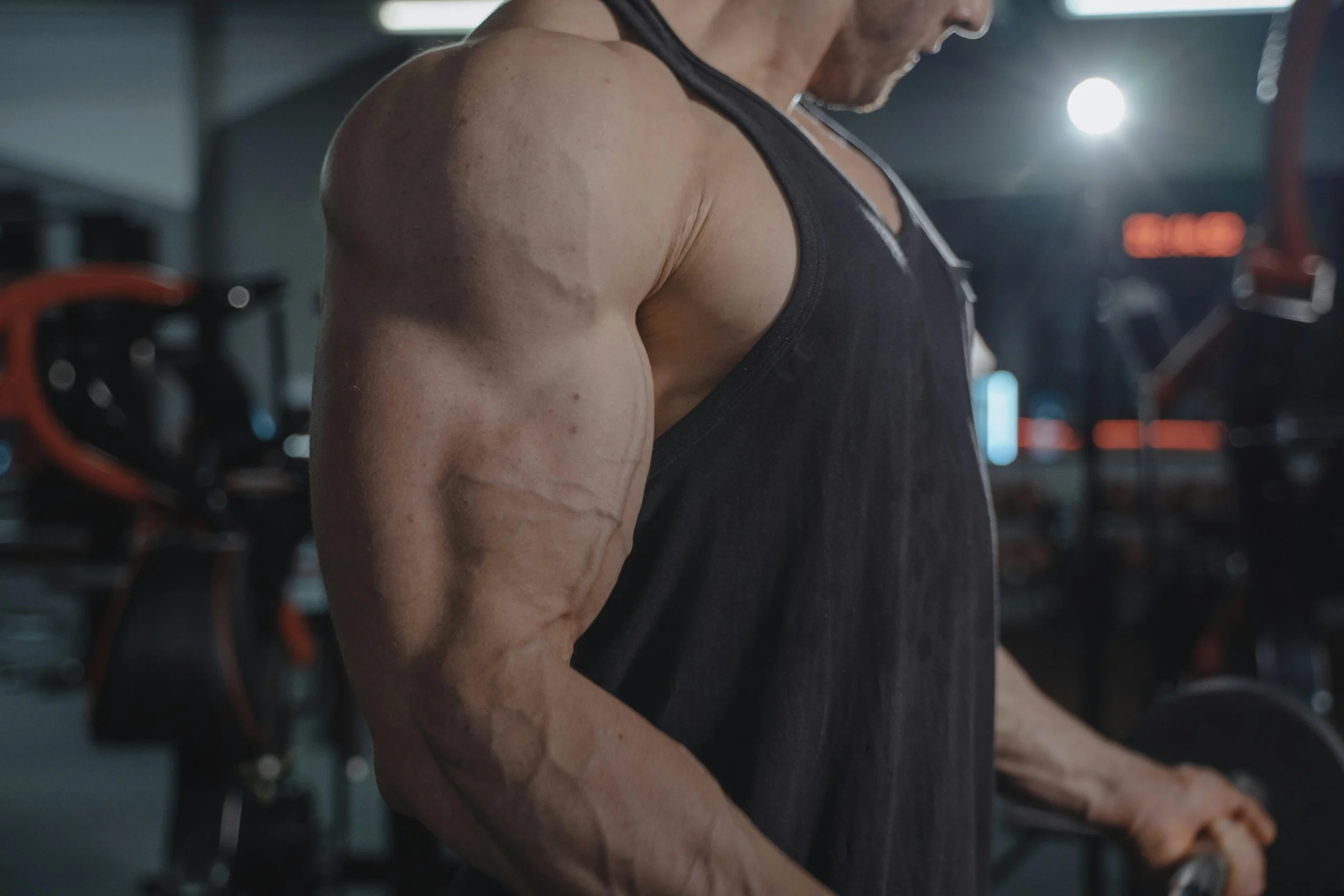
The long head is a big part of your triceps’ overall size. It’s also the most commonly undertrained, not because people skip tricep work, but because the most popular tricep exercises don’t effectively reach it.
The reason comes down to anatomy. The long head is the only part of the triceps that crosses the shoulder joint — it originates from the scapula rather than the humerus. That gives it a second job beyond elbow extension: it assists in pulling the arm back and stabilising the shoulder.
This creates a problem with pressing movements. When you bench press or do close-grip press variations, the long head pulls your shoulder back — which interferes with the pressing motion and prevents full engagement. In a study that compared training programs built around the bench press with programs built around lying barbell triceps extensions, the long head grew significantly more with the extensions, while the lateral head grew more with the bench press [1]. Pressing alone favours the lateral head. The long head needs something different.
Tricep Anatomy: All Three Heads Explained
Understanding why specific exercises work requires knowing what each head does and where it attaches.
The Long Head
The long head is the largest tricep head and the only one that crosses both the elbow and shoulder joint. It originates from the infraglenoid tubercle of the scapula (the shoulder blade), travels down the back of the arm, and connects at the olecranon — the bony point of the elbow.
Because it crosses the shoulder joint, it assists with shoulder extension (bringing the arm back) and shoulder adduction (pulling the arm toward the body). This dual role means its activation changes significantly based on arm position — which is why exercise selection matters so much for the long head specifically.
The Lateral Head
The lateral head originates from the posterior surface of the humerus above the radial groove. It’s the most visible head from the side and creates the horseshoe shape on the back of the arm when developed. It responds well to pressing movements and pushdowns.
The Medial Head
The medial head sits underneath the other two, also originating from the humerus. It’s the workhorse — active in all forms of elbow extension regardless of arm position or load. You train it in every tricep exercise you do.
The practical implication: pressing and pushdown exercises build the medial and lateral heads effectively. The long head needs overhead and arm-back patterns to reach its full potential.
The Two Movement Patterns That Reach the Long Head
Two movement patterns effectively target the long head:
- Overhead (stretch): Arm raised overhead, placing the long head under maximal stretch. In a 12-week study, overhead cable extensions produced about 40% more whole-triceps growth than the same exercise done with the arm at the side, and the long head showed the biggest difference (about 1.5×) [2].
- Arm back (contraction): Arm extended behind the body, taking the long head through full shortening at the opposite end of its range.
An effective long head program includes both patterns every week. The 10 exercises below cover both.
The 10 Best Long Head Tricep Exercises
1. Overhead Cable Triceps Extension
The overhead extension is the single best exercise for the long head. In a 12-week study, it produced about 40% more triceps growth than a cable extension with the arm at the side (a pushdown-style position), with the long head gaining the most [2] — the overhead position puts it under a deep stretch.
The cable version provides constant tension throughout the full range of motion, unlike dumbbells which lose tension at the top of the movement.
How to perform:
- Set the pulley at or above head height with a rope attachment
- Step forward, hinge slightly at the hips, face away from the machine
- Hold the rope behind your head with upper arms beside your ears
- Keep upper arms completely fixed — only forearms move
- Extend to full lockout, then lower as far behind your head as shoulder mobility allows
Sets and reps: 3–4 sets of 10–12 reps. This is your primary long head movement — treat it like a main lift.
2. Skull Crushers (EZ Bar Lying Extension)
Skull crushers are the most overloadable overhead-pattern exercise for the long head. The EZ bar reduces wrist strain compared to a straight barbell. Most people perform these incorrectly — angling the upper arms slightly back toward the bench (rather than straight up) keeps constant tension on the long head throughout the movement.
How to perform:
- Lie on a flat bench, holding an EZ bar above your chest
- Angle your upper arms slightly backward — not straight up
- Lower the bar in an arc toward and slightly behind your head — not straight down to the forehead
- Retract and depress your shoulder blades — no shoulder movement during the rep
- Press back to the starting position
Sets and reps: 3–4 sets of 8–10 reps. Use this as your strength-focused long head movement and track your working weight over time.
3. Incline Dumbbell Overhead Extension
The slight incline angle (20–35 degrees) tilts your torso back, increasing the stretch on the long head beyond what a seated overhead extension achieves. A study in the European Journal of Sport Science (published online in 2022) found significantly greater triceps hypertrophy when extensions were performed in the overhead versus neutral arm position [2] — the stretch at the bottom is where the stimulus comes from.
How to perform:
- Set the bench to a slight incline (20–35 degrees) — steeper anglesare not necessary and can cause shoulder discomfort
- Hold dumbbells in a neutral grip (palms facing each other) overhead
- Lower behind your head by bending only at the elbows — upper arms stay fixed
- Keep abs and glutes engaged to avoid arching through the lower back
- Return to full extension
Sets and reps: 3 sets of 10–12 reps.
4. Overhead Rope Cable Extension (Bottom Pulley)
A variation of exercise #1 using the rope attachment from the bottom pulley. The bottom pulley position creates more consistent tension throughout the movement and allows the elbows to travel further behind the head at the start, maximising long head stretch. The rope also allows your hands to split apart at lockout, increasing the squeeze at full extension.
How to perform:
- Attach a rope to the bottom pulley
- Stand facing away from the machine, rope held behind your head
- Lean forward slightly — upper arms stay beside your ears throughout
- Extend to full lockout, splitting the rope handles apart at the top
- Lower slowly back behind your head, feeling the full stretch
Sets and reps: 3 sets of 12–15 reps. Use this as a higher-rep finisher after heavier overhead work.
5. Incline Dumbbell Kickback
The kickback targets the long head in its fully contracted position-the opposite end of the range from overhead extensions. Because the long head also extends the shoulder, finishing each rep with your upper arm in line with your torso trains it at full contraction. The incline bench setup removes lower back involvement entirely, improving isolation.
How to perform:
- Lie chest-down on an incline bench, arms hanging straight down
- Extend both arms back until parallel to your torso
- Keep elbows locked in at your sides throughout — they do not move
- Full elbow extension at the top is where long head activation peaks — don’t cut it short
Sets and reps: 3 sets of 12–15 reps. Use lighter weight — the quality of contraction matters more than the load here.
6. EZ Bar Incline Skull Crusher
Setting the bench to a 30–45 degree incline and lowering the bar behind your head increases the range of motion and the stretch on the long head compared to the flat bench version. The incline allows deeper lowering without the bar hitting the bench, making this one of the most underrated long head exercises.
How to perform:
- Set a bench to a 30–45 degree incline
- Lie back, holding an EZ bar with a close grip
- Angle your upper arms slightly back from vertical
- Lower the bar behind your head-the incline allows you to go deeper than the flat version
- Press back to full extension
Sets and reps: 3–4 sets of 8–10 reps. Alternate this with flat skull crushers across training weeks to vary the stretch angle.
7. Drag Pushdown
The drag pushdown is a cable variation where the bar stays close to the body throughout the movement, forcing the elbows to travel back behind the torso. This position takes the long head through a greater range of motion than a standard pushdown and trains it in its contracted position more effectively than any other cable pushdown variation.
How to perform:
- Set a cable machine with a straight bar at the high pulley, use a narrow grip
- Position elbows close to your body and as far back as possible-maintain this throughout
- Pull the bar down and drag it close along the front of your torso toward your thighs
- Squeeze the triceps at the bottom with elbows fully extended and pulled back
- Slowly return to the starting position
Sets and reps: 3 sets of 12–15 reps.
8. Single-Arm Overhead Dumbbell Extension
The unilateral version of the overhead dumbbell extension. Working one arm at a time allows you to identify and correct strength imbalances between sides, and the free hand can brace against the working arm’s elbow at the bottom of the range for a deeper stretch. A good alternative for anyone who finds the bilateral version uncomfortable on the shoulders.
How to perform:
- Hold a dumbbell in one hand, arm extended fully overhead
- Keep your upper arm beside your ear — elbow pointing up
- Lower the dumbbell behind your head by bending only at the elbow
- Your upper arm stays completely still throughout
- Press back to full extension, squeezing the tricep at the top
- Complete all reps before switching arms
Sets and reps: 3 sets of 10–12 reps per arm.
9. Triceps Bodyweight Extension
The best no-equipment option for the long head. Using a fixed bar, Smith machine bar, or the edge of a sturdy bench, you lean into an overhead position that stretches the long head under your own bodyweight. Difficulty is controlled by bar height and forward lean-a lower bar and more forward lean makes it harder.
How to perform:
- Grip a fixed bar at about waist height with an overhand grip
- Walk your feet back and lean forward — body forms a straight line from head to heels
- Bend your elbows to lower your head toward and below the bar, arms moving overhead
- Keep your core and glutes tight throughout — no hinging at the hips
- Press back to full extension by extending your elbows only
Sets and reps: 3 sets of 10–15 reps. Make it harder by lowering the bar or walking feet further back.
10. Weighted Dips
Dips are the only compound movement in this list. They’re less specific to the long head than overhead extensions, but they allow heavy loading that drives overall tricep size and carries over to pressing strength. A slight forward lean (not fully upright) recruits more of the long head than strict vertical dips.
How to perform:
- Lower until elbows reach 90 degrees
- Keep elbows tracking straight back — not flaring wide
- Drive to full arm extension at the top
- Add a weight belt once bodyweight reps exceed 12 with clean form
Sets and reps: 3–4 sets of 8–12 reps.
Common Mistakes to Avoid
Letting the elbows drift forward on overhead extensions. Your upper arms should stay fixed beside your ears. Once elbows drift forward, the movement turns into a partialoverhead press and the long head loses tension at the stretched position — which is exactly where the growth stimulus comes from.
Cutting the range of motion short. The stretch at the bottom of overhead extensions is where the stimulus is highest. Stopping when forearms are parallel to the floor — instead of going all the way behind your head — removes the most valuable part of every rep.
Using too much weight on kickbacks. Kickbacks are a contraction exercise, not a strength exercise. Heavy weight causes momentum and shortens the range. Lighter weight with a full, controlled squeeze at the top is always more effective.
Only doing pushdowns. Standard cable pushdowns primarily build the medial and lateral heads. If all your tricep work is pushdowns, the long head is being systematically undertrained regardless of total volume.
Skipping the arm-back pattern. Most lifters who do overhead work don’t pair it with a contraction-pattern exercise. The long head needs to be trained through both ends of its range for complete development.
How Many Sets Per Week Does the Long Head Actually Need?
This is the question every long head guide skips. The exercise list is only half the answer.
For hypertrophy, at least 10 working sets per muscle group per week is a well-supported target [3], and more volume keeps adding growth with diminishing returns [4]. For most people, 10–20 sets is a practical range. For the long head specifically, the distribution between movement patterns matters — you need both overhead and arm-back patterns represented each week.
| Movement pattern | Weekly sets | Example exercises |
|---|---|---|
| Overhead (stretch) | 6–10 sets | Overhead cable extension, skull crushers, incline overhead, EZ bar incline skull crusher |
| Arm back (contraction) | 4–6 sets | Incline kickbacks, drag pushdowns, single-arm cable kickback |
| Total | 10–16 sets | Across 2–3 sessions per week |
If you’re already doing pressing work (bench press, weighted dips) regularly, count roughly half those sets as indirect tricep volume-they’re building the medial and lateral heads primarily, with limited long head contribution.
Check your total weekly tricep volume
See how many sets your long head is actually getting — before deciding what to add.
Sample Workouts
Beginner (2 sessions/week)
| Exercise | Sets | Reps |
|---|---|---|
| Overhead cable triceps extension | 3 | 10–12 |
| Skull crushers (EZ bar) | 3 | 8–10 |
| Incline dumbbell kickback | 3 | 12–15 |
Intermediate — Push/Pull/Legs Split
| Session | Exercise | Sets |
|---|---|---|
| Push Day 1 | Skull crushers + Weighted dips | 4 + 3 = 7 sets |
| Push Day 2 / Arms | Overhead cable extension + Drag pushdown | 3 + 3 = 6 sets |
| Weekly total | 13 sets |
Arms-Focused Block (3 sessions/week)
| Day | Exercise | Sets | Reps |
|---|---|---|---|
| Day 1 | Overhead cable extension | 4 | 10–12 |
| Day 1 | EZ bar incline skull crusher | 3 | 8–10 |
| Day 2 | Incline dumbbell overhead extension | 3 | 10–12 |
| Day 2 | Incline dumbbell kickback | 3 | 12–15 |
| Day 3 | Single-arm overhead dumbbell extension | 3 | 10–12 each |
| Day 3 | Drag pushdown | 3 | 12–15 |
One important sequencing note: always do your pressing movements (bench press, overhead press) before tricep isolation work. If your triceps are fatigued going into a bench press, your chest becomes the limiting factor — not because your chest is failing, but because your triceps gave out first.
How to Find Your Working Weight
Progressive overload on skull crushers and overhead extensions is the primary driver of long head growth over time. The goal is to add load or reps every 1–2 weeks on these two movements.
Rough starting points for working weights (coaching estimates, not research figures):
- Skull crushers and overhead extensions: 65–75% of 1RM for 8–12 rep work
- Incline overhead extension: 60–70% of 1RM — the stretch position reduces the load you can handle
- Incline kickbacks: 50–60% of 1RM — load is not the goal; full contraction is
Since these percentages fall well below your pressing weights, a set of adjustable dumbbells makes it easy to dial in the exact load for each movement without a rack full of fixed pairs.
Set your working weight for tricep extensions
Find your 1RM and calculate the right load for each rep range.
Find your working weight for dumbbell tricep work
Match your current strength level to the right dumbbell increment for extensions and kickbacks.
Frequently Asked Questions
What exercises hit the long head of the tricep?
Two movement patterns reach the long head effectively: overhead exercises (skull crushers, overhead cable extension, incline overhead dumbbell extension) and arm-back exercises (kickbacks, drag pushdowns). Standard pressing movements and pushdowns primarily build the medial and lateral heads.
Is the long head the biggest part of the tricep?
It’s usually described as the largest head, but the often-quoted figure of “50% of the triceps” doesn’t come from a human study. What is certain is that it’s the only head that crosses the shoulder, so it needs overhead and arm-back work that pressing doesn’t fully provide. Developing it is a key part of increasing overall arm size.
Do dips hit the long head of the tricep?
Yes, dips recruit all three tricep heads including the long head. However, they are not as specific to the long head as overhead extension exercises. Use them for overall tricep mass and compound loading — not as your primary long head exercise.
How do you isolate the long head of the tricep?
The most effective isolation exercises are overhead extensions (overhead cable extension, skull crushers, incline dumbbell overhead extension) which stretch the long head maximally, and kickbacks or drag pushdowns which contract it fully. To isolate it effectively, keep your upper arms completely fixed during all exercises-any shoulder movement shifts load away from the long head.
How many sets per week does the long head need?
10–16 working sets per week is effective for most people, split between 6–10 overhead sets and 4–6 arm back sets across 2–3 sessions per week.
What is the single best long head tricep exercise?
The overhead cable extension is the best single exercise for the long head. It provides constant tension through the full range of motion, places the long head under maximum stretch, and is backed by research showing about 40% more triceps growth than a pushdown-style extension with the arm at the side [2].
Related Reading
The Bottom Line
The 10 best long head tricep exercises work because they use the two movement patterns the long head is built for:
Overhead (stretch) pattern:
- Overhead cable triceps extension — best single exercise for long head stretch and growth
- Skull crushers (EZ bar) — most overloadable overhead pattern, best for progressive loading
- Incline dumbbell overhead extension — maximum stretch angle, high activation
- Overhead rope cable extension (bottom pulley) — constant tension with a deep stretch
- EZ bar incline skull crusher — deeper range of motion than the flat bench version
- Single-arm overhead dumbbell extension — identifies and corrects side-to-side imbalances
- Triceps bodyweight extension — best no-equipment long head option
Arm-back (contraction) pattern:
- Incline dumbbell kickback — long head contraction at full shortening
- Drag pushdown — cable variation that takes the long head through full contraction
- Weighted dips — compound loading for overall tricep size and strength
Program them at 10–16 sets per week, split across overhead and arm-back patterns, across 2–3 sessions. Progress the load on skull crushers and overhead cable extensions as your primary overloading movements — those two exercises are where long head growth comes from.
Sources: [1] Brandão L, et al. Varying the order of combinations of single- and multi-joint exercises differentially affects resistance training adaptations. J Strength Cond Res. 2020. [2] Maeo S, et al. Triceps brachii hypertrophy is substantially greater after elbow extension training performed in the overhead versus neutral arm position. Eur J Sport Sci. 2023. [3] Currier BS, et al. ACSM Position Stand: Resistance training prescription for muscle function, hypertrophy, and physical performance. Med Sci Sports Exerc. 2026. [4] Pelland JC, et al. The resistance training dose response: meta-regressions exploring the effects of weekly volume and frequency. Sports Med. 2026.