

Last updated: May 2026 | By Dennis Kiplimo
Why Most Lat Training Produces Flat Results
The lats — or latissimus dorsi — are the largest muscle in your upper body. They’re also one of the most commonly undertrained, not because people skip back day, but because most programs only train one half of the muscle’s function.
Your latissimus dorsi does two things:
- Pull your arms down from overhead — the vertical pulling function, responsible for back width and the V-taper
- Pull your arms back from in front of you — the horizontal pulling function, responsible for back thickness and depth
Width and thickness require different exercises at different angles. Programs that only include pull-ups and pulldowns build wide lats with no depth. Programs that only include rows build thick lats with limited width. You need both.
The 10 exercises below cover both movement patterns. The volume framework that follows tells you how many sets to do of each.
Anatomy of the Lats
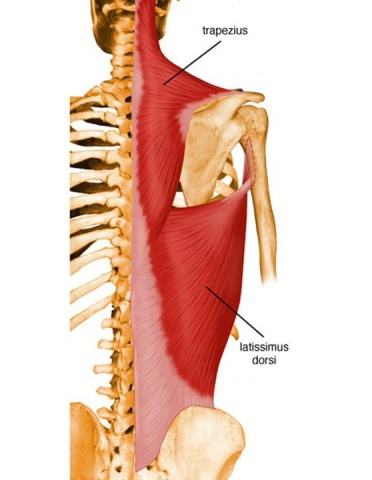
The latissimus dorsi runs from the spine, lower ribs, and pelvis all the way to the upper arm bone (humerus). This broad attachment is why the muscle controls arm movement across such a wide range — and why it responds to training from many different angles.
Several synergist muscles assist during latissimus dorsi exercises:
- Teres major — sits just beneath the lat and assists on both vertical and horizontal pulls; contributes to back width alongside the lat
- Biceps brachii — provides elbow flexion during all pulling movements; the less you recruit your biceps, the more your lats do the work
- Rear deltoid — contributes to shoulder extension during rowing movements
- Rhomboids and lower traps — retract and depress the scapula, creating the stable base the lats pull from
A fully developed lat requires training both functions. Vertical pulls develop back width. Horizontal pulls develop back thickness. Neither is optional.
Related Reading
10 Best Deltoid Exercises for All 3 Heads (Sets, Reps & Volume)
The 10 Best Lat Exercises
1. Wide-Grip Pull-Up
The pull-up is the most effective lat exercise you can do. It requires your lats to move your full bodyweight through a complete range of motion — from a dead hang with the long head fully stretched, to full scapular depression at the top. No machine replicates this demand.
A wide overhand grip (just outside shoulder width) keeps the emphasis on the lats. Going excessively wide reduces range of motion and shifts load to the shoulders.
Key cues:
- Start from a full dead hang — shoulders elevated, arms straight. This is the stretched position your lats need.
- Initiate by depressing your shoulder blades before you bend your elbows — think “pull your shoulders into your back pockets”
- Pull until your chin clears the bar, chest driving toward it
- Lower under control — the eccentric is as important as the pull
Sets and reps: 3–4 sets of 6–10 reps. Add weight via belt once you can complete 3 sets of 10 with clean form.
Track your pull-up progress
Use our pull-up calculator to find your max rep estimate and set a progression target.
2. Lat Pulldown
The lat pulldown trains the same vertical pulling pattern as the pull-up, but with adjustable resistance. This makes it the best option for lifters who can’t yet do bodyweight pull-ups, and a valuable volume tool for those who can — allowing higher rep sets and drop sets that aren’t practical on a pull-up bar.
A medium overhand grip (just wider than shoulder width) produces the best lat activation. Excessively wide grips reduce range of motion; close underhand grips shift load to the biceps.
Key cues:
- Sit upright with a slight backward lean — not a pronounced lean that turns this into a row
- Initiate by pulling your shoulder blades down before bending your elbows
- Pull the bar to your upper chest, elbows driving down and back
- Control the ascent — letting the bar snap back eliminates the eccentric
Sets and reps: 3–4 sets of 8–12 reps. Use this as a pull-up complement or substitute, not in addition to a full pull-up session on the same day.
3. Chin-Up
The chin-up uses an underhand grip with hands roughly shoulder-width apart. This creates greater lat activation at full stretch (the bottom position) compared to a wide overhand pull-up, making it a valuable variation rather than just an easier version. The increased bicep recruitment also helps for lifters who struggle to feel their lats during overhand pulls.
Key cues:
- Same dead hang starting position as the pull-up — shoulders fully elevated
- Pull your elbows to your sides as you rise, rather than driving them straight back
- Chest to bar at the top, then full controlled descent
Sets and reps: 3 sets of 8–12 reps. Alternate with pull-ups across training sessions rather than doing both in the same workout.
4. Barbell or Dumbbell Row
Rowing movements train the horizontal pulling function of the lats — pulling the arm back from in front of the body. This builds lat thickness, which pull-ups and pulldowns cannot replicate. If your back looks wide from the front but flat from the side, you’re not rowing enough.
The barbell row allows the heaviest loading and drives overall back strength. The dumbbell row allows unilateral training to correct side-to-side imbalances and a greater range of motion at the bottom of each rep.
Key cues for barbell row:
- Hinge until torso is 45 degrees to the floor — not parallel, which strains the lower back under heavy load
- Pull the bar to your lower chest/upper abdomen, not your upper chest
- Keep elbows at 45 degrees to the torso — flaring them wide shifts load to the rear delts
- No momentum — each rep starts with the bar controlled, not bounced
Sets and reps: 3–4 sets of 6–10 reps (barbell), 3 sets of 8–12 reps per side (dumbbell).
Set your working weight for rows
Use your 1RM to find the load that keeps your rows in the strength or hypertrophy range.
5. Straight-Arm Pulldown
The straight-arm pulldown isolates the lat function that compound exercises share with other muscles. By keeping the elbows straight and locked, the biceps and rear delts are removed from the movement — leaving only the lats to drive the weight down. This makes it the best exercise for building the mind-muscle connection with your lats and finishing a session with targeted lat work.
Key cues:
- Set the cable at the highest pulley position with a rope or straight bar attachment
- Hinge slightly forward at the hips, arms extended overhead — this is your starting position
- Pull the bar down and back to your thighs in a sweeping arc, keeping elbows fully extended throughout
- Squeeze at the bottom — this is where full lat contraction happens
- Return slowly under control
Sets and reps: 3 sets of 12–15 reps. Use this as a finishing movement, not a primary exercise.
6. Seated Cable Row
The seated cable row trains horizontal pulling with constant cable tension throughout the entire range of motion — unlike free weights, the resistance doesn’t drop off at the bottom. This makes it particularly effective for developing the mind-muscle connection with the lats and accumulating horizontal pulling volume with consistent form. A neutral or close grip keeps the elbows tight to the sides, emphasizing the lats over the rear delts.
Key cues:
- Sit upright and allow your shoulders to protract fully at the start of each rep — this creates a lat stretch before you pull
- Row the handle to your lower abdomen, driving elbows straight back alongside your torso
- Pause briefly at full contraction — don’t let the cable jerk you back to the start
- Control the return until the lat is fully stretched before the next rep
Sets and reps: 3–4 sets of 10–12 reps. Use as your primary horizontal pull on a second pull session, or as volume work to supplement barbell rows.
7. T-Bar Row
The T-bar row allows the heaviest loading of any horizontal pulling exercise. The neutral grip aligns naturally with the lat’s line of pull, and the fixed bar path makes it easier to maintain position under heavy loads compared to a barbell row. If lat thickness is your primary weak point, this is the overloading movement to track week to week.
Key cues:
- Straddle the barbell with feet shoulder-width apart and hinge until your torso is roughly 45 degrees to the floor
- Grip the V-handle with both hands in a neutral position
- Pull the plates toward your chest, driving elbows back — not flaring them wide, which shifts load to the rear delts
- Lower under control; don’t bounce the weight off the floor between reps
Sets and reps: 3–4 sets of 6–10 reps. Treat this as a strength movement and add load weekly.
Set your T-bar row working weight precisely
Use your 1RM to find the load that keeps your rows in the hypertrophy range.
8. Single-Arm Lat Pulldown
The unilateral version of the lat pulldown fixes the most common problem with the bilateral version: one side compensating for the other without you noticing. Training each lat independently also allows a greater range of motion per side and makes it easier to feel each lat contract and stretch individually — a significant advantage for building the mind-muscle connection that makes lat training productive long-term.
Key cues:
- Attach a single handle to the top pulley; kneel or sit facing the machine
- Start with your arm fully extended overhead, shoulder elevated — this is the stretched position
- Pull the handle toward your hip, not your chest — the lat’s line of pull runs toward the pelvis
- Squeeze at the bottom, then return slowly through the full stretch before the next rep
Sets and reps: 3 sets of 10–12 reps per side. Use as a complement to bilateral pull-ups or lat pulldowns — not a direct replacement for them.
9. Dumbbell Pullover
The pullover is the only exercise that loads the lats in a fully stretched position — arms overhead with the long head of the lat under maximum tension. Pull-ups and rows never achieve this; your lats are partially shortened the moment you begin the pull. The pullover fills a stimulus gap no other exercise covers.
Key cues:
- Lie perpendicular across a bench so only your upper back contacts it; hips hang below bench level to increase the lat stretch
- Hold the dumbbell with both palms pressed against the inner plate, arms nearly straight
- Lower the dumbbell behind your head until you feel a full lat stretch — stop before shoulder discomfort
- Pull it back in a wide arc using your lats; resist bending your elbows to compensate
Sets and reps: 3 sets of 12–15 reps. Use as a finishing movement or as an intra-set stretch between heavier compound sets.
10. Inverted Row
The inverted row is a bodyweight horizontal pull that builds the scapular control required for heavy barbell rows. EMG data shows lat activation comparable to the lat pulldown — it’s not a beginner-only exercise. It also loads the spine far less than a barbell row, making it a useful substitute on days when lower back fatigue is limiting your rowing.
Key cues:
- Set a barbell in a rack at hip height; hang underneath with your chest facing up, arms extended, body forming a straight line from heels to shoulders
- Keep your hips up and core tight throughout — sagging hips shift the load off the lats
- Pull your chest to the bar by driving elbows toward your back pockets
- Lower slowly under control — the eccentric is where most lat stimulus occurs
Sets and reps: 3–4 sets of 10–15 reps. Place a weight plate on your chest to progress once you can complete 3 sets of 15 with clean form.
How to Target Your Lower Lats
“Lower lat exercises” is one of the most searched topics in back training — but the anatomy is often misunderstood. The latissimus dorsi is one continuous muscle, not two. You cannot fully isolate the upper or lower portion. However, the fiber direction varies across the muscle: fibers at the lower attachment (near the pelvis) run at a different angle than fibers near the armpit. This means the line of pull during an exercise determines which fibers are placed under the most mechanical tension.
The key to emphasizing the lower lat fibers: pull your elbow toward your hip, not toward your shoulder. When your elbow travels down and behind your torso — rather than straight back — the lower attachment point is placed under greater tension.
Best exercises for lower lat emphasis:
- Straight-arm pulldown — the sweeping arc from overhead to the thighs is the most direct lower lat movement available. No elbow bend means all tension stays on the lats, not the biceps.
- Dumbbell pullover — loads the lower attachment in the stretched position. The overhead start position creates the most tension exactly where the lower fibers insert.
- Seated cable row (pulling to navel) — pulling the handle to your lower abdomen (rather than your chest) directs the force toward the lower lat fibers. Think “elbow to hip pocket.”
- Single-arm lat pulldown (toward hip) — angle the pull so the handle travels toward your hip rather than your chest at the bottom.
Note: wide-grip pull-ups done from a dead hang do create a strong stretch across the lower lat fibers at the starting position, making the dead hang starting position — not a half-hang — essential for full lat development.
How to Target Your Upper Lats
The upper lat fibers — the ones running near the armpit and teres major border — are responsible for back width and the V-taper. They are most heavily recruited when the arm is pulled from a fully elevated (overhead) position, which creates the greatest stretch across those fibers.
Best exercises for upper lat emphasis:
- Wide-grip pull-up (dead hang) — the dead hang starting position with a wide grip creates the maximum stretch across the upper lat fibers. This is why partial reps (not descending to a full hang) consistently produce less lat development than full-range reps.
- Lat pulldown (medium overhand grip) — the lat pulldown allows you to train the vertical pull pattern with adjustable resistance and maximizes time under tension in the stretched position.
- Chin-up (underhand grip) — EMG studies show the supinated (underhand) grip produces comparable upper lat activation to the pull-up while allowing more stretch at the bottom of each rep.
The consistent pattern: to develop upper lat width, you need to fully stretch the muscle overhead at the start of every rep. Half-reps eliminate the stimulus that produces width. If you want a wider back, the most important cue is simply to hang all the way down at the bottom of every pull-up and pulldown rep.
How Many Sets Per Week for Lat Growth
For hypertrophy, research supports 10–20 working sets per muscle group per week. For the lats specifically, those sets should be split across both movement types — not concentrated entirely on vertical or horizontal pulling.
| Movement type | Weekly sets | Exercises |
|---|---|---|
| Vertical pull (width) | 6–10 sets | Pull-up, lat pulldown, chin-up, single-arm pulldown |
| Horizontal pull (thickness) | 6–10 sets | Barbell row, T-bar row, seated cable row, dumbbell row, inverted row |
| Isolation / stretch | 3–4 sets | Straight-arm pulldown, dumbbell pullover |
| Total | 12–20 sets | Across 2 sessions per week |
Start at 12 sets per week split across two sessions. Add 2 sets per week every 4–6 weeks as recovery allows, up to 16–18 sets before a planned deload.
Find your exact weekly set target
Use our training volume calculator to find your MEV, MAV, and MRV for lats and every other muscle group.
Progressive Overload for Lat Exercises
Lat exercises plateau for the same reason any exercise plateaus — the load stops increasing. Here’s how to progress each movement type:
Pull-ups: Add a weight belt once you reach 3 sets of 10 with clean form. Progress in 2.5–5 kg increments.
Lat pulldown / Single-arm pulldown: Increase the stack by the smallest available increment when you complete the top of your rep range for two consecutive sessions.
Barbell row / T-bar row: The most overloadable lat exercises. Work at 70–80% of your 1RM for hypertrophy. Use the 1RM calculator to set precise working loads:
Set precise working loads for barbell rows and T-bar rows
Enter your rep max to find your 1RM and calculate the ideal training weight for every rep range.
Seated cable row / Inverted row: Increase the cable stack or place a weight plate on your chest for inverted rows. Both respond well to higher rep ranges (12–15) as a complement to heavier free-weight rows.
Straight-arm pulldown / Dumbbell pullover: Progress in the smallest available increment once you consistently reach the top of your rep range with controlled form. These are isolation movements — form breaks down faster than on compound exercises when you go too heavy.
How to Structure Lat Training in Your Week
Two lat sessions per week with adequate recovery between them (48–72 hours) is the effective minimum for growth. Here’s how to distribute the exercises:
| Session | Exercises | Sets |
|---|---|---|
| Back day 1 / Pull day | Wide-grip pull-ups + barbell or T-bar row + straight-arm pulldown | 4 + 4 + 3 = 11 sets |
| Back day 2 / Upper day | Lat pulldown + seated cable row + dumbbell pullover | 3 + 3 + 3 = 9 sets |
| Weekly total | 20 sets |
If you’re on a 3-day full-body program, combine pull-ups or lat pulldown with a rowing movement in each session — 3–4 sets vertical pull and 3–4 sets horizontal pull per workout gets you to 12–16 sets per week across three sessions.
Frequently Asked Questions
What is the best lat exercise for width?
Wide-grip pull-ups and lat pulldowns are the most effective latissimus dorsi exercises for back width. Both train the vertical pulling function — drawing the arms down from overhead — which develops the upper lat fibers responsible for the V-taper. Starting each rep from a full dead hang maximizes the stretch across the upper fibers, which is the most critical factor for developing back width.
What is the best lat exercise for thickness?
Barbell rows and T-bar rows are the most effective exercises for back thickness. Both train horizontal pulling — pulling the arm back from in front of the body — which develops the lower and outer lat fibers that create visible depth from the side. If your back looks wide from the front but flat from the side, you need more horizontal pulling volume and less pulldown work.
What are the best lower lat exercises?
The best lower lat exercises are the straight-arm pulldown, dumbbell pullover, and seated cable row (pulling to your navel rather than your chest). The key is elbow path: when your elbow travels toward your hip pocket rather than straight back toward your shoulder, the lower lat fibers are placed under greater mechanical tension. The straight-arm pulldown is the most direct lower lat exercise available because no elbow bend means all tension stays on the lat throughout the sweeping arc.
How do I feel my lats during exercises?
Before your set, reach one arm fully overhead and feel the muscle tighten along the side of your torso — that’s the lat. During the exercise, replicate that sensation by initiating with a shoulder depression (pulling the shoulder blade down) before bending your elbow. Most lifters feel nothing in their lats because they pull with their arms rather than initiating from the shoulder. A few sets of straight-arm pulldowns at the start of back day is the fastest way to establish this connection.
How many sets per week do lats need to grow?
10–20 working sets per week is the effective range for most lifters. Start at 12 sets across two sessions. Add 2 sets per 4–6 week training block as long as you’re recovering between sessions. Split the volume across both vertical and horizontal pulling — concentrating all sets on pulldowns or all sets on rows produces an unbalanced result regardless of total volume.
How do I build bigger lats?
Building bigger lats requires three things working together: sufficient volume (12–20 sets per week), progressive overload on your main lifts (add weight to pull-ups and barbell rows every 1–2 weeks), and adequate protein (1.6–2.2 g per kg of bodyweight to support muscle repair). The most common mistake is accumulating volume without progressing the load — doing the same weight for the same reps every session produces no new stimulus. Track your pull-up and barbell row numbers. If they’re not increasing over a 6–8 week block, your lats are not getting a growth stimulus regardless of how many sets you do.
Can I build lats without pull-ups?
Yes. Pull-ups are the single most effective lat exercise, but the lat pulldown trains the identical movement pattern with adjustable resistance and is a direct substitute for anyone who can’t yet do bodyweight pull-ups. Use the pulldown to build the required strength, and periodically test the pull-up to track progress. Once you can do 3 sets of 8 pull-ups, add weight via belt rather than continuing to increase reps.
How long does it take to build wider lats?
With consistent training at 12–16 sets per week, progressive overload, and adequate protein, most lifters notice visible lat development within 3–6 months. Back muscles show results slower than arms or chest because the skin and fat layer over the back is typically thicker. Track strength progress on pull-ups and barbell rows as the primary indicator — if your numbers are going up, your lats are growing even when the mirror isn’t showing it yet.
The Bottom Line
The 10 best latissimus dorsi exercises work because they cover both functions the lats are built for — and they all progress reliably with added load:
- Wide-grip pull-up — most effective vertical pull, full range of motion, best overall lat developer
- Lat pulldown — adjustable resistance for the vertical pull pattern, best for volume work and beginners
- Chin-up — vertical pull with greater stretch at the bottom, targets the long head effectively
- Barbell or dumbbell row — horizontal pull for lat thickness, most overloadable compound back movement
- Straight-arm pulldown — best lower lat isolation exercise, builds mind-muscle connection
- Seated cable row — constant tension horizontal pull, excellent for volume and feel
- T-bar row — heaviest horizontal pull, primary overloading movement for lat thickness
- Single-arm lat pulldown — corrects side-to-side imbalances, allows greater range of motion per side
- Dumbbell pullover — the only exercise that loads the lats in the fully stretched position
- Inverted row — bodyweight horizontal pull, builds scapular control, low spinal load
Train both vertical and horizontal pulling movements at 12–20 total sets per week across two sessions. Progress the load on pull-ups and barbell or T-bar rows — those are your primary overloading movements for long-term lat development.