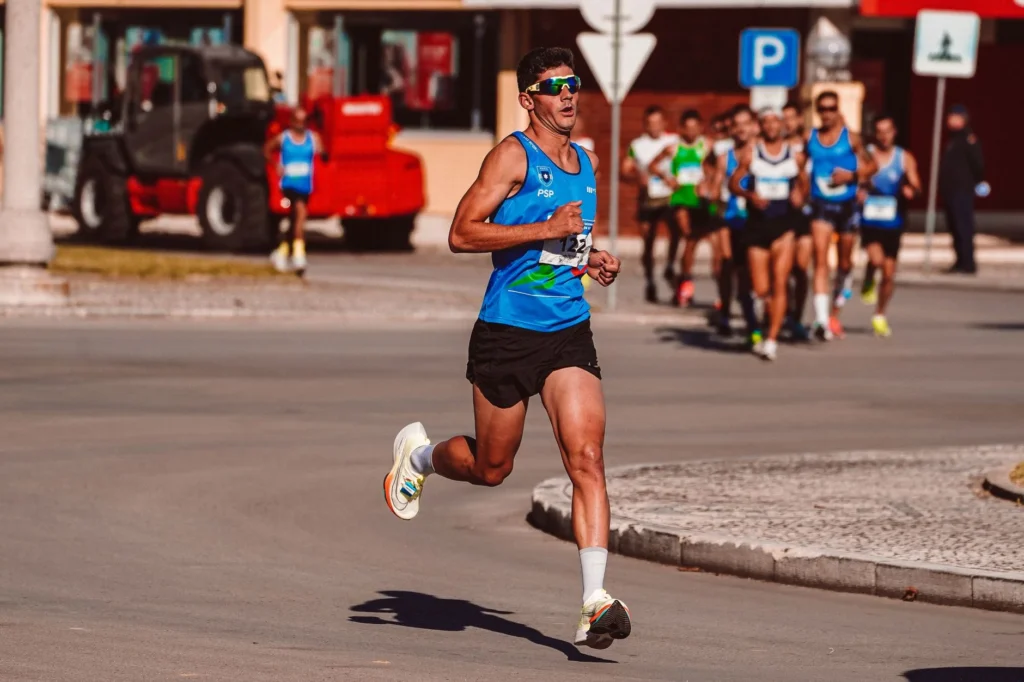
A running pace chart does one thing: it converts a pace per mile into a finish time for any race distance, or works the reverse — takes a goal finish time and shows what pace you need to hold. The chart below covers paces from 6:00 to 14:00 per mile across the four most common race distances.
How to Use This Chart
There are two ways to use the chart:
Find your finish time: Know your pace from training or a recent race? Find that row and read across to see your projected finish time for each distance.
Find your required pace: Have a goal finish time? Scan the column for your target distance and find the finish time closest to your goal. Read left to find the pace you need to sustain every mile.
All times assume even pacing — the same pace held mile for mile. Most races involve slight variation: conservative early, stronger late (negative split), or fast start with a slowdown (positive split). Even-pace projections are the most reliable baseline for planning.
Running Pace Chart: 5K, 10K, Half Marathon, Marathon
| Pace (min/mile) | 5K | 10K | Half Marathon | Marathon |
|---|---|---|---|---|
| 6:00 | 18:38 | 37:17 | 1:18:39 | 2:37:19 |
| 6:30 | 20:12 | 40:23 | 1:25:13 | 2:50:25 |
| 7:00 | 21:45 | 43:30 | 1:31:46 | 3:03:32 |
| 7:30 | 23:18 | 46:36 | 1:38:19 | 3:16:38 |
| 8:00 | 24:51 | 49:43 | 1:44:53 | 3:29:45 |
| 8:30 | 26:24 | 52:49 | 1:51:26 | 3:42:52 |
| 9:00 | 27:58 | 55:55 | 1:57:59 | 3:55:58 |
| 9:30 | 29:31 | 59:02 | 2:04:32 | 4:09:05 |
| 10:00 | 31:04 | 1:02:08 | 2:11:06 | 4:22:11 |
| 10:30 | 32:37 | 1:05:15 | 2:17:39 | 4:35:18 |
| 11:00 | 34:11 | 1:08:21 | 2:24:12 | 4:48:24 |
| 11:30 | 35:44 | 1:11:27 | 2:30:45 | 5:01:31 |
| 12:00 | 37:17 | 1:14:34 | 2:37:19 | 5:14:38 |
| 13:00 | 40:23 | 1:20:47 | 2:50:25 | 5:40:51 |
| 14:00 | 43:30 | 1:27:00 | 3:03:32 | 6:07:04 |
Common Reference Points
A few paces worth knowing:
- 9:39/mile — the pace required to run a 5K in exactly 30:00, the most common beginner target.
- 9:00/mile — roughly the average half marathon pace for men (RunRepeat puts the average men’s half marathon at about 1:55–2:00).
- 9:57/mile — the average marathon pace for men (RunRepeat: 4:21:03 average finish time) [1].
- 8:03/mile — required for a sub-25:00 5K; a popular recreational goal.
Pace vs. Finish Time: The Compounding Effect of Pace Differences
Small pace changes produce large finish time differences over long distances. The difference between a 9:00/mile and a 9:30/mile is 30 seconds per mile. Over a marathon (26.2 miles), that 30 seconds compounds to 13 minutes and 7 seconds total. A runner who goes out 30 seconds per mile too fast early in a marathon and fades to 30 seconds per mile slower in the back half has effectively run a different race entirely.
This is why even-pace or slight negative-split pacing consistently produces faster finish times than fast-start strategies: it avoids the disproportionate cost of pace deceleration in the final miles.
Calculate Your Exact Target Pace
Enter your goal finish time and distance to get the exact pace per mile or kilometer you need to hold — down to the second.
Use the Running Pace Calculator →Related Reading
What Is a Good Running Pace? Benchmarks by Experience Level →Related Reading
Average Running Pace by Age: Benchmarks for Men and Women →Related Reading
How to Improve Your Running Pace: 5 Training Methods That Work →Sources: [1] RunRepeat. Marathon performance across nations (2018 race results).