Last updated: June 2026
How Many Laps in a Pool to Lose Weight?
To burn 500 calories in a single swim session — a standard target for one pound per week of fat loss — a 155-pound person needs approximately 35 laps in a standard 25-yard pool at moderate freestyle pace, or about 15 laps in a 50-meter Olympic pool. The numbers shift significantly with body weight and stroke choice. Heavier swimmers reach 500 calories in fewer laps; breaststroke swimmers need more laps than freestyle swimmers at the same effort level because breaststroke has a lower calorie burn per minute.
Calculate Swimming Calories by Session
Enter your weight, stroke, and duration for a personalised calorie estimate — no guesswork about lap pace.
What Counts as a Lap?
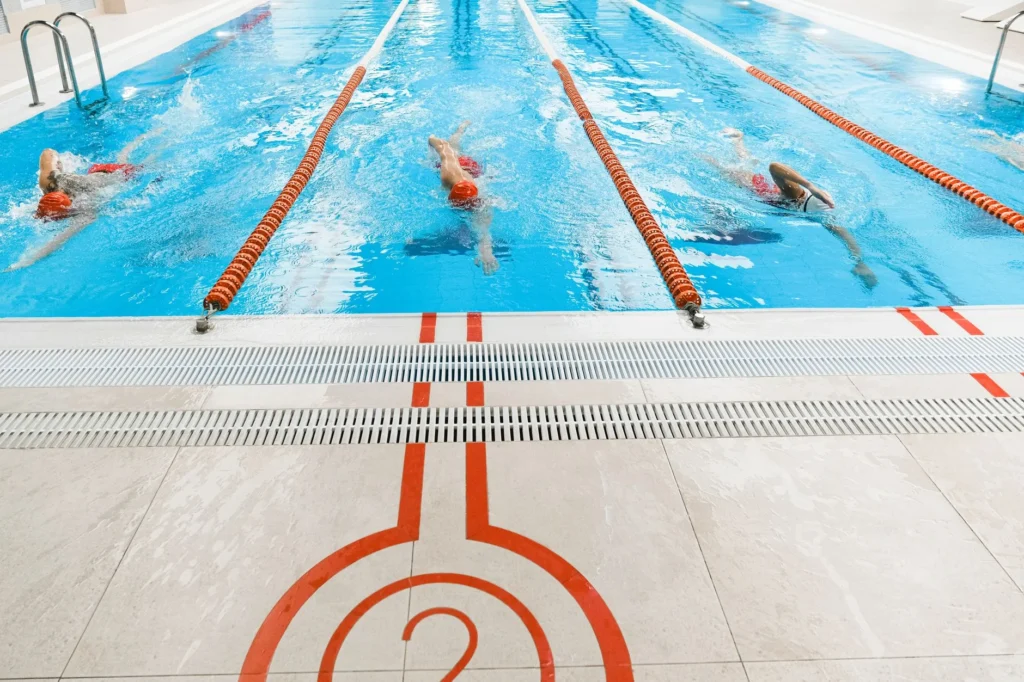
A lap in swimming means one trip down the pool and back — two lengths. The most common pool configurations in the US and UK are:
- 25-yard pool (short course yards) — standard for most recreation centres and health clubs. One lap = 50 yards (45.7m).
- 25-metre pool (short course metres) — common internationally. One lap = 50m.
- 50-metre pool (Olympic / long course) — competitive pools only. One lap = 100m.
In a 25-yard pool, a recreational swimmer completing moderate freestyle takes approximately 1.5 minutes per lap. In a 25m pool, approximately 1.7 minutes per lap. In a 50m Olympic pool, approximately 3.5 minutes per lap. These time-per-lap assumptions underpin the calorie and lap tables below.
Laps to Burn 500 Calories — Table by Pool Length and Body Weight
Figures below are for freestyle at moderate effort (MET 8.3) using Calories = MET × weight (kg) × time (hours). Lap times assumed: 25yd pool — 1.5 min/lap; 25m pool — 1.7 min/lap; 50m pool — 3.5 min/lap.
| Body weight | 25yd pool (50yd/lap) | 25m pool (50m/lap) | 50m pool (100m/lap) |
|---|---|---|---|
| 130 lb (59 kg) | 41 laps (~62 min) | 36 laps (~61 min) | 18 laps (~63 min) |
| 155 lb (70 kg) | 35 laps (~53 min) | 30 laps (~51 min) | 15 laps (~53 min) |
| 185 lb (84 kg) | 29 laps (~44 min) | 25 laps (~43 min) | 12 laps (~42 min) |
| 220 lb (100 kg) | 24 laps (~36 min) | 21 laps (~36 min) | 10 laps (~35 min) |
The time to 500 calories is similar regardless of pool length — the lap count changes, but the swimming time stays roughly the same. This confirms that time in the water matters more than lap count when planning a calorie-focused session. A swimmer in a 25-yard pool reaching 500 calories in 35 laps is swimming for the same duration as a swimmer in a 50m pool completing 15 laps.
Weekly Lap Targets for 1 Pound Per Week of Fat Loss
One pound of fat contains approximately 3,500 calories. To lose one pound per week requires a sustained 500-calorie daily deficit — from swimming, diet, or a combination. Here is a realistic target for a 155-pound person pairing swimming with a modest dietary reduction:
- Swimming contribution: 250 cal/day → 1,750 cal/week from swimming
- Diet contribution: 250 cal/day reduction in food intake
- Swimming sessions needed: 4 × 45-minute sessions per week ≈ 4 × 435 cal = 1,740 cal ✓
- Laps per session (25yd pool, freestyle moderate): approximately 30 laps (45 min ÷ 1.5 min/lap)
- Weekly lap total: approximately 120 laps
This is achievable without elite fitness. Four 45-minute sessions plus trimming one indulgent meal per day produces a pound per week of fat loss consistently over time.
Is 20 Laps in a Pool a Good Workout?
For a 25-yard pool: yes, 20 laps (1,000 yards, roughly 0.57 miles) is a solid intermediate workout. At moderate freestyle for a 155-pound person, 20 laps burns approximately 291 calories in 30 minutes — comparable to a brisk 30-minute jog. For context:
| Experience level | Lap target (25yd pool) | Distance | Approx time | Calories — 155 lb |
|---|---|---|---|---|
| Beginner | 10 laps | 500 yards | ~15 min | ~145 cal |
| Intermediate | 20 laps | 1,000 yards | ~30 min | ~291 cal |
| Advanced | 50 laps | 2,500 yards | ~75 min | ~726 cal |
Beginners should start with 10 laps and build gradually — adding two laps per session every week is a sustainable progression that prevents early burnout. Most swimmers reach 20 laps comfortably within four to six weeks of consistent training. At 20 laps, rest as needed between laps to maintain form; as fitness improves, reduce rest time rather than adding more laps immediately.
Why Time Matters More Than Lap Count
Swimming calories are time-based, not distance-based. The MET formula calculates energy expenditure as a function of intensity and duration — not metres covered. A swimmer doing 20 laps of breaststroke (2.5 min/lap = 50 minutes) burns more calories than a swimmer doing 20 laps of fast freestyle (1.0 min/lap = 20 minutes) because more time is spent in active exertion. If your goal is calorie burn, track total minutes in the water, not just lap count.
Lap count is most useful as a proxy for distance — helpful for planning training volume — but can mislead on the calorie side if different swimmers are using different pool lengths, strokes, or speeds.
Related Reading
Get Your Personalised Swimming Calorie Estimate
Enter your weight and session duration to see exactly how many calories you burn per swim — more accurate than any lap count estimate.