Last updated: June 2026
How Many Calories Does Breaststroke Burn?
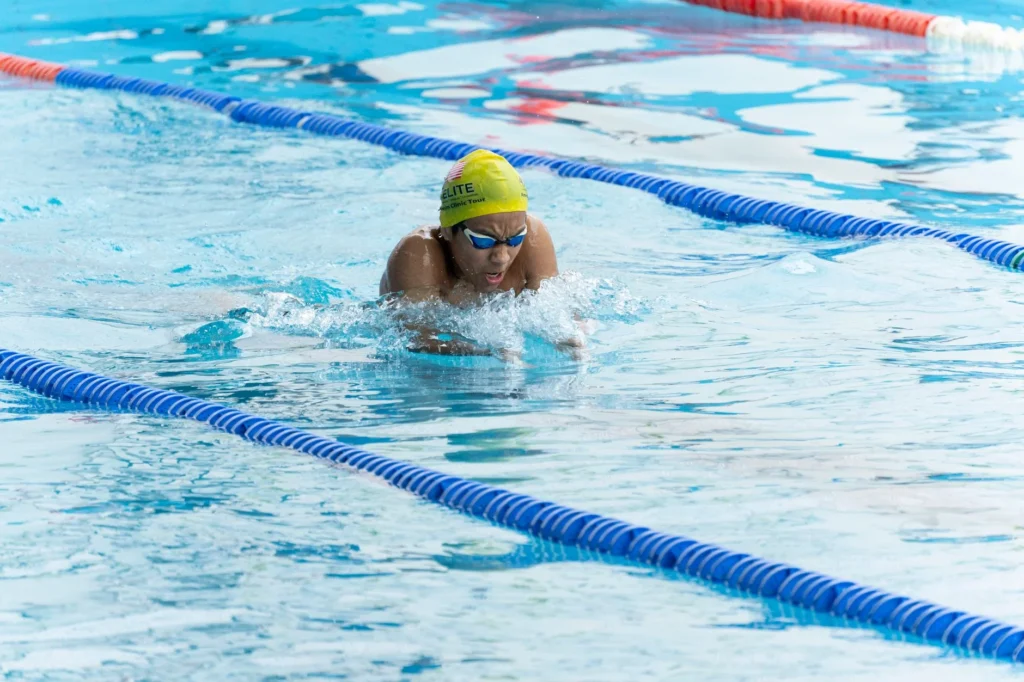
Breaststroke at a recreational pace burns between 156 and 265 calories per 30 minutes for most adults — roughly equivalent to a brisk walk. At vigorous effort, the same 30 minutes produces 304–515 calories, which is more comparable to a moderate jog. The reason breaststroke has such a wide range is that its effort levels are uniquely polarised: the frog-kick and glide pattern allows for a very relaxed, low-intensity pace that other strokes do not. Push the intensity and it becomes a demanding total-body cardiovascular exercise.
Calculate Your Breaststroke Calorie Burn
Enter your weight and session length for a personalised calorie estimate based on stroke and intensity level.
Calories Burned Doing Breaststroke — by Weight and Intensity (30 Minutes)
The table below uses MET (Metabolic Equivalent of Task) values from the Compendium of Physical Activities: MET 5.3 for recreational breaststroke and MET 10.3 for vigorous/high-effort breaststroke. Formula: Calories = MET × weight (kg) × 0.5 hours.
| Effort level | MET | 130 lb (59 kg) | 155 lb (70 kg) | 185 lb (84 kg) | 220 lb (100 kg) |
|---|---|---|---|---|---|
| Recreational / moderate | 5.3 | 156 cal | 186 cal | 223 cal | 265 cal |
| Vigorous / high effort | 10.3 | 304 cal | 361 cal | 433 cal | 515 cal |
Vigorous breaststroke burns approximately twice as many calories per minute as the recreational version — a bigger relative gap than most other strokes. This is because breaststroke’s glide phase can either be long and leisurely (low MET) or shortened into a rapid, continuously demanding cycle (high MET). Eliminating the glide between strokes and swimming at near-maximum effort is what separates a 186-calorie session from a 361-calorie session for the same 155-pound swimmer in the same 30 minutes.
Why Breaststroke Calorie Numbers Vary So Widely Online
Articles citing breaststroke as burning “200 calories per 30 minutes” and articles claiming “700 calories per hour” are both technically correct — they are measuring different things. Three variables account for almost all the variation you will see:
- Effort level. Recreational pace (MET 5.3) vs. vigorous pace (MET 10.3) produces nearly a 2× difference in calories burned per minute. Most published figures do not specify which they are using.
- Body weight. The same session burns 70% more calories for a 220-pound swimmer than a 130-pound swimmer. Articles using different reference weights produce different numbers.
- Calculation method. Some sources use the simplified MET × weight × time formula; others use the Compendium formula that multiplies by 3.5/200, which yields slightly higher values. Both are approximations.
The most reliable approach is to use the formula with your own body weight and the appropriate MET for your actual effort level.
How Breaststroke Compares to Other Strokes
The table below shows calories burned per 60 minutes for a 155-pound (70 kg) swimmer across all four competitive strokes at both recreational and vigorous effort. Calculated using Calories = MET × 70 × 1 hour.
| Stroke | Effort | MET | Cal/hr (155 lb) |
|---|---|---|---|
| Butterfly | General | 13.8 | 966 cal |
| Breaststroke | Vigorous | 10.3 | 721 cal |
| Freestyle | Vigorous | 10.0 | 700 cal |
| Backstroke | Vigorous | 9.5 | 665 cal |
| Freestyle | Recreational | 8.3 | 581 cal |
| Breaststroke | Recreational | 5.3 | 371 cal |
| Backstroke | Recreational | 4.8 | 336 cal |
A notable finding: vigorous breaststroke (MET 10.3) burns slightly more per hour than vigorous freestyle (MET 10.0) and considerably more than vigorous backstroke (MET 9.5). Breaststroke at high effort is a surprisingly demanding cardiovascular exercise, despite its slower visual pace. It also engages the inner thighs, hamstrings, chest, and triceps more directly than freestyle — the resistance pattern is simply different, not inferior.
Is Breaststroke Good for Weight Loss?
Yes — with a caveat about intensity. At recreational pace, breaststroke burns fewer calories per minute than freestyle, which means you need to swim longer to reach the same calorie total. A 155-pound person burning 500 calories through recreational breaststroke needs approximately 81 minutes, versus 52 minutes for the same person swimming moderate freestyle.
The practical implication: if breaststroke is your preferred or most comfortable stroke, compensate for the lower per-minute burn by extending session duration or increasing effort. A 60-minute vigorous breaststroke session burns 721 calories — exceeding a 60-minute recreational freestyle session (581 cal) and matching a vigorous freestyle session.
How to Increase Calorie Burn While Swimming Breaststroke
- Reduce the glide. The glide phase in breaststroke is where most energy saving happens. Shortening it — initiating the next stroke cycle before you slow significantly — converts recreational breaststroke into vigorous breaststroke. This one change roughly doubles the MET value.
- Use interval sets. Alternate 25m at near-maximum effort with 25m easy recovery. This pushes calorie burn above the simple MET average and creates an after-burn effect that continues post-session.
- Extend session time. At recreational effort, 45–60 minutes of breaststroke (280–371 cal for 155 lb) becomes competitive with 30 minutes of vigorous freestyle. More total time in the water is the most accessible lever for recreational swimmers who do not want to swim faster.
Related Reading
Get Your Personalised Breaststroke Calorie Estimate
The calculator adjusts for your exact weight and effort level — more accurate than any single-number table estimate.