Last updated: June 2026
Does Swimming Burn Calories?
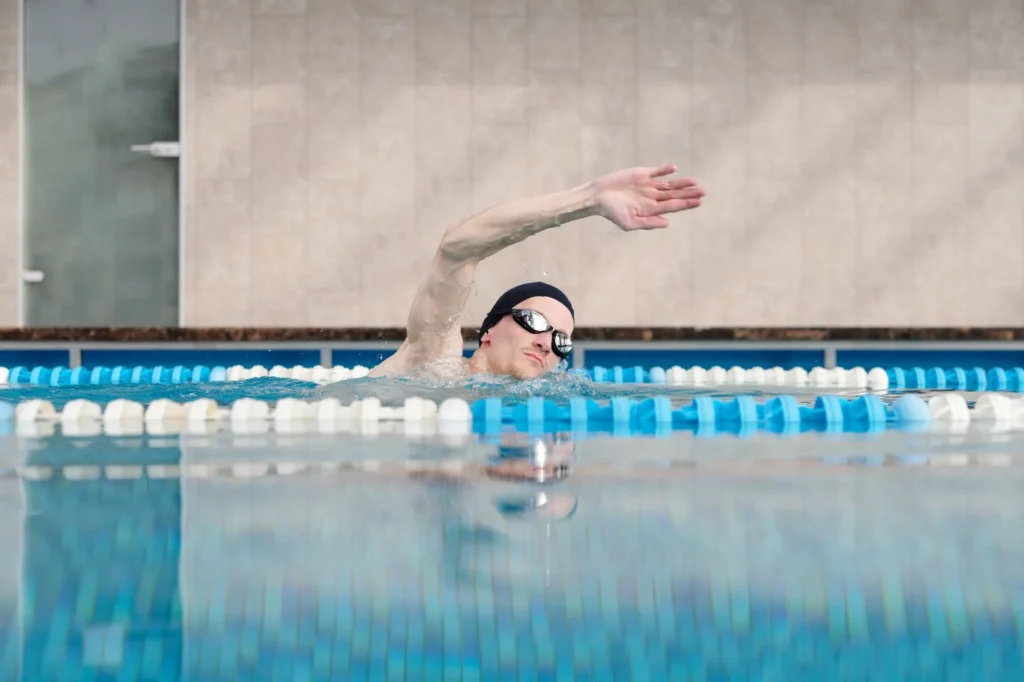
Yes — swimming burns between 140 and 490+ calories per 30 minutes depending on your stroke, body weight, and intensity. Water is approximately 800 times denser than air, which means every stroke, kick, and turn meets continuous resistance. Unlike running or cycling, there is no coasting in the pool — your body must generate effort throughout the entire session to stay afloat and move forward. This continuous full-body demand is why swimming calorie burn per minute is competitive with running, even though pace feels much slower.
Get Your Exact Swimming Calorie Burn
Enter your weight, stroke, and session length for a personalised calorie estimate — not a population average.
Calories Burned Swimming — 30-Minute Table by Stroke and Weight
The figures below are calculated using the standard formula: Calories = MET × weight (kg) × time (hours). MET (Metabolic Equivalent of Task) values are drawn from the Compendium of Physical Activities. All figures assume a recreational to moderate effort level — not competitive pace.
| Stroke | MET | 130 lb (59 kg) | 155 lb (70 kg) | 185 lb (84 kg) | 220 lb (100 kg) |
|---|---|---|---|---|---|
| Butterfly | 13.8 | 407 cal | 483 cal | 580 cal | 690 cal |
| Freestyle / crawl | 8.3 | 245 cal | 291 cal | 349 cal | 415 cal |
| Breaststroke | 5.3 | 156 cal | 186 cal | 223 cal | 265 cal |
| Backstroke | 4.8 | 141 cal | 168 cal | 202 cal | 240 cal |
| Treading water (relaxed) | 3.5 | 103 cal | 123 cal | 147 cal | 175 cal |
The stroke range is wide for two reasons. First, butterfly demands near-maximal upper-body effort at all times — there is no easy version of butterfly. Second, treading water at a relaxed pace is a low-intensity activity compared to continuous lap swimming. For most recreational swimmers, freestyle or breaststroke is the realistic daily reference point. Pushing either stroke to vigorous effort roughly doubles the calorie output from the moderate figures shown above.
Why Swimming Burns So Many Calories
Water resistance
Water provides 12–14 times more resistance than air. Moving your arms and legs through it costs substantially more energy per movement than an equivalent action on land. Your stabilising muscles — core, hips, lower back — also work continuously to maintain body position in the water, adding to total energy output beyond the primary stroke effort.
Full-body muscle recruitment
All four competitive strokes engage the legs, core, back, shoulders, and arms simultaneously. Running is predominantly lower-body; cycling is almost entirely lower-body. The more muscle mass active during an exercise, the more oxygen and fuel the body must deliver — which is why swimming calorie burn per minute is competitive with running even though swimmers cover far less distance per hour than runners.
Thermoregulation in cooler water
Pool water is typically cooler than body temperature. The body expends additional energy maintaining core temperature throughout the session, adding a modest but consistent increment to total calorie expenditure beyond what the muscular work alone produces.
How Body Weight Changes the Calorie Burn
Body weight is the single largest variable in swimming calorie burn — more influential than stroke choice or intensity level for most recreational swimmers. The MET formula captures this directly: calories scale linearly with body weight.
A 220-pound swimmer doing 30 minutes of moderate freestyle burns approximately 415 calories. A 130-pound swimmer doing the same session burns 245 calories — a 70% difference driven entirely by body weight. Heavier swimmers must push more mass through the same resistant medium, which requires proportionally more energy per stroke cycle.
How Swimming Compares to Other Exercises
Freestyle swimming at recreational pace (MET 8.3) burns the same number of calories per minute as running at 5 mph — both have a MET value of 8.3. The key difference is impact: running places repetitive load on the knees, hips, and ankles; swimming generates near-zero joint stress at any pace. Butterfly outburns nearly every common cardio activity on a per-minute basis.
| Activity | Calories burned — 30 min (155 lb) |
|---|---|
| Swimming — butterfly | 483 cal |
| Running — 6 mph (10 min/mile) | 350 cal |
| Swimming — freestyle moderate | 291 cal |
| Running — 5 mph (12 min/mile) | 291 cal |
| Cycling — moderate effort | 280 cal |
| Swimming — breaststroke moderate | 186 cal |
| Walking — brisk (3.5 mph) | 151 cal |
Does Getting Better at Swimming Reduce Calorie Burn?
As you become a more efficient swimmer, you will burn fewer calories per lap at the same perceived effort. Your body learns to produce the same forward movement with less energy waste — the same adaptation that makes experienced runners more economical. The response is to increase distance, add more sessions per week, or introduce interval training rather than relying on inefficiency as a calorie driver.
Alternating hard and easy lengths — one length near maximum effort, one recovery length easy — increases calorie burn by roughly 25–30% compared to a steady-pace swim of equal duration, because the intense lengths push calorie burn well above moderate MET values.
Related Reading
Calculate Your Swimming Calorie Burn
Select your stroke, enter your weight, and set your session length to get a precise calorie estimate for your next swim.