Last updated: October 2026
Body recomposition is the simultaneous process of reducing body fat while maintaining or increasing lean muscle mass — often with no meaningful change in total body weight. Instead of focusing on the scale, body recomposition focuses on shifting the ratio of fat to muscle in your body.
Calculate Your Body Recomposition Targets
Find your ideal calorie deficit, protein target, and training volume for body recomposition.
What Body Recomposition Actually Means
Traditional approaches to body change ask you to choose: either bulk (eat more, build muscle, accept some fat gain) or cut (eat less, lose fat, accept some muscle loss). Body recomposition rejects this binary. It treats fat loss and muscle gain not as mutually exclusive states but as outcomes that can occur within the same time window under the right conditions.
The science supports this. Research reviews conclude that body recomposition has been demonstrated in untrained, trained, and even highly trained people of different ages. The idea that simultaneous fat loss and muscle gain is impossible has been progressively dismantled by accumulating research.
The key mechanism: when you resistance train, eat enough protein, and maintain a modest calorie deficit, your body receives a signal to build new muscle tissue while drawing energy from stored fat to fuel that process. The energy cost of building new muscle is relatively modest, so in people with enough stored fat, a small deficit can still leave room for muscle growth.
Who Benefits Most from Body Recomposition
Beginners and novice trainees
People with less than 6–12 months of consistent, structured resistance training experience are highly sensitive to training stimuli. Their bodies produce dramatic adaptation responses to exercise they haven’t previously performed — enabling both significant fat loss and muscle gain simultaneously. This response is so pronounced it’s sometimes called “newbie gains.”
Detrained individuals
Anyone returning from a prolonged break from training (due to injury, illness, life circumstances) can experience body recomposition-like results. Muscle memory accelerates re-gain of previously held muscle, and returning trainees respond to training stress similarly to true beginners for the first several months back.
Overweight individuals with high body fat
People with body fat above 25–30% (men) or 35–40% (women) have a significant stored energy advantage. Their body fat reserves provide ample fuel for muscle synthesis even in a meaningful calorie deficit. The result: rapid fat loss and muscle gain can occur simultaneously more easily than in already-lean individuals.
Who benefits less from body recomposition
Advanced trainees — those who have been training consistently for 3+ years and are already relatively lean — find body recomposition far slower and less efficient. At advanced levels, the stimulus required for muscle growth is extreme and the body’s ability to fuel muscle synthesis from fat stores is more limited. For advanced trainees, dedicated bulking and cutting phases produce better results.
The Five Pillars of Body Recomposition
1. Resistance training (3–4 days per week)
Strength training is the primary driver of body recomposition. Without the stimulus for muscle growth, any calorie deficit produces only fat and muscle loss, not recomposition. At minimum, 2 days per week of resistance training is required for body composition change; 3–4 days per week produces optimal body recomposition results.
2. High protein intake (0.7–1g per pound of body weight)
Protein provides the amino acids necessary for muscle repair and growth, and also protects muscle tissue from breakdown during a calorie deficit. Research on successful body recomposition protocols consistently uses protein intakes of 1.6–2.2g/kg (0.7–1g/lb). Distribute protein evenly across meals — muscle protein synthesis is maximized when multiple protein-rich meals are consumed throughout the day rather than one large dose.
3. Modest calorie deficit (150–500 calories below maintenance)
The deficit must be small enough that muscle growth remains possible. A 2011 study by Garthe et al. [1] found that athletes losing a maximum of 0.7% of body weight per week gained 2.1% lean body mass over 9 weeks, while the faster-losing group gained no lean mass. A ~500 calorie deficit is typically the maximum that allows simultaneous muscle growth.
4. Adequate sleep (7–9 hours per night)
Growth hormone, which plays a role in tissue repair and fat metabolism, is released in its largest pulses during deep sleep. Sleep deprivation raises cortisol (promoting fat storage), reduces testosterone (hampering muscle building), and increases hunger. Studies show that calorie-restricted subjects sleeping adequate hours lose significantly more fat and less muscle than sleep-deprived groups in the same deficit.
5. Strategic cardio (HIIT preferred, 2–3 sessions per week)
HIIT produces similar fat loss to steady-state cardio in less time, which makes it easy to fit around lifting. Excessive steady-state cardio competes with recovery from resistance training. Limit cardio to 2–3 HIIT sessions per week of 20–30 minutes to support fat loss without interfering with muscle adaptation.
Body Recomposition vs. Bulking and Cutting
| Approach | Best For | Results | Timeframe |
|---|---|---|---|
| Body Recomposition | Beginners, overweight, detrained | Fat loss + muscle gain simultaneously | Slower changes, sustainable |
| Bulking | Advanced lifters, underweight, already lean | Maximum muscle gain (with some fat gain) | Faster muscle growth |
| Cutting | Overweight, advanced lifters finishing a bulk | Maximum fat loss (with some muscle risk) | Faster fat loss |
How to Track Body Recomposition Progress
The scale is a poor tracker of body recomposition — you may lose 5 lbs of fat and gain 5 lbs of muscle, showing zero change on the scale despite a dramatic physique transformation. Use these metrics instead:
- Body fat percentage: Measured via DEXA scan, skinfold calipers, or bioelectrical impedance — shows the actual fat-to-muscle ratio change
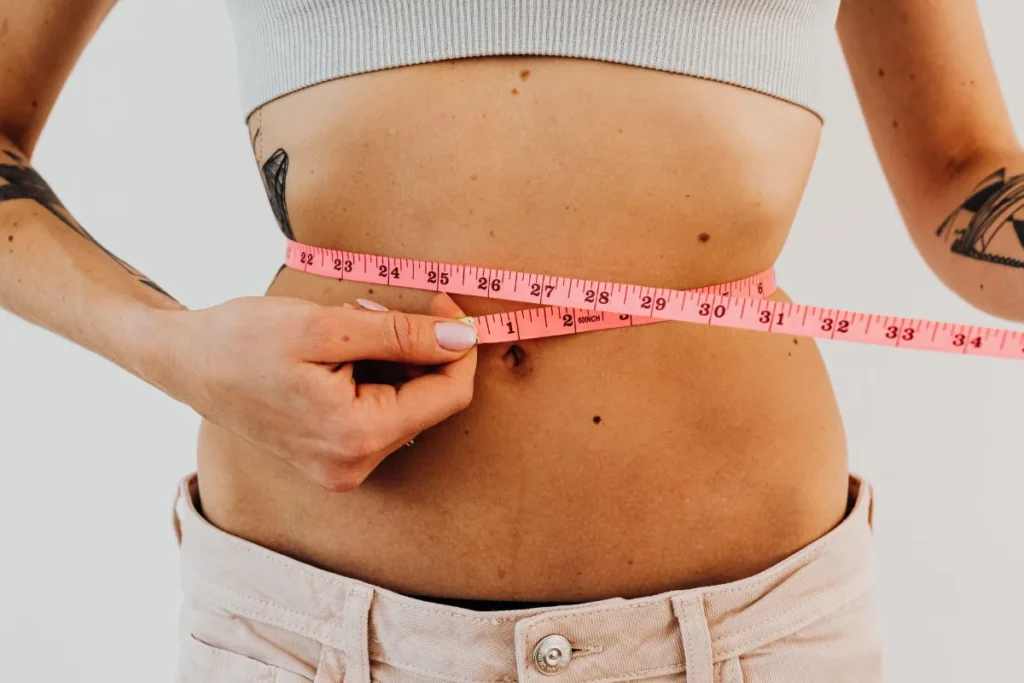
- Body measurements: Waist, hips, chest, arms, thighs — fat loss shows as reduced waist; muscle gain shows as increased arm/chest/leg measurements
- Gym performance: If your squat, bench, and deadlift numbers are increasing while you’re in a calorie deficit, you’re almost certainly gaining or preserving muscle
- Progress photos: Taken under consistent lighting and conditions monthly — visual changes are the most motivating indicator
How Long Does Body Recomposition Take?
Most beginner trainees see noticeable physique changes within 12–16 weeks. Meaningful reductions in body fat percentage (3–5%) combined with measurable muscle gain typically take 4–6 months of consistent effort. Body recomposition is inherently slower than either pure bulking or cutting — but the advantage is that you’re moving toward both goals simultaneously without the downsides of either extreme.
Frequently Asked Questions
Is body recomposition possible for everyone?
Technically yes, but practically the results vary enormously by training experience and starting body composition. Beginners and overweight individuals see dramatic recomposition. Advanced, already-lean lifters see minimal recomposition and are typically better served by dedicated bulking and cutting cycles.
How do I know if body recomposition is working?
Track three things: body measurements (waist shrinking, arms growing), gym performance (strength increasing), and body fat percentage if you have access to measurement. If your waist is getting smaller while your lifts go up, recomposition is working — even if the scale barely moves.
Related Reading
Calculate Your Recomposition Targets
Get your personalized calorie, protein, and training targets for body recomposition.
Sources: [1] Garthe I, et al. Effect of two different weight-loss rates on body composition and strength and power-related performance in elite athletes. Int J Sport Nutr Exerc Metab. 2011.