Last updated: June 2026
Beginner Bodyweight Workout
A complete beginner bodyweight workout uses six exercises: push-ups, squats, lunges, glute bridges, planks, and jumping jacks. Done as a circuit for 2–3 rounds, 3 days per week, these movements train every major muscle group and provide enough cardiovascular stimulus to improve fitness without any equipment. Research published in the Journal of Human Kinetics confirms that bodyweight training at adequate intensity produces statistically equivalent strength and muscle gains to resistance machine training in untrained individuals over 8 weeks.
Get a Structured Beginner Home Workout Plan
The home workout generator builds a full weekly plan matched to your fitness level — with exercises, sets, reps, and a built-in progression system so you keep improving week to week.
The 20-Minute Beginner Bodyweight Circuit
Perform each exercise back to back with minimal rest between movements. Rest 60–90 seconds between rounds. Complete 2 rounds in your first week, 3 rounds from week 3 onward.
| Exercise | Reps / Hold | Modification | Muscles Worked |
|---|---|---|---|
| Push-up | 8–10 | Knee push-up | Chest, shoulders, triceps |
| Bodyweight squat | 12–15 | Squat to chair | Quads, glutes, hamstrings |
| Reverse lunge | 8 each leg | Stationary lunge | Quads, glutes, balance |
| Glute bridge | 12–15 | Hold 2 sec at top | Glutes, hamstrings |
| Plank | 20–30 sec | Knee plank | Core, obliques |
| Jumping jacks | 30 sec | Step jacks (no jump) | Full body, cardio |
The order is intentional. Push-ups come first when you are freshest to maximise upper-body strength stimulus. Squats and lunges follow while legs are not yet fatigued from each other. Glute bridges and planks finish the strength portion. Jumping jacks end each round to elevate heart rate and accumulate cardio stimulus within the strength session.
Exercise Form: What Beginners Must Get Right
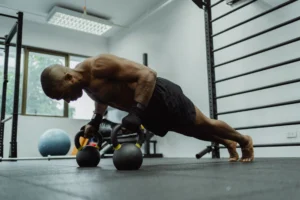
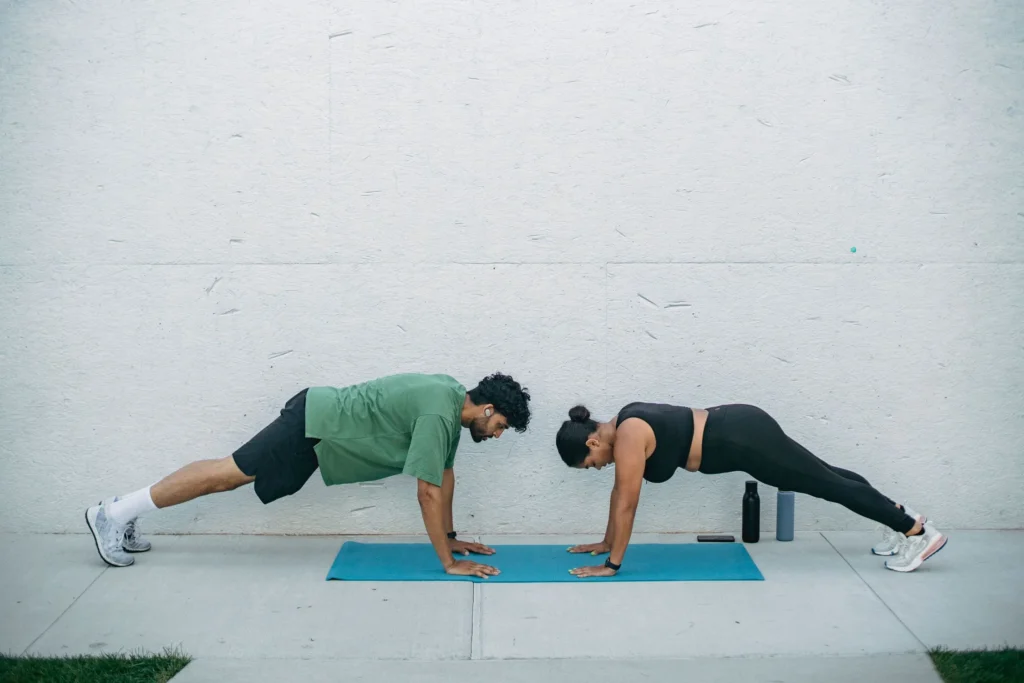
Push-up. Place hands slightly wider than shoulder-width. Before you lower, brace your core as if preparing for a punch — your torso should be rigid throughout every rep. Lower your chest (not your chin) toward the floor. Lock your elbows at the top. If you cannot maintain a straight line from head to heels, use your knees. A well-executed knee push-up produces far more chest activation than a sloppy full push-up with sagging hips.
Bodyweight squat. Stand with feet shoulder-width apart, toes angled out 15–30 degrees. Sit your hips back and down simultaneously — not just down. Keep your chest up and your knees tracking over your second toe. Lower until your thighs are parallel to the floor or as deep as you can comfortably reach. Drive through your full foot (not just the ball) to stand.
Reverse lunge. Step backward rather than forward to reduce stress on the front knee. Lower your back knee toward the floor while keeping your torso vertical. Push through the heel of your front foot to return to standing. If balance is a challenge, perform stationary split squats with both feet planted and simply drop and rise repeatedly before adding the step.
Glute bridge. Lie on your back with feet flat and knees bent at roughly 90 degrees. Press through your heels to lift your hips until your body forms a straight line from knees to shoulders. Squeeze your glutes at the top for 1–2 seconds. Lower under control. The most common error is stopping the hips too early — the top position should feel like a full glute contraction, not a partial lift.
Plank. Brace your core and squeeze your glutes before looking at the clock. A plank held with full tension for 20 seconds is more effective than 60 seconds of passive hanging. If your lower back aches, your hips are likely too high or sagging — adjust before continuing.
How Often to Train as a Beginner
Train this circuit 3 days per week with at least one rest day between sessions — for example Monday, Wednesday, Friday. Muscle does not grow during training; it grows during recovery. Two consecutive training days with the same circuit is not twice as productive — it is often counterproductive because the repair process hasn’t completed.
On rest days, light walking or stretching is fine and mildly beneficial for circulation and recovery. Avoid treating rest days as a second training session with different exercises — your muscles need the full recovery window, especially in the first 4 weeks when soreness is at its peak.
How to Progress After the First 4 Weeks
Beginner bodyweight training has a short plateau window. Most people exhaust the useful range of the basic circuit within 6–8 weeks. Progress through these stages in order:
Stage 1 (Weeks 1–4): 2 rounds → 3 rounds. Reach 12–15 reps in good form on every strength exercise before progressing.
Stage 2 (Weeks 5–8): Increase reps to 15–20 per exercise. Add a 4th round. Reduce rest between rounds from 90 seconds to 60 seconds.
Stage 3 (Weeks 8+): Introduce harder variations. Replace standard push-ups with feet-elevated push-ups. Replace squats with jump squats or Bulgarian split squats. Replace glute bridges with single-leg glute bridges. Replace planks with side planks or plank shoulder taps.
Each progression should be applied one exercise at a time, not all at once. Changing one variable per session allows you to identify which exercise is driving the increased difficulty and adjust accordingly if one movement causes discomfort.
Related Reading
Personalized Workout Plan: How to Build One Around Your Goals →
Can Beginners Build Muscle with Bodyweight Training?
Yes — with one condition. Muscle growth requires progressive overload, which means your muscles must be challenged with more work than they can comfortably handle. This is as achievable through bodyweight as through weights, but it requires deliberate progression through harder variations rather than simply repeating the same exercises indefinitely.
For a beginner, the first 3–6 months of any consistent resistance training — including bodyweight — typically produce the fastest muscle growth of a lifetime, because untrained muscles are highly sensitive to any novel mechanical stimulus. This “beginner gains” window is real and significant: beginners can gain 1–2 lbs of muscle per month with consistent training and adequate protein intake (approximately 0.7–1g per lb of bodyweight daily), even without adding external load.
Related Reading
Home Workouts to Lose Weight: HIIT Circuits and Weekly Plan →
Get Your Full Home Workout Plan
Generate a complete weekly training plan built around your fitness level, goal, and available days — with exercises, sets, reps, and a built-in progression path.