How Many Push-Ups Should a Woman Be Able to Do?
A healthy woman in her 20s or 30s should be able to do 13–20 full push-ups to be considered in the “good” range. Women who strength train regularly can hit 25–35+. Women who are new to training often start at 0–5 full reps — this is more common than not, and it reflects a starting point rather than a ceiling.
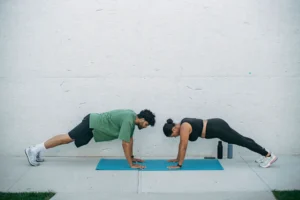
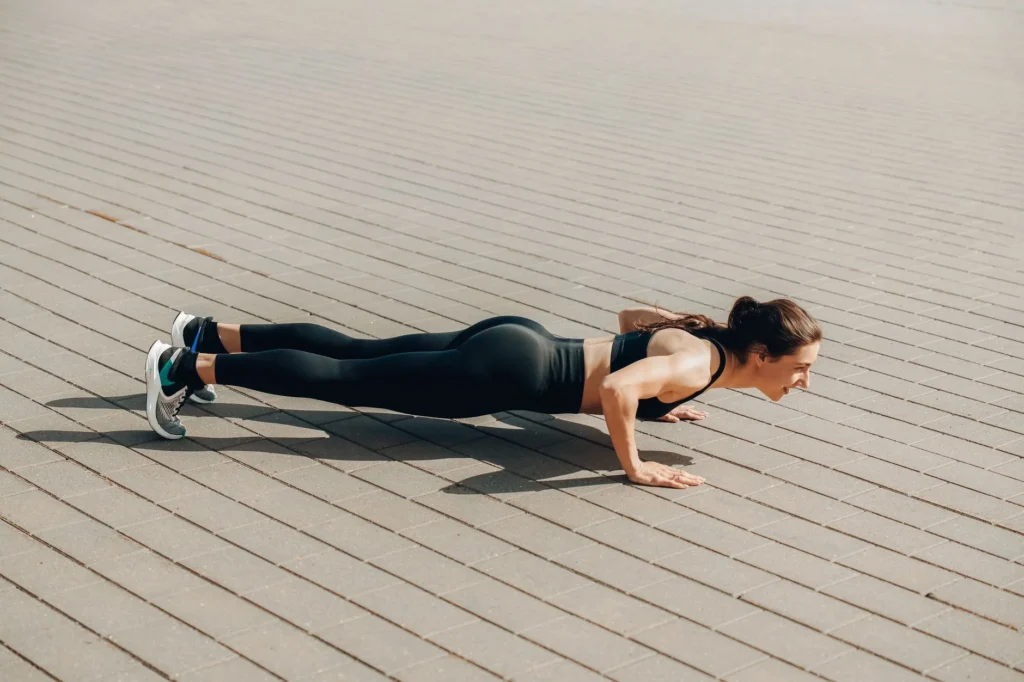
These numbers are for full push-ups: hands and feet on the floor, body in a rigid straight line, chest descending to within an inch of the floor, arms fully extended at the top. Modified knee push-ups are useful for building toward full form, but they are not interchangeable with the full version for benchmarking purposes.
Find Your Push-Up Level
Enter your push-up count and bodyweight to see your estimated strength level and how you compare against standards for your age and sex.
Use the Push-Up Calculator →Push-Up Benchmarks for Women by Age
The table below is adapted from widely used norms (the Canadian CSEP norms reprinted by the ACSM) and fitness-professional benchmarks. Note that the CSEP women’s norms were built on bent-knee push-ups, so treat these as approximate — strict full push-up counts are often a little lower.
| Age | Needs Improvement | Good | Excellent |
|---|---|---|---|
| 15–19 | 0–6 | 18–24 | 25+ |
| 20–29 | 0–5 | 15–20 | 22+ |
| 30–39 | 0–4 | 13–19 | 20+ |
| 40–49 | 0–3 | 11–14 | 16+ |
| 50–59 | 0–2 | 7–10 | 13+ |
| 60–69 | 0–1 | 5–11 | 12+ |
| 70+ | 0 | 2–6 | 8+ |
The “needs improvement” range is not a failing grade — it’s simply below the baseline for that age group. Most women start somewhere in this range, and it is the range where training produces the most dramatic week-over-week progress.
Why Push-Ups Are Harder for Women (It’s Biomechanics, Not Weakness)
Women, on average, produce fewer push-ups than men at every fitness level and age. This gap reflects three structural differences — none of which are about effort, motivation, or trainability:
Upper body muscle mass. Men carry roughly 40% more upper body muscle mass than women at comparable training levels. The pectorals, anterior deltoids, and triceps that drive the push-up movement are naturally larger and produce more absolute force in men. Women can train these muscles to similar functional levels, but the starting point is different.
Body fat distribution. A standard push-up requires lifting about 65% of your bodyweight. Men’s essential body fat is typically 2–5% of total bodyweight. Women’s essential body fat is 10–13% — necessary for hormonal function, reproductive health, and general physiology. This means women, at equivalent fitness levels, are lifting a higher percentage of non-contractile tissue with each rep. It is not a deficit — it is biology.
Centre of mass location. Women tend to carry more mass in the hips and lower body, which shifts the centre of gravity lower relative to the upper body. This changes the leverage required to stabilise the plank position and maintain alignment through each rep — particularly in the lower back and core.
None of these factors limit what a woman can achieve with training. They explain why a woman who trains consistently at the same relative intensity as a man will typically produce fewer reps. Her strength-to-trained-bodyweight ratio may be nearly identical; the raw rep count will differ.
The “11 Push-Ups” Claim: What It Actually Means
In early 2025, a claim went viral across social media: that every woman should be able to do 11 push-ups, based on research linking push-up capacity to health outcomes. The source was a 2019 JAMA Network Open study on cardiovascular risk and fitness [1].
Here’s the critical detail that got lost in the viral sharing: that study was conducted entirely on male firefighters. The 1,104 participants were all men, and the 10-year cardiovascular event data was recorded for that male population only. The “11 push-ups” threshold that appeared in media coverage was derived from the lowest performance category in a male occupational fitness study — it was not a female health standard, and the original researchers never framed it as one.
The 11-push-up figure was popularised by a widely shared media clip. The broader message — that push-up capacity is a useful health marker for women — is reasonable, but the specific number was not drawn from female-specific research.
What does research actually say about women and push-up capacity as a health marker? Less than it says for men — this is an acknowledged gap in the exercise science literature. What is well-supported is that upper-body muscular endurance, functional strength, and body composition together predict better health outcomes in women as in men. Push-up capacity reflects all three.
A more useful standard for women: 10–15 full push-ups with strict form is a reasonable general health benchmark for adults under 50. Getting there, from any starting point, is meaningful progress regardless of where the finish line sits.
Full Push-Ups vs. Modified Push-Ups: The Modern Standard
Older fitness testing norms — including the original ACE benchmarks — allowed women to use a bent-knee position for push-up assessments, arguing that the test was still valid for measuring relative upper-body endurance. This standard has shifted.
Military fitness tests have long used full push-ups for both sexes (the US Army’s newer tests use hand-release push-ups). The Marines’ PFT has required full push-ups from women since 2017. CrossFit and most contemporary athletic fitness assessments use the same full-form standard for both sexes.
The practical implication: many published women’s charts (including the CSEP norms) were built on bent-knee push-ups, so full push-up counts are usually lower. Comparing your full push-up count to a knee-push-up chart will make your performance look worse than it is.
Knee push-ups are valuable as a training step toward full push-ups — not as a permanent substitute for benchmarking. If you can do 15 clean knee push-ups but zero full push-ups, training toward your first full rep is the next logical goal.
How to Progress from 0 to 15 Full Push-Ups
This is a reliable 6–10 week progression for women starting from zero or very low full push-up reps:
Phase 1 (Weeks 1–2): Build the plank. Hold a high plank position for 30–45 seconds, focusing on core engagement and straight body alignment. Then do 3 sets of incline push-ups (hands on a bench or counter at roughly 45°). Aim for 10–12 controlled reps per set. Two sessions per week.
Phase 2 (Weeks 3–4): Lower the angle. Move to a lower incline (hands on a step or a chair seat). Three sets of 10–12 reps, twice per week. Focus on reaching full elbow extension at the top and getting the chest as close to the surface as possible at the bottom.
Phase 3 (Weeks 5–6): Mix floor and knee push-ups. Start each set with as many full (feet on floor) push-ups as you can with strict form, then immediately drop to knee push-ups to finish the set. Target 3 sets with a total of 10–12 reps per set. Most women complete their first full push-up in this phase.
Phase 4 (Weeks 7–10): Build full push-up volume. Three sets of full push-ups to near-failure, twice per week. Add one rep per set each week. By the end of this phase, most women with consistent training are completing 8–15 clean full push-ups.
Related Reading
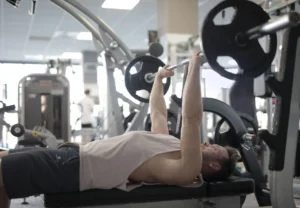
Bench Press vs. Push-Ups: Which Builds More Muscle for Women? →Track Your Push-Up Progress
Enter your current push-up count and bodyweight to see your strength level and how you compare to women’s benchmarks for your age — then track how the number changes as you train.
Use the Push-Up Calculator →Sources: [1] Yang J, et al. Association between push-up exercise capacity and future cardiovascular events among active adult men. JAMA Netw Open. 2019.