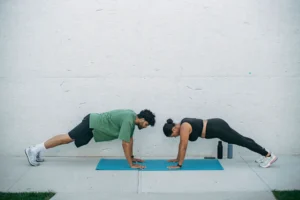
How Many Sets of Push-Ups Should I Do?
For most people, 3–5 sets per session, 2–3 times per week is the most effective push-up volume for building strength and muscle. Beginners doing 3 sets twice a week will see steady progress. Intermediate trainees doing 4–5 sets three times a week will maximise their rate of improvement. Advanced athletes doing more than 5 sets per session gain relatively little from adding more of the same exercise — they need harder progressions instead.
The more important variable than the number of sets is what happens within each set: how close to failure you work, how well you maintain form, and whether you are doing more total reps than last time. A training session of 3 sets done with genuine effort and good form consistently outperforms 6 lazy sets at 50% intensity.
Track Your Push-Up Strength
Enter your push-up count and bodyweight to see your estimated 1RM and strength level — then use that baseline to plan the right training volume.
Use the Push-Up Calculator →Sets and Reps by Goal
The right number of sets depends entirely on what you are training for. Four different goals call for four meaningfully different approaches:
| Goal | Sets per Session | Reps per Set | Frequency | Key Principle |
|---|---|---|---|---|
| Habit building / general health | 1–2 | 10–15 | Daily is fine | Consistency over intensity |
| Muscle endurance | 3–4 | 15–25 | 3–4x/week | High volume, moderate intensity |
| Muscle building (hypertrophy) | 3–5 | 8–15 | 3x/week | Near-failure sets with 48-hr recovery |
| Strength (max reps) | 4–6 | As many as possible | 2–3x/week | Progressive overload + rest |
Reps per set can range from as few as 4 to as many as 40 and still drive adaptation — what matters is that each set ends close to the point where your form would break down. Going well short of failure on every set is the most common reason push-up progress stalls.
Sets by Experience Level
Beginners (0–10 push-ups max)
Start with 2–3 sets per session, twice per week. If you cannot yet complete a full push-up, use incline push-ups or knee push-ups — the set scheme is the same. Focus entirely on form: rigid body, chest to the floor, full lockout at the top. Adding reps to broken-form sets builds nothing useful.
A simple beginner programme: 2 sets to near-failure on Monday and Thursday. Add one rep to each set per week. When you can complete 3 sets of 10 with full form, move to an intermediate approach.
Intermediate (11–25 push-ups max)
Three to four sets, three times per week. Calculate your daily volume by multiplying your maximum reps by 2–3: if your max is 20, target 40–60 push-ups per session, spread across sets. Taking sets to within 1–2 reps of failure is appropriate here. Rest 60–90 seconds between sets.
An intermediate template: Monday — 4 sets to near-failure with 2-minute rest. Wednesday — 3 sets at 80% of max with 90-second rest. Friday — 4 sets to near-failure again. Track total weekly reps and aim to beat your previous week.
Advanced (25+ push-ups max)
At this stage, standard push-up volume (more sets of the same exercise) produces diminishing returns. Five to six sets per session is the ceiling for most people before recovery becomes the limiting factor. More effective is to make the exercise harder: elevate your feet, add a weighted vest, use a narrow diamond grip, or move to deficit push-ups with handles that increase your range of motion. The set count stays at 4–6; the exercise gets harder.
| Level | Max Reps | Sets/Session | Frequency | Volume Target |
|---|---|---|---|---|
| Beginner | 0–10 | 2–3 | 2x/week | 20–40 reps/session |
| Intermediate | 11–25 | 3–4 | 3x/week | 40–80 reps/session |
| Advanced | 25+ | 4–6 | 2–3x/week | 80–150 reps/session + progressions |
Daily Push-Ups vs. Every Other Day: Which Is Better?
This is one of the most common questions in push-up training, and the answer depends on what you are actually trying to achieve.
Daily push-ups work well for: habit building, technique practice, light conditioning, and maintaining a base level of fitness. If your daily volume is modest — say, 10–20 push-ups if your max is around 25 — you are not creating enough muscular stress to require significant recovery. Daily low-intensity practice improves the motor pattern and keeps the movement ingrained, without accumulating enough fatigue to interfere with the next session.
Every-other-day training works better for: muscle growth, strength gains, and meaningful improvement in your max rep count. Muscle protein synthesis peaks in the 24 hours after an intense set and returns to baseline within 36–48 hours. Training at genuine intensity — sets within 1–2 reps of failure — requires that recovery window before your muscles are ready to adapt and respond to the next training stimulus. Training them again before they’ve recovered produces diminishing returns on that investment.
The practical rule: if a session leaves your chest and triceps noticeably fatigued or sore, wait at least 48 hours before the next push-up session. If it feels light and easy, daily practice is fine. Most people looking for real progress are better served by 3 harder sessions per week than 7 easy ones.
How Many Sets Per Week for Muscle Building?
Exercise science research on hypertrophy consistently finds that 10–20 hard sets per muscle group per week is the range that maximises muscle growth. For push-ups as the primary chest and tricep exercise, this means:
- 3 sessions × 4 sets = 12 sets/week — solid muscle-building volume
- 3 sessions × 5 sets = 15 sets/week — high end of productive volume for most people
- More than 20 sets/week — risk of junk volume (sets that are too fatigued to stimulate growth)
Below 10 sets per week, muscle gains are possible but sub-optimal. Above 20 sets per week, recovery becomes the limiting factor and additional sets stop producing additional growth for most people. The sweet spot for most intermediate trainees is 12–16 sets per week: 3–4 sessions of 4 sets each.
When to Add Sets vs. When to Make Push-Ups Harder
This is the decision most people get wrong. The instinct when push-ups start to feel easy is to do more sets. The smarter move is usually to make the push-up harder instead.
The trigger to progress the exercise, not the volume, is when you can comfortably complete your target reps with clean form and don’t feel meaningfully challenged by the final set. At that point, adding another set of the same exercise is largely wasted effort — you’ve already shown your muscles can handle the stimulus.
Progressive options in order of increasing difficulty:
- Feet elevated on a low step — increases load to about 70% bodyweight
- Feet elevated on a bench — increases load to about 75% bodyweight
- Diamond push-ups (hands close together) — increases tricep and inner chest demand
- Deficit push-ups (handles or dumbbells) — increases range of motion
- Decline push-ups with 30–45° foot elevation — heaviest standard push-up variation
- Weighted vest — adds absolute load while keeping the movement identical
Each progression step meaningfully changes the strength stimulus without requiring you to accumulate endless reps of a lighter movement.
Sample Weekly Push-Up Programmes
Beginner (building to 10 solid reps):
| Day | Session |
|---|---|
| Monday | 2 sets incline or knee push-ups, as many reps as possible with good form |
| Thursday | 2 sets incline or knee push-ups, same target as Monday + 1 rep |
Intermediate (building from 10 to 30 reps):
| Day | Session |
|---|---|
| Monday | 4 sets to near-failure, 2-min rest between sets |
| Wednesday | 3 sets at 75–80% of max reps, 90-sec rest between sets |
| Friday | 4 sets to near-failure, 2-min rest between sets |
Advanced (maintaining 30+ reps, building to harder variations):
| Day | Session |
|---|---|
| Monday | 3 sets decline or weighted push-ups (4–6 reps, heavy), then 2 sets standard push-ups to near-failure |
| Wednesday | Active recovery or lower body; no push-up work |
| Friday | Same as Monday, try to beat Monday’s reps |
| Sunday | Optional: 2–3 light sets (50% of max) for technique and frequency |
Find Your Push-Up Level
Enter your current max push-up count to see your strength level, estimated 1RM, and where you stand relative to norms for your age and sex — then use that to choose the right training volume.
Use the Push-Up Calculator →