Last updated: October 2026
The waist sounds like an obvious landmark, but the measuring point is not where most people assume. Your waist is not at your belly button. It is not at your hip bone. It is not where your jeans sit. The anatomical waist — the point used in health assessments, clothing size charts, and waist-to-hip ratio calculations — sits in a specific zone between your lowest rib and the top of your hip bone, and the exact spot within that zone depends on both which protocol you follow and what shape your body is. Getting this wrong by even an inch shifts every calculation built on top of it.
Calculate Your Waist-to-Hip Ratio
Once you’ve found the correct waist point, enter your measurements to calculate your WHR and see how it compares to WHO health thresholds.
The Two Definitions of Waist
There is no single universally agreed anatomical waist point. Two definitions are in common use, and they often land at slightly different spots on the same body:
1. The natural waist (practical definition)
The natural waist is the narrowest circumference of the torso — the point where your body visually curves inward when viewed from the front. On most people with an hourglass, pear, or inverted-triangle body shape, this is easy to find: stand relaxed, let your arms hang loosely at your sides, and look in a mirror. The narrowest point between your ribs and hips is your natural waist.
This practical definition is used by tailors, clothing brands, and most fitness contexts. For the majority of body types, it sits roughly 1–2 inches above the belly button.
2. The WHO anatomical waist (clinical definition)
The World Health Organization defines the waist measurement point as the midpoint between the bottom of the lowest palpable rib and the top of the iliac crest (the uppermost bony ridge of the hip). To find this point:
- Run your fingers down your ribcage until you reach the bottom of the lowest rib on your side — the last rib you can feel.
- Find the top of your hip bone (iliac crest) — the bony ridge you can feel on either side when you press your thumbs into your sides.
- The WHO waist point is the midpoint between these two landmarks.
On many people, this midpoint coincides closely with the natural waist. On others — particularly those with a longer torso or a tubular body shape — the two can differ by 1–2 inches.
| Definition | Location | Used by |
|---|---|---|
| Natural waist | Narrowest point of torso | Tailors, clothing brands, fitness contexts |
| WHO anatomical waist | Midpoint between lowest rib and iliac crest | Clinical health assessments, WHR research |
| Practical approximation | ~1 inch above belly button | General guidance when landmarks are hard to feel |
For health tracking and WHR calculations, the WHO protocol is the most consistent because it uses fixed bony landmarks that don’t vary with posture or muscle tension. For clothing, the natural waist is more useful.
Note that US guidance (NIH and the NHANES survey) uses a slightly different point — just above the top of the hip bone (iliac crest). Whichever method you pick, use the same one every time.
Where Your Waist Is Not
Two common measurement errors come from mistaking the waist for a nearby landmark:
Not the belly button
The belly button (navel) is a scar, not an anatomical landmark tied to waist position. Where it sits relative to the waist varies significantly between people based on height, trunk proportions, and whether the abdomen has changed shape through pregnancy, weight gain, or surgery. On most people, the waist sits 1–2 inches above the navel — but this gap is larger in taller people with longer trunks, and smaller in shorter people. Measuring at the navel consistently gives a reading below the true waist point.
Not the hip bone
The iliac crest — the top of the hip bone — is the lower boundary of the waist zone, not the waist itself. Measuring at the hip bone gives a reading that is too low and too wide on almost every body. It also confuses waist measurement with hip measurement, as discussed in more detail below.
Related Reading
How Body Type Affects Where Your Waist Is
The location of the natural waist varies more than most people expect, and the biggest driver is body shape.
Hourglass and pear shapes
The natural waist is easy to find — it corresponds to a clear inward curve. It typically sits about 1–2 inches above the belly button and coincides closely with the WHO midpoint.
Rectangle and inverted-triangle shapes
The torso may not have a pronounced inward curve. The “narrowest” point is less distinct visually. In this case, using the WHO protocol (midpoint between lowest rib and iliac crest) gives a more reliable and consistent result than trying to find a visual narrowing.
Apple shape and tubular midsection
The midsection is the widest part of the body, so there is no narrowing to measure. The WHO midpoint method becomes essential here. As a practical approximation, measuring approximately 1 inch above the belly button is commonly used when bony landmarks are difficult to palpate through abdominal fat — though it introduces more variability than the true midpoint method.
Postpartum bodies
After pregnancy, the abdomen can remain distended for months even after fat loss, and the position of abdominal structures may shift. The bony landmarks (lowest rib, iliac crest) remain reliable even when the soft tissue contours change. Use the WHO midpoint in this context.
How to Find and Measure Your Waist
Step 1: Find your lowest rib
Run your fingers down the side of your ribcage. The lowest rib is the last bony ridge you can feel before your torso softens into the abdomen. Mark this point mentally or with a piece of tape.
Step 2: Find the top of your hip bone
Press your thumbs into your sides at roughly the level of your lower abdomen until you feel a bony ridge — this is the iliac crest. It sits higher than most people expect, typically a few inches below the lowest rib.
Step 3: Find the midpoint
Estimate the halfway point between the lowest rib and the top of the hip bone. This is your WHO waist point. On most bodies it corresponds to, or sits just above, the natural narrowing of the waist.
Step 4: Measure
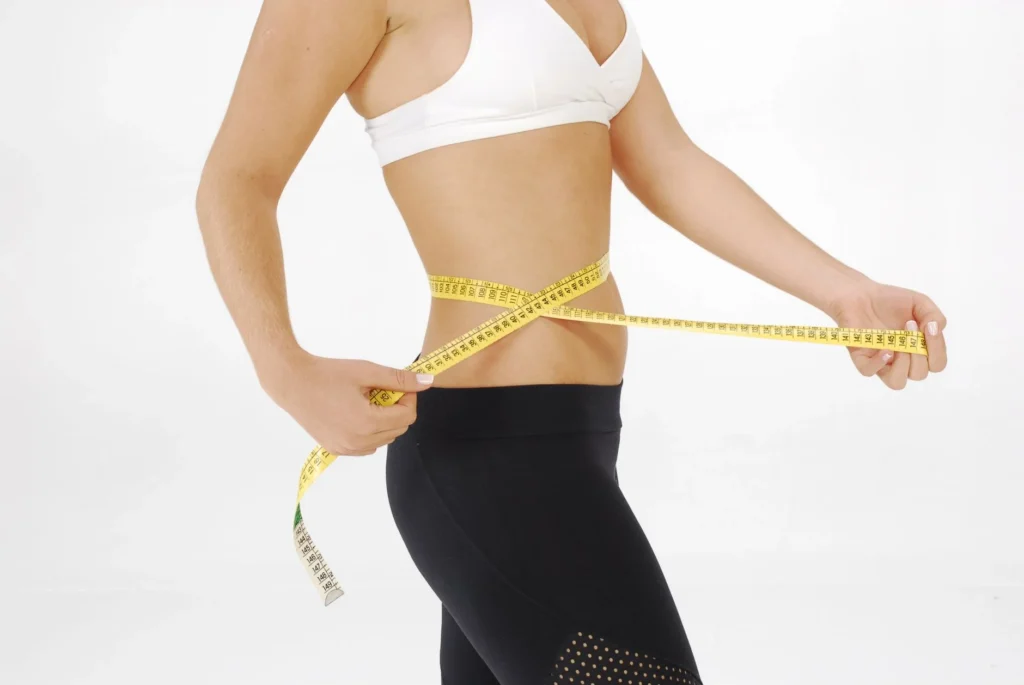
Wrap a soft tape measure around the waist at this point. Keep the tape parallel to the floor all the way around. Exhale normally before reading — don’t suck in, don’t push out. The tape should sit snug against the skin without pressing into it. Record the number and repeat once to confirm.
Keep a soft measuring tape nearby — it’s the only equipment this step requires.
Why the Correct Waist Point Matters for WHR
The waist-to-hip ratio (WHR) divides your waist circumference by your hip circumference. Because the waist is the numerator in this fraction, measuring it even 2 cm too high or too low shifts the result in ways that can misclassify health risk.
Example: A woman with true waist of 74 cm and hips of 96 cm has a WHR of 0.77 — below the WHO risk threshold of 0.85. If she measures at her belly button instead (say, 79 cm), her WHR becomes 0.82 — still below threshold but meaningfully higher. If she measures at a point 4 cm below the true waist (say, 83 cm), her WHR becomes 0.86 — now above the risk threshold, but based on an incorrect measurement.
The measurement point is not a minor technical detail. It determines what the number means.
Consistency Over Time
Whether you use the natural waist or the WHO midpoint, the most important rule for body composition tracking is to measure the same point every time. The absolute number matters less than the trend over time — and that trend is only meaningful if the measuring point stays consistent.
A useful trick: use a permanent marker or body tape to mark your waist point the first time you measure, then take a photo so you can replicate the position at future measurements. For ongoing tracking, measure at the same time of day (morning, before eating) and under the same conditions to minimise variation from fluid retention and digestion.
Related Reading
Attractive Waist to Hip Ratio: What Research Actually Shows →
Calculate Your Waist-to-Hip Ratio
Enter your waist and hip measurements to get your WHR and compare it against WHO health benchmarks — takes under a minute.