Last updated: September 2026
What percentage of women can do a pull-up? The number you’ll see everywhere is 1–5% of untrained women. That figure is an estimate, though. No study has tested a representative sample of women to measure it. The research that does exist tells a more useful story: untrained women rarely manage a strict pull-up, but with focused training, a meaningful share get there, and what predicts success is measurable.
How Far Are You From Your First Pull-Up?
Use the pull-up calculator to estimate your pulling strength and track it as you build toward your first strict rep. Band-assisted performance counts too.
Use the Pull-Up Calculator →What Percentage of Women Can Do a Pull-Up? What the Data Shows
| Source | Who was tested | What they found |
|---|---|---|
| The widely quoted “1–5%” | Untrained adult women | An estimate repeated online and in the media, not a measured result |
| Flanagan et al., University of Dayton (2003) [1] | 17 college-age women who couldn’t do a pull-up, 3-month strength and conditioning programme | 4 of 17 (about 24%) could do a pull-up at the end |
| US Marine Corps, 2013 [2] | Female recruits at Parris Island during a pull-up training trial | 55% couldn’t do 3 pull-ups, so about 45% could |
Put together, the picture is consistent. Among women who’ve never trained for it, a strict pull-up from a dead hang is uncommon, so single-digit percentages are plausible. With deliberate training, the share rises substantially, but a few months isn’t enough for everyone. The Marine Corps delayed its planned pull-up requirement for women in 2014 after the trial results. It later replaced the flexed-arm hang with pull-ups in the women’s fitness test [3].
That’s why being able to do even one strict pull-up puts you in a small group. It’s also why “I can’t do one yet” is the normal starting point, not a sign that you can’t.
Why Pull-Ups Are Harder for Women
Pull-ups are hard for most untrained people. Several average differences make them harder for women:
- Less of the body’s muscle is in the upper body. In a study of 468 adults, women had about 40% less upper-body skeletal muscle than men, compared with about 33% less in the lower body [4]. The lats, biceps and upper back that drive a pull-up are exactly where the gap is widest.
- Upper-body strength differs more than lower-body strength. In a classic strength study, women were on average about 52% as strong as men in the upper body but 66% as strong in the lower body [5].
- Higher body fat on average. Women naturally carry more essential and stored fat than men. In a pull-up you lift your whole bodyweight, so more non-contracting mass means more load for the same pulling muscles.
- Less pulling practice. Many women’s training has historically focused on the lower body, cardio and core, with little rowing or overhead pulling. That’s a training gap, not a fixed limit.
These are population averages, not rules. Plenty of trained women do more pull-ups than the average man. What matters for you is your own strength relative to your bodyweight, and that can be trained.
What Predicts Whether You’ll Get Your First Pull-Up
The Dayton study went further than counting who succeeded. Over the 3 months, participants gained upper-body strength and lean mass and lost body fat. The women who could do a pull-up by the end had greater one-rep-max strength and higher strength relative to their body mass and their lean (fat-free) mass. The researchers’ prediction equation used just two measures: body fat percentage and strength relative to lean mass [1].
That gives you two practical levers:
- Get stronger relative to your lean mass: progressive pulling work (lat pulldowns, rows, negatives, assisted pull-ups) done consistently.
- Reduce body fat if you have fat to lose: less mass to lift makes the same strength go further.
You don’t need both. Strength alone gets many women there. But if you’re close and stuck, the second lever often makes the difference.
How Many Pull-Ups Is Good for a Woman?
One strict rep is already an achievement most women never reach. By our standards for women aged 18–39, 2–6 strict reps is intermediate and 8 or more is advanced. For the full breakdown by level and age, see our pull-up standards.
How to Get Your First Pull-Up as a Woman
The approach is the same as for anyone starting from zero. Expect it to take months rather than weeks, and that’s normal.
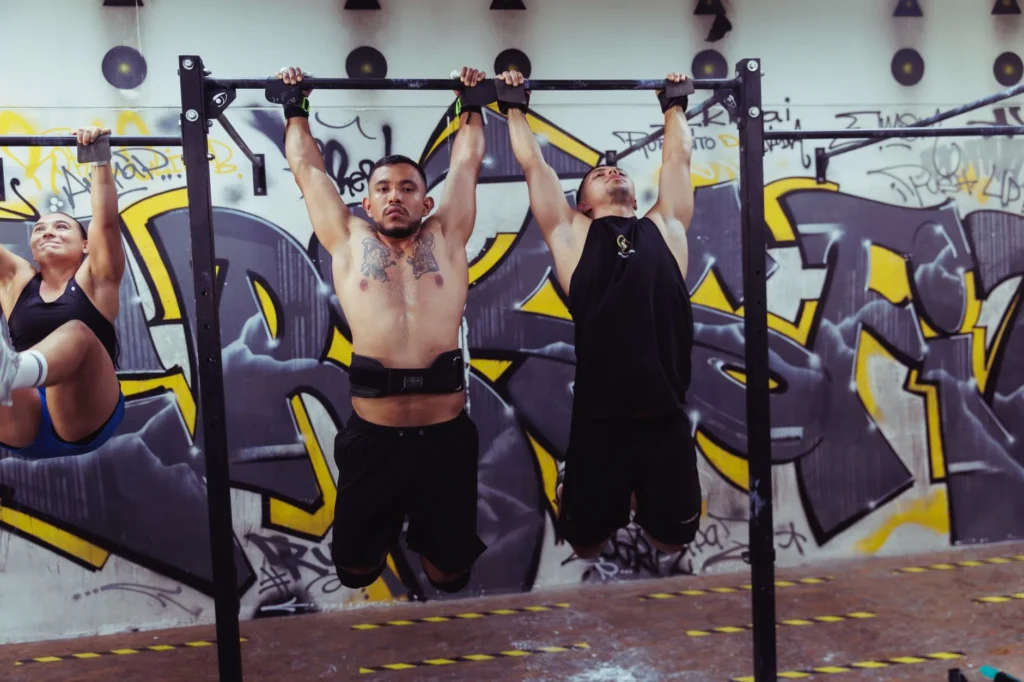
Step 1: Build the dead hang. Hang from a bar with a shoulder-width, overhand grip for as long as you can. This builds grip, shoulder stability and comfort on the bar. Work toward 30-second holds, three times a week. If you don’t have access to a gym, a pull-up bar at home makes it easy to fit these sessions in.
Step 2: Add negative pull-ups. Step or jump to the top position with your chin over the bar, then lower yourself as slowly as you can, aiming for 3–5 seconds. Do 3 sets of 3–5 negatives twice a week. As the descent gets slower and more controlled, your strength is improving.
Step 3: Band-assisted pull-ups and lat pulldowns. Loop a resistance band over the bar and put a knee or foot in it, or use an assisted pull-up machine. Do 3 sets of 5–8 reps, moving to lighter assistance over time. Add lat pulldowns and rows to build pulling strength between sessions.
Step 4: Test and practise the full rep. Start each pull-up session with one attempt at a full rep before your negatives. Getting a few inches off the bottom is real progress. Many women find a chin-up (palms facing you) comes first, because it uses more of the biceps. It’s a good intermediate goal.
How long does it take? It varies widely. In the Dayton study, three months of training was enough for about a quarter of women who started at zero. Others need longer, especially if they’re starting with little upper-body training or have fat to lose. Consistency over several months matters more than any single programme.
Related Reading
Pull-Up vs Chin-Up: Which Is Easier for Beginners? →Related Reading
How Many Pull-Ups a Day? Training Volume and Frequency Plans →Frequently Asked Questions
Can the average woman do a pull-up?
Usually not without specific training. The common estimate is that only 1–5% of untrained women can do a strict pull-up, though no study has measured this directly in the general population. With consistent training the share rises considerably. In one university study, about a quarter of women who started at zero succeeded after three months.
Why are pull-ups harder for women?
On average, women carry less of their muscle in the upper body (about 40% less upper-body muscle than men in one large study) and more body fat, so there’s less pulling muscle for each pound being lifted. These are averages, not limits. Strength relative to bodyweight can be trained, and many women become very good at pull-ups.
How long does it take a woman to get her first pull-up?
Typically several months of consistent training, and it varies widely. In a University of Dayton study, three months was enough for about a quarter of women starting from zero. Starting strength, body fat and training consistency make the biggest difference. Negatives, band-assisted reps and lat pulldowns two to three times a week work well.
How many pull-ups is impressive for a woman?
Even one strict pull-up is impressive, since most women can’t do one without training. By our standards for women aged 18–39, 2–6 strict reps is intermediate and 8 or more is advanced. Reps should be from a dead hang, chin over the bar, without kipping, to count toward these benchmarks.
Is a chin-up easier than a pull-up for women?
For most people, yes. A chin-up uses an underhand grip that brings in more of the biceps, so many women manage a chin-up before a pull-up. It’s a useful stepping stone: train both, count your first chin-up as progress, and keep practising the overhand pull-up alongside it.
Track Every Rep on the Way to Your First Pull-Up
Even with band assistance, you can use the pull-up calculator to estimate your strength and watch it climb toward a bodyweight rep.
Use the Pull-Up Calculator →Sources: [1] Flanagan SP, Vanderburgh PM, Borchers SG, Kohstall CD. Training college-age women to perform the pull-up exercise. Res Q Exerc Sport. 2003;74:52–59. [2] Military.com. Marine Corps delays pull-up requirement for women. January 2014. [3] Arnold B, et al. Trends in upper extremity injuries in female Marines following the addition of the pull-up as a physical fitness test event. Mil Med. 2026. [4] Janssen I, et al. Skeletal muscle mass and distribution in 468 men and women aged 18–88 yr. J Appl Physiol. 2000. [5] Miller AE, et al. Gender differences in strength and muscle fiber characteristics. Eur J Appl Physiol. 1993.