Last updated: October 2026
Most workout soreness guides assume you have DOMS. They give you eight recovery tips and send you on your way. The problem: not all workout pain is DOMS. Back pain during ab exercises, wrist pain during pressing, and arm stiffness after bicep training are three different things with three different causes — and three different fixes.
This guide helps you identify which type of workout pain you’re dealing with, explains what’s causing it, and gives you the specific fix for each.
Step One: Identify Your Pain Type
| Pain Type | When It Starts | Where You Feel It | What It Means |
|---|---|---|---|
| DOMS (muscle soreness) | 12–48 hours after workout | The muscles you trained | Normal — muscles rebuilding |
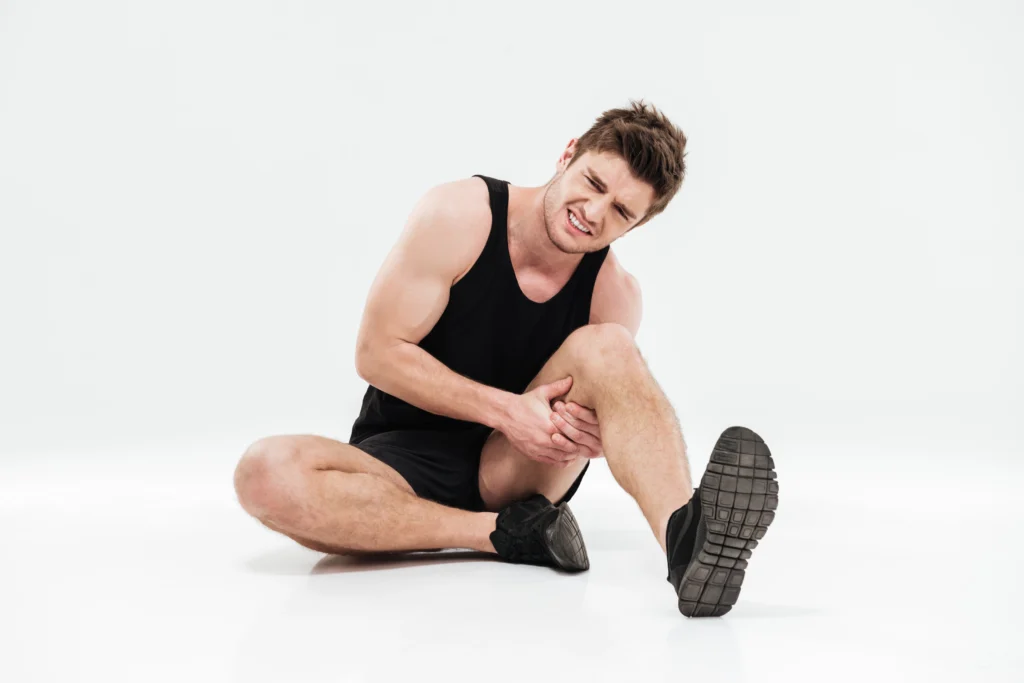
| Technique-related pain | During the exercise | Back, neck, or joints — not the target muscle | Form problem — fixable |
| Overuse or injury pain | During or immediately after | Joints or tendons (wrist, elbow, knee) | Overuse or injury — needs rest |
| Warning sign | During or after — severe | Sharp, does not improve with rest | See a doctor |
Type 1: DOMS — Normal Muscle Soreness
Delayed onset muscle soreness (DOMS) is the ache and stiffness you feel in a muscle you’ve trained hard — typically 12–48 hours after your session. It is the most common type of post-workout pain and the only one that is expected and normal.
Why It Happens
When you train — particularly with unfamiliar movements or higher intensity than usual — you create microscopic tears in your muscle fibres. Your body responds with inflammation, sends blood and nutrients to the area, and begins repair. DOMS is the sensation of that inflammatory response. Soreness itself isn’t required for progress — you can build muscle without getting very sore.
Eccentric movements cause the most DOMS. These are exercises where a muscle resists a load while lengthening:
- The lowering phase of a bicep curl or pull-up
- The descent in a squat or lunge
- Running or walking downhill
- The lowering phase of a Romanian deadlift
Why Can’t I Straighten My Arm After a Workout?
If you can’t fully straighten your arm after a bicep or triceps session, that’s DOMS from eccentric loading — the lowering phase of curls, presses, and pull-ups causes the most micro-tears in the muscle fibres you just trained. The same thing happens to your legs after a hard leg day: stiffness that limits full extension is your body doing exactly what it should, and it typically eases within 24–72 hours (see the timeline below).
How Long Does It Last?
- 12–24 hours: Soreness starts to develop
- 24–72 hours: Peak soreness — usually worst around 48 hours
- 3–5 days: Gradual improvement back to normal
If soreness is still worsening after 5 days or has not resolved within 7, it is no longer DOMS — see a healthcare provider.
How to Recover
- Light movement: Short walks or easy swimming on rest days keep blood circulating and reduce stiffness. Light movement often eases stiffness, even if it doesn’t speed up the underlying repair.
- Foam rolling: Apply sustained pressure to sore areas for 10–15 minutes. Research shows it can modestly reduce how sore you feel [2]. A foam roller is inexpensive and works for this on any sore muscle group.
- Cold then heat: In the first 48 hours, cold (ice pack, cold bath) can ease pain; after that, heat can help loosen stiffness. If you’re training to build muscle, avoid regular cold baths straight after lifting — they can blunt the muscle-building response.
- Protein: Muscle repair requires protein. Aim for 1.6–2.2g per kg of bodyweight daily when training regularly.
- Hydration: Dehydration intensifies soreness and slows recovery. Drink water consistently across the day.
- Sleep: Muscle repair happens primarily during sleep. Consistently poor sleep means consistently worse recovery.
Should You Train Through DOMS?
It depends on severity. If soreness is mild — a 1–3 out of 10 — training is fine, though you should reduce intensity. Above a 5, train a different muscle group and let the sore one recover. If pain increases during a warm-up rather than fading, stop the session.
Related Reading
How Often Should I Workout to Build Muscle? →Does a Sauna Help After a Workout?
Heat exposure is a legitimate recovery tool, but timing and hydration matter more than most people realize.
What It Actually Does
Sauna use raises core and muscle temperature, which increases blood flow to the muscles you just trained — similar in effect to the “heat” half of the cold-then-heat protocol above. Regular sauna use is also linked to increased production of heat shock proteins, which play a role in cellular repair and may modestly support recovery and even cardiovascular adaptation over time.
Timing: When to Use It
There’s no strong evidence that a sauna after lifting blunts muscle growth — the research showing blunted growth signals after training involves cold-water immersion, not heat [1]. If you feel drained after a hard session, a sauna on a rest day or several hours after training is a comfortable option.
How to Do It Safely
- Rehydrate first. You’re already down fluids from training; adding heat exposure on top of a dehydrated state is how people end up lightheaded or nauseous.
- 15–20 minutes at a time is a standard, well-tolerated session length — longer isn’t automatically better.
- Leave if you feel dizzy, nauseous, or your heart is racing. These are signs you’re overheating, not signs you should push through.
- Skip it after a very intense or fasted session until you’ve eaten and rehydrated properly — that combination is where most sauna-related incidents happen.
Type 2: Back Pain During Ab Workouts — A Technique Problem
If your lower back hurts during or immediately after ab exercises — not 24–48 hours later, but right then — this is not DOMS. It is a form or muscle imbalance issue, and treating it like soreness will not fix it.
Why It Happens
The most common cause: the wrong muscles are doing the work. During sit-ups, leg raises, and crunches, the lower back and hip flexors can take over if the core is not properly engaged. When that happens, the lumbar spine absorbs forces it is not designed to handle.
Specific causes:
- Hip flexor dominance: If your hip flexors are stronger than your abs, they take over in ab exercises and the back compensates.
- Loss of neutral spine: Letting the lower back arch off the floor during leg raises or dead bugs shifts load onto the lumbar spine.
- Moving too fast: Momentum replaces muscle control. The lower back loads rather than the abs.
- Overextending the range of motion: Extending legs or torso further than your core stability allows shifts load directly onto the spine.
The Fix: Exercises That Build Core Without Loading the Back
- Plank: Body in a straight line from shoulders to heels, core braced. Hold 20–30 seconds. Progress by increasing hold time before adding any movement or weight.
- Dead bug: On your back, extend opposite arm and leg while maintaining full lower back contact with the floor. The moment your back arches, you’ve gone too far.
- Bird dog: On all fours, extend opposite arm and leg. Builds stability across the entire core without spinal compression.
- Glute bridge: Strengthens glutes and hamstrings — essential for reducing hip flexor dominance during ab work.
For your existing exercises: slow the pace, reduce the range of motion, and focus on feeling the abs contract before initiating any movement. If your lower back still loads, the exercise is too advanced for your current core strength — regress until it isn’t.
When to See a Doctor
See a healthcare provider if you have sharp or localised lower back pain, pain that radiates down one or both legs, or pain that persists after rest and technique correction.
Type 3: Wrist Pain During Lifting — Overuse and Technique
Wrist pain during exercise is not DOMS and should not be trained through. It signals either a technique problem, cumulative overuse, or an underlying condition — all of which have different solutions.
Common Causes
- Overuse from repetitive movement: Repeated wrist extension under load — push-ups, front squats, overhead press — creates cumulative stress on the wrist joint and surrounding tendons.
- Bent wrist position under load: Wrists that bend back during pressing movements force the joint to absorb force rather than transmitting it through the forearm. This is the single most common cause of lifting-related wrist pain.
- Grip or wrist weakness: When grip strength fails before the target muscle does, the wrist compensates — particularly under heavy loads.
- Underlying conditions: Carpal tunnel syndrome, tendonitis, and arthritis all worsen during physical activity. If wrist pain is present outside the gym as well, medical assessment is necessary.
The Fix
- Maintain a neutral wrist: During pressing movements, your wrist should be in line with your forearm — not bent back. This is the most important correction and often resolves pain immediately.
- Use wrist wraps for heavy lifting: External support keeps the wrist neutral under load and reduces cumulative joint stress.
- Reduce load if wrists are fatiguing first: If your wrists or grip are failing before the target muscle, the load is too heavy for your current wrist strength.
- Build wrist strength directly: Wrist curls, wrist extensions, and grip exercises strengthen the muscles that protect the joint during training.
- Warm up the wrists: Gentle rotations and stretches before pressing or pulling sessions. Cold, unstretched wrists under load are significantly more injury-prone.
When to See a Doctor
See a healthcare provider if pain is persistent outside of training, if you have swelling or bruising around the wrist, if there is limited range of motion that does not improve with rest, or if pain appeared suddenly after a fall or impact.
Warning Signs: When Workout Pain Needs Medical Attention
Most workout pain is harmless. These are the exceptions.
Rhabdomyolysis
Rhabdomyolysis (“rhabdo”) is a rare but serious condition where severe muscle breakdown releases muscle proteins into the bloodstream — mainly myoglobin, which can damage the kidneys. Doctors diagnose it by measuring creatine kinase (CK), an enzyme that leaks from damaged muscle. It typically occurs when someone pushes far beyond their current fitness capacity — usually by jumping into extreme exercise without building up to it gradually.
Signs that distinguish rhabdo from normal DOMS:
- Dark, tea-coloured urine — the most reliable indicator
- Severe swelling around muscles disproportionate to the workout
- Soreness that is getting worse, not better, after 72 hours
- Inability to urinate for an extended period
If you have dark urine after a workout, go to the emergency room that day. Do not wait for it to improve.
Other Warning Signs
- Sharp, acute pain during exercise — stop immediately
- Pain radiating down one leg or arm
- Significant swelling or bruising around a joint
- Inability to bear weight or move a limb normally after rest
- Soreness not improving after 7 days
How to Reduce Workout Soreness Over Time
The most effective way to minimise soreness is progressive overload done at the right pace. Your muscles adapt to training stress over time — which means each session should build on the last without leaping ahead of what your recovery can handle.
- Never increase load and volume at the same time: Add weight while keeping sets and reps the same, or add volume while keeping load the same. Not both simultaneously.
- Introduce new exercises gradually: Unfamiliar movements cause the most DOMS. Start with less volume than you think you need.
- Warm up every session: 5–10 minutes of light cardio followed by dynamic stretching of the muscles you’re about to train.
- Cool down and stretch: Static stretching after training — while muscles are warm — can improve flexibility, though it doesn’t meaningfully reduce soreness [3].
- Protect your sleep: Most muscle repair happens during sleep. Consistently poor sleep means consistently slower recovery and worse results.
If your goal is building muscle while managing soreness and recovery effectively, understanding your body recomposition targets helps you set the right training intensity without tipping into overtraining:
Set your body recomposition targets
Build muscle and manage body fat with targets matched to your training capacity and recovery ability.
Calculate your body recomposition targets →The Bottom Line
DOMS — the delayed soreness that peaks 24–72 hours after a hard session — is normal, harmless, and a sign your muscles are adapting. Manage it with light movement, foam rolling, hydration, protein, and sleep. It resolves on its own within 3–5 days.
Back pain during ab exercises and wrist pain during lifting are different problems. Both are usually technique or overuse issues that rest alone will not fix — they need form correction or load management.
Use the diagnostic table at the top to identify which type of pain you have. Apply the right fix. If pain is severe, not improving, or accompanied by dark urine or significant swelling, see a healthcare provider.
Sources: [1] Roberts LA, et al. Post-exercise cold water immersion attenuates acute anabolic signalling and long-term adaptations in muscle to strength training. J Physiol. 2015. [2] Wiewelhove T, et al. A meta-analysis of the effects of foam rolling on performance and recovery. Front Physiol. 2019. [3] Herbert RD, et al. Stretching to prevent or reduce muscle soreness after exercise. Cochrane Database Syst Rev. 2011.