Last updated: October 2026 | By Dennis Kiplimo
Most guides will tell you to do 3 sets of 12–15 squats and call it a day. That advice isn’t wrong — but it’s incomplete. The daily rep count is almost the wrong question. What actually determines whether squats produce results is your weekly volume: how many total sets you’re doing across the week, whether you’re recovering between sessions, and whether the load is progressing over time.
This guide answers the daily question directly — with specific numbers by goal — then gives you the framework underneath it that most squat guides skip entirely.
How Many Squats Per Day: The Direct Answer by Goal
| Goal | Sets per session | Reps per set | Sessions per week |
|---|---|---|---|
| General fitness / health | 2–3 | 10–15 | 2–3 |
| Build muscle (hypertrophy) | 3–5 | 6–10 | 2–3 |
| Strength | 3–5 | 3–6 | 2–3 |
| Glute development | 3–4 | 10–15 | 2–3 |
| Beginners (form focus) | 2–3 | 8–12 | 2–3 |
These are working sets — sets taken close to failure with controlled form. Warm-up sets don’t count.
One thing all of these have in common: none of them recommend squatting every day. Your muscles grow during recovery, not during the session itself. Squatting daily without adequate recovery produces fatigue, not results.
What Muscles Do Squats Work?
Squats are a compound movement — they recruit multiple muscle groups simultaneously, which is why they’re one of the most efficient lower body exercises available.
- Quadriceps: The primary mover in the squat. The quads extend the knee as you drive up from the bottom position.
- Glutes (gluteus maximus and medius): Drive hip extension from the bottom of the squat. Deeper squats recruit the glutes more effectively than shallow squats.
- Hamstrings: Work as stabilisers throughout the movement and assist hip extension at the top.
- Calves: Help stabilise the ankle joint throughout the squat, particularly important for maintaining heel contact with the floor.
- Core (erector spinae, rectus abdominis, obliques): Brace to maintain spinal stability under load. This core demand increases significantly with loaded squat variations.
- Adductors (inner thighs): Assist with stabilisation and are more directly recruited in wider-stance variations like the sumo squat.
Variation selection shifts emphasis between these muscle groups. Wider stances increase glute and adductor activity, while quad activity stays about the same across stance widths [1]. Bulgarian split squats isolate each leg and intensify glute activation.
Benefits of Squats
Beyond the obvious lower body strength gains, squats offer a range of benefits that make them one of the most valuable exercises in any programme:
- Functional strength: Squats mirror everyday movements — sitting down, standing up, picking things off the floor. Building strength in this pattern directly improves daily physical capability.
- Bone density: Loaded squats create mechanical stress on the femur and spine that signals the body to deposit more bone mineral. In one trial, supervised heavy squats and deadlifts improved bone density in postmenopausal women with low bone mass [2], which makes this especially relevant for women.
- Calorie burn: Squats recruit some of the largest muscles in the body. A loaded squat session burns significantly more calories than isolation work targeting the same muscle area.
- Balance and stability: Squats train the muscles responsible for knee and hip stability, which directly reduces injury risk in sport and daily movement.
- Blood sugar regulation: The quadriceps, glutes, and hamstrings are among the largest muscles in the body. Training them uses glucose from the bloodstream, and a single session can improve insulin sensitivity for up to a day or two afterwards.
100 Squats a Day: What Actually Happens
The 100 squats a day challenge is one of the most popular fitness challenges online — and one of the most misunderstood. Here’s an honest breakdown of what you can expect.
Week 1–2: Your body adapts quickly
In the first one to two weeks, 100 daily bodyweight squats will produce noticeable soreness, improved movement pattern, and some initial strength gains. Your body is learning the movement and adapting to the new stimulus. For complete beginners, this phase produces real results.
Week 3–4: Plateau sets in
Within a few weeks, many people find 100 bodyweight squats easy. The soreness disappears, the movement feels effortless — and that’s the problem. Your muscles have fully adapted to the load. Bodyweight squats stop producing a hypertrophy stimulus once your body can do them without significant effort. You’re now building cardiovascular endurance, not muscle or strength.
Is 100 squats a day enough to see results?
For complete beginners: yes, for the first 4–6 weeks. For anyone with 2+ months of training history: no. The load is too low. Muscle growth requires progressive overload — increasing the stimulus over time. Doing the same 100 bodyweight squats every day gives your body no reason to keep adapting after the initial adjustment.
Will 100 squats a day grow your glutes?
Marginally, for beginners. The glutes respond to load and depth — deeper squats with progressive resistance produce significantly more glute growth than high-rep bodyweight work. If glute development is your goal, 3–4 sets of loaded squats (goblet squats, barbell squats, or Bulgarian split squats) 2–3 times per week will outperform 100 daily bodyweight squats within 6 weeks.
100 squats a day before and after: realistic expectations
Most people who complete a 100-squats-a-day challenge for 30 days report improved endurance, some visible muscle tone (particularly for beginners), and better movement quality. They do not report dramatic increases in muscle size or glute shape — because bodyweight volume alone cannot drive that adaptation. The before-and-after photos that circulate online typically involve people who were also eating in a calorie deficit and doing other training.
The verdict on 100 squats a day
It’s a useful habit-building tool and a reasonable starting point for complete beginners. It is not an effective muscle-building or strength programme for anyone beyond the first month of training. If you want to continue progressing after the initial challenge, the next step is adding load — not adding more reps.
Can You Do Squats Every Day?
The answer depends entirely on what kind of squatting you’re talking about.
Bodyweight squats daily: Technically possible. Your body can recover from unloaded squats in 24 hours for most people. The issue isn’t injury risk — it’s diminishing returns. Once your body adapts to daily bodyweight squats, they stop producing a training stimulus. You’re maintaining, not progressing.
Loaded squats (goblet, barbell, weighted) daily: Not recommended. Loaded squat variations place significant mechanical stress on the quads, glutes, hamstrings, and spine. Muscle protein synthesis — the process that actually builds muscle — stays elevated for roughly a day or two after a hard session [3]. Squatting heavy every day without managing the load tends to pile up fatigue faster than you recover from it, which is why most people progress best on 2–3 loaded sessions a week.
Functional daily squats: You already do these. Sitting down, standing up, loading a dishwasher — these all use the squat pattern and are perfectly fine every day. They don’t count as training.
The practical answer: Squat 2–3 times per week with load, allow 48 hours between sessions, and progress the weight over time. That structure produces more results than daily squatting at the same bodyweight load.
Why Weekly Volume Matters More Than Daily Rep Count
Here’s what most squat guides miss: two people can both do “50 squats a day” and get completely different results.
Person A does 50 bodyweight squats every single day — same weight, same reps, no progression, no recovery days.
Person B does 3 sets of 8 loaded squats three times a week — 72 reps total per week, with recovery between sessions, and adds weight every 1–2 weeks.
Person B will build significantly more muscle and strength. Not because they did more reps — they did fewer. Because they applied the principles that actually drive adaptation: adequate load, sufficient recovery, and progressive overload.
The research on hypertrophy training consistently points to 10–20 working sets per muscle group per week as the effective range for most people. For squats specifically — targeting quads, glutes, and hamstrings — that means 10–20 sets per week split across 2–3 sessions, not crammed into one daily bout.
Use the training volume calculator to check your current weekly squat volume and see where you stand:
Check your weekly squat volume
See if your current sets per week put you in the effective range for your goal.
How to Keep Making Progress: Progressive Overload
Doing the same number of squats with the same weight every session is the most common reason people stop seeing results. Your body adapts to a stimulus — once it has, you need to increase the demand to keep progressing.
There are three ways to apply progressive overload to squats:
- Increase weight: Add 2.5–5 kg when you can complete all sets with clean form for 2 consecutive sessions
- Increase reps: Work toward the top of your rep range before adding weight
- Increase sets: Add a working set once you’ve maxed out reps at a given weight
For loaded squats, 70–80% of your one rep max is a practical working range. Muscle growth is similar across a wide range of loads as long as sets are taken close to failure [4]. Use the 1RM calculator to establish your baseline and set precise working weights:
Find your squat working weight
Use your 1RM to set a precise load that keeps you in the hypertrophy range.
Squats also burn a significant number of calories — particularly loaded variations that recruit the quads, glutes, hamstrings, and core simultaneously. If fat loss is part of your goal, use the calorie calculator to estimate your session expenditure:
Estimate calories burned during your squat session
See your session calorie expenditure based on duration and bodyweight.
The Main Squat Variations
Different squat variations shift the emphasis across muscle groups. You don’t need all of them — pick 1–2 per session based on your equipment and goal.
1. Bodyweight Squat
The foundation. No equipment, full range of motion. Best for beginners building technique or as a warm-up for loaded sessions.
- Feet shoulder-width apart, toes slightly out
- Push hips back and down, chest up, spine neutral
- Thighs parallel to floor at the bottom, then drive through heels to stand
Use it for: Form practice, warm-ups, high-rep conditioning work.
2. Barbell Back Squat
The most effective squat variation for building overall lower body strength and muscle. Allows the heaviest loading, making it the best vehicle for progressive overload.
- Bar across upper back (not neck), even grip slightly wider than shoulders
- Descent initiated by pushing hips back, knees tracking over toes
- Hips below parallel at the bottom, drive through heels to stand
Use it for: Strength and hypertrophy as your primary squat movement.
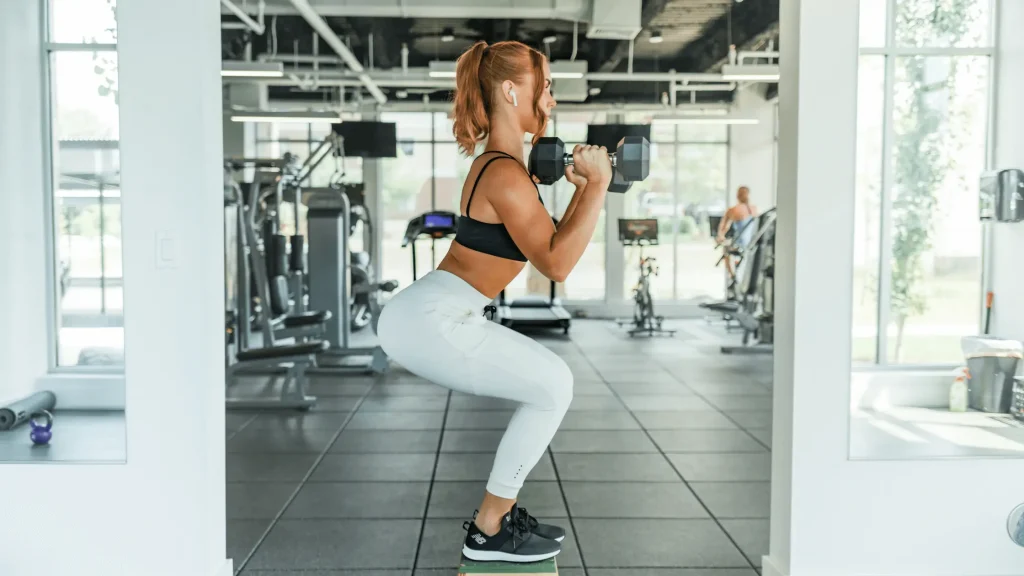
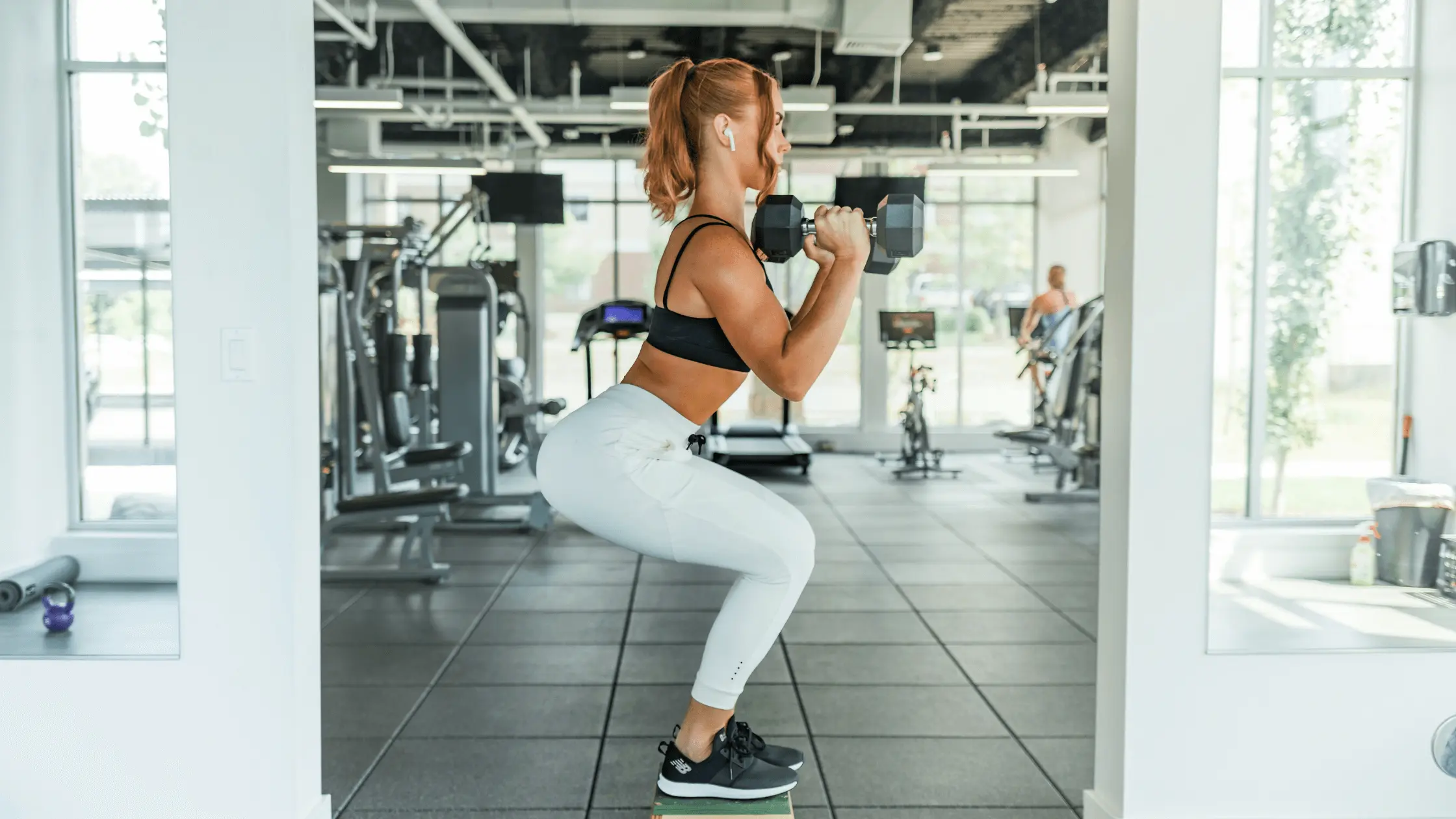
3. Goblet Squat
A dumbbell or kettlebell held at the chest counterbalances your weight and makes it easier to maintain an upright torso. Excellent for beginners transitioning to loaded squats and for targeting the quads with more direct emphasis.
- Hold dumbbell vertically at chest height with both hands
- Feet slightly wider than shoulder-width, toes out
- Elbows come between knees at the bottom — use them to push knees out
Use it for: Learning loaded squat mechanics, quad emphasis, higher rep accessory work.
4. Sumo Squat
A wider stance with toes angled significantly outward shifts emphasis from quads toward the inner thighs (adductors) and glutes. Useful for adding variety and targeting glutes more directly.
- Feet wider than shoulder-width, toes pointing 45 degrees out
- Lower straight down, keeping chest up and knees tracking over toes
- Drive through heels and squeeze glutes at the top
Use it for: Glute and inner thigh development as a secondary movement.
5. Bulgarian Split Squat
Rear foot elevated on a bench, all the load on the front leg. One of the most effective squat variations for glute and quad hypertrophy because it isolates each leg and removes the ability to compensate with the stronger side.
- Stand about 60–90 cm in front of a bench, rear foot resting on top
- Lower the rear knee toward the floor, keeping the front shin vertical
- Drive through the front heel to return to standing
- Complete all reps on one side before switching
Use it for: Addressing strength imbalances between legs, glute and quad hypertrophy with less spinal loading than barbell squats.
6. Jump Squat
A plyometric variation that develops explosive power in the quads and glutes. Best performed at the start of a session when fully fresh — never at the end when fatigued, as form breakdown increases injury risk.
- Descend into a squat position, then drive explosively through the heels
- Leave the ground at the top of the movement
- Land softly with bent knees to absorb the impact, immediately transitioning into the next rep
Use it for: Athletic power development, conditioning finishers, adding intensity without adding load.
How Many Squats Should You Be Able to Do? (Benchmarks by Age)
If you want to know how your squat capacity compares to others your age, the tables below give rough benchmarks for max bodyweight squat reps. They are general fitness-test guides rather than a validated scientific standard, so treat them as a ballpark. These are reps performed to failure with good form — not a daily target, but a useful reference point for where you stand.
Men — Squat Benchmarks by Age
| Age group | Below average | Average | Above average |
|---|---|---|---|
| 18–25 | Below 35 | 35–43 | 44–49+ |
| 26–35 | Below 31 | 31–39 | 40–45+ |
| 36–45 | Below 27 | 27–34 | 35–41+ |
| 46–55 | Below 22 | 22–28 | 29–35+ |
| 56–65 | Below 18 | 18–24 | 25–31+ |
| 65+ | Below 16 | 16–21 | 22–28+ |
Women — Squat Benchmarks by Age
| Age group | Below average | Average | Above average |
|---|---|---|---|
| 18–25 | Below 29 | 29–36 | 37–43+ |
| 26–35 | Below 25 | 25–32 | 33–39+ |
| 36–45 | Below 20 | 20–26 | 27–33+ |
| 46–55 | Below 16 | 16–21 | 22–27+ |
| 56–65 | Below 13 | 13–17 | 18–24+ |
| 65+ | Below 12 | 12–16 | 17–23+ |
These benchmarks decline with age because leg strength, mobility, and neuromuscular coordination naturally decrease over time — but the good news is that regular squatting slows that decline significantly. If you’re below average for your age group, 2–3 sessions of squatting per week with progressive load will move most people into the average range within a few months.
Form matters as much as reps. A squat only counts if the thighs reach parallel and the movement is controlled on the way down. Half-reps inflate the number but don’t reflect actual strength.
Common Squat Mistakes That Kill Progress
Squatting every day without progression — Volume without progressive overload produces fatigue, not adaptation. If you’re not adding load or reps over time, daily squats will plateau quickly.
Butt wink — Pelvis tucking under at the bottom places strain on the lower back. Usually caused by limited hip mobility or going deeper than your current mobility allows. Fix depth before adding load.
Heels rising — Indicates tight ankle mobility. Use a small heel elevation (weight plate under heels) as a temporary fix while working on ankle mobility separately.
Knees caving inward — Often a glute weakness issue. Consciously cue knees to track over toes throughout the movement. A resistance band above the knees during warm-up sets can help reinforce the pattern.
Not going deep enough — Stopping well above parallel significantly reduces glute activation. In a 10-week study, full squats grew the glutes more than half squats [5]. Develop the mobility to hit parallel before adding heavy load.
FAQ
How many squats should I do a day as a beginner?
Beginners should start with 2–3 sets of 8–12 bodyweight squats, 2–3 times per week. That’s 16–36 squats per session. Focus entirely on technique — consistent depth, neutral spine, knees tracking over toes — before adding any load. After 4–6 weeks of consistent form, introduce a goblet squat with a light dumbbell.
How many sets of squats should I do?
For most goals, 3–5 working sets per session is the effective range. Beginners do well with 2–3 sets. Intermediate and advanced lifters targeting hypertrophy should aim for 3–5 sets per variation, with 10–20 total working sets for the quads and glutes spread across the week. Going beyond 5 sets per exercise in a single session often produces more fatigue than additional growth stimulus.
How many squats a day to lose weight?
Weight loss is driven by calorie deficit, not squat count. Squats support fat loss by burning calories during the session and increasing muscle mass, which raises your resting metabolic rate. 3–4 sets of 10–15 squats, 3 times per week, combined with a calorie deficit, will produce better fat loss results than daily high-rep bodyweight squats alone.
How many squats a day to grow glutes?
For glute development specifically, 3–4 sets of 10–15 reps, 2–3 times per week, using variations that emphasise the glutes — Bulgarian split squats, sumo squats, and deep goblet squats — will outperform any number of daily bodyweight squats. The glutes are a large, powerful muscle that responds to load and full range of motion, not to high-rep light work. Go below parallel on every rep and add load progressively every 1–2 weeks.
Related Reading
Can you do squats every day?
For bodyweight squats, yes — though the returns diminish quickly once your body adapts. For loaded squats, no. After a hard loaded session, your muscles typically need a day or two to recover. Heavy squatting every day tends to accumulate fatigue faster than your body can recover, which can stall progress. Squat 2–3 times per week with load; use the remaining days for other training or active recovery.
What do squats target?
Squats primarily target the quadriceps, glutes, and hamstrings. The calves and core work as stabilisers. Variation selection shifts emphasis: a wider sumo stance works the adductors and glutes harder (the quads work about the same either way), and Bulgarian split squats intensify glute activation per leg.
What happens if I do 100 squats a day?
For complete beginners, 100 daily bodyweight squats will build initial strength and movement quality for the first 4–6 weeks. After that, your body adapts and the stimulus is no longer sufficient for muscle growth. The result is improved endurance and movement efficiency, but minimal gains in size or strength. To keep progressing after the initial adaptation, you need to add load — not more reps.
Is a squat challenge worth doing?
A 30-day or 100-squats-a-day challenge is worth doing if you’re a complete beginner who wants to build the habit and learn the movement. It’s a reasonable starting point. It is not a substitute for a structured programme for anyone who has been training for more than a month or two. Use the challenge to build the movement pattern, then transition to loaded squats with progressive overload for continued results.
Is 50 squats a day enough to see results?
For beginners, 50 bodyweight squats split into 3–4 sets will build initial strength and movement quality. For anyone with 3+ months of training, 50 squats a day at bodyweight will produce minimal results — the stimulus is too low. Add load and structure it into weekly sessions with recovery.
How many squats a day to see results?
Results come from weekly volume and progressive overload, not daily reps. 3 sets of 8–10 loaded squats, 2–3 times per week, progressing the load consistently, will produce visible results within 6–8 weeks for most people.
Will 20 squats a day make a difference?
For complete beginners, yes — 20 squats a day is enough to start building the movement pattern and initial strength. For anyone beyond the first 4–6 weeks, 20 squats a day is below the threshold for meaningful adaptation.
The Bottom Line
The direct answer: 3–5 sets of 6–15 reps, 2–3 times per week, with the rep range depending on your goal. That gives you 6–15 weekly sets of squats. Add other leg work (lunges, leg press, hip hinges) to reach the 10–20 weekly sets per muscle group that works for most people.
But the daily count is only part of the picture. What produces results long-term is weekly volume in the 10–20 set range, adequate recovery between sessions, and load that increases over time. Do 50 bodyweight squats every day without progression and you’ll plateau. Do 3 sets of loaded squats three times a week with progressive overload and you’ll still be making gains after a year.
Use the training volume calculator to check where your current weekly squat volume sits and identify whether you’re in the effective range:
Are you in the effective volume range?
Check your weekly squat sets and find out if your programme is built for results.
Sources: [1] Paoli A, et al. The effect of stance width on the electromyographical activity of eight superficial thigh muscles during back squat with different bar loads. J Strength Cond Res. 2009. [2] Watson SL, et al. High-intensity resistance and impact training improves bone mineral density and physical function in postmenopausal women with osteopenia and osteoporosis: the LIFTMOR randomized controlled trial. J Bone Miner Res. 2018. [3] MacDougall JD, et al. The time course for elevated muscle protein synthesis following heavy resistance exercise. Can J Appl Physiol. 1995. [4] Schoenfeld BJ, et al. Strength and hypertrophy adaptations between low- vs. high-load resistance training: a systematic review and meta-analysis. J Strength Cond Res. 2017. [5] Kubo K, et al. Effects of squat training with different depths on lower limb muscle volumes. Eur J Appl Physiol. 2019.