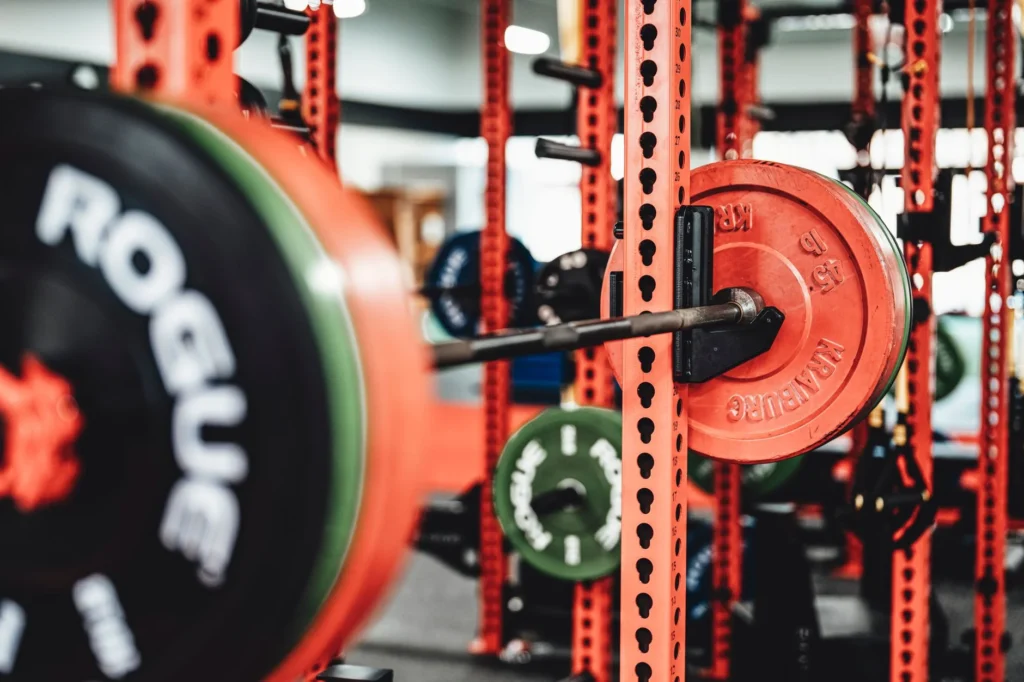
How Many Plates Is 225? Barbell Weight Math Explained
Two 45-pound plates on each side of a standard 45-pound barbell equals 225 pounds. That’s the short answer. The longer answer is that this calculation only holds when the bar weighs 45 pounds — and not every bar in a gym does. This guide covers the math behind the 225 milestone, the full plate-to-total reference table for common setups, and the plate notation system that experienced lifters use to communicate loading without stating the full number every time.
Building Toward Barbell Milestones With Dumbbell Training?
The dumbbell weight calculator gives you a target load for any exercise — useful if you’re using dumbbell training to build toward barbell strength benchmarks.
Calculate My Dumbbell Weight →The Calculation: How Two 45-Pound Plates Equals 225
The formula for any barbell setup is:
(Weight per side) × 2 + bar weight = total
For two 45 lb plates per side on a standard 45 lb bar:
- One side: 45 + 45 = 90 lb
- Both sides: 90 × 2 = 180 lb
- Add bar: 180 + 45 = 225 lb
The reason 225 is such a landmark number is mostly convention — it’s what two 45-pound plates on each side of the most common bar happens to produce. Pound plates are modelled on the metric plates used in international weightlifting (a 20 kg plate is about 44.1 lb), which is why the standard sizes are 45, 35, 25, 10, 5, and 2.5 lb rather than round numbers.
The Complete Plate-to-Total Reference Table
All totals assume a standard 45 lb men’s Olympic bar. The most common mixed-plate combinations are included alongside same-plate setups.
| Plates Per Side | Total Weight | Gym Shorthand |
|---|---|---|
| One 45 | 135 lb | “One plate” / “135” |
| One 45, one 25 | 185 lb | “One and a quarter” / “185” |
| One 45, one 35 | 205 lb | “205” |
| Two 45s | 225 lb | “Two plates” / “225” |
| Two 45s, one 10 | 245 lb | “245” |
| Two 45s, one 25 | 275 lb | “Two and a quarter” / “275” |
| Three 45s | 315 lb | “Three plates” / “315” |
| Three 45s, one 25 | 365 lb | “Three and a quarter” / “365” |
| Four 45s | 405 lb | “Four plates” / “405” |
| One 45, one 10, one 5 | 165 lb | “165” |
| Two 45s, two 10s | 265 lb | “265” |
| Two 45s, one 35 | 295 lb | “295” |
When the Bar Is Not 45 Pounds
The 225 calculation only holds on a standard men’s Olympic bar. Different bars change the total meaningfully:
| Bar Type | Bar Weight | Total with Two 45s Per Side |
|---|---|---|
| Standard men’s Olympic bar | 45 lb (20 kg) | 225 lb |
| Women’s Olympic bar | 33 lb (15 kg) | 213 lb |
| Safety squat bar (typical) | 60–70 lb | 240–250 lb |
| Trap / hex bar (typical) | 45–65 lb | 225–245 lb |
| Swiss / multi-grip bar (typical) | 35–55 lb | 215–235 lb |
| EZ curl bar | 15–25 lb | 195–205 lb |
Smith machine bars are the most variable — commercial machines may start at 15–35 lb of felt resistance depending on the counterbalance, not the actual bar weight. Always verify bar weight on unfamiliar equipment rather than assuming 45 lb.
Related Reading
Dumbbell Bench Press: How to Build to Your Barbell Milestones →What 225 lb Means as a Strength Benchmark
The 225 lb bench press is the most recognised single-exercise milestone in gym culture, partly because it’s the weight used in the NFL Combine bench press test (225 lb for maximum reps). As a strength standard, two 45-pound plates on the bench press represents different things depending on body weight:
| Bodyweight | 225 lb bench = bodyweight × | Rough classification |
|---|---|---|
| 200 lb+ | ~1.1× | Beginner-intermediate milestone |
| 175 lb | ~1.3× | Solid intermediate |
| 155 lb | ~1.45× | Intermediate-advanced |
| 135 lb | ~1.7× | Advanced for this bodyweight |
On the squat and deadlift, 225 lb carries different milestone significance. For most trained men, 225 lb represents an early-intermediate squat and a beginner-to-novice deadlift. The 315 lb (three plates) and 405 lb (four plates) markers are the more meaningful strength milestones for those lifts.
Why Lifters Count Plates Per Side, Not Total Plates
Gym shorthand references plates on one side of the bar, not the total number. “Two plates” means two 45 lb plates on each side — not four total across the bar. This convention exists because you load barbells symmetrically, one side at a time, so counting per-side is the natural unit of work when you’re setting up a bar.
The shorthand breaks down with mixed-plate setups. “One plate and a 25” is unambiguous (one 45 and one 25 per side = 185 lb), but once you get into stacks like 45+35+10, most lifters just say the total weight rather than describe the combination.
Plate Math for Percentage-Based Training
If you follow percentage-based programming (e.g., working at 75% of your 1RM), plate math adds a rounding layer. Example: if your bench 1RM is 225 lb, 75% is 168.75 lb — which rounds to 170 lb (one 45, one 10, one 5, and one 2.5 per side + bar). The rounding decisions matter when plate increments are limited. Most well-constructed percentage programmes specify the nearest 5 lb increment to account for this.
Related Reading
Dumbbell Weight Guide: Starting Weights for Every Exercise →Building Your Foundation With Dumbbell Training
Whether you’re working toward barbell milestones or training exclusively with dumbbells, the dumbbell weight calculator gives you the right starting load and progression target for any exercise.
Calculate My Dumbbell Weight →