Last updated: June 2026
Home Workouts to Lose Weight
Home workouts produce weight loss through the same mechanism as gym workouts: they increase total daily energy expenditure, which — when combined with a moderate calorie deficit — creates the conditions for fat loss. The specific exercises matter less than two factors: weekly calorie burn and frequency. That said, HIIT circuits using compound bodyweight movements burn the most calories per minute of any equipment-free format and continue elevating metabolism for up to 24 hours post-exercise through excess post-exercise oxygen consumption (EPOC). This combination makes them the highest-return option for home-based fat loss.
Get a Home Weight-Loss Workout Plan Built for You
The home workout generator builds a weekly training plan around your weight-loss goal, fitness level, and available days — with the right mix of HIIT and strength training to maximise fat burning at home.
Why HIIT Is the Most Effective Home Format for Fat Loss
High-intensity interval training alternates short bursts of maximum-effort exercise with brief recovery periods. A 2019 meta-analysis in the British Journal of Sports Medicine found that HIIT produced 28.5% greater reductions in total fat mass than moderate-intensity continuous training (steady-state cardio) and required significantly less total exercise time per week. For home training — where sessions are typically short and equipment is limited — this efficiency advantage is decisive.
The physiological reason HIIT outperforms steady-state for fat loss is EPOC: the elevated oxygen consumption that continues after the session ends as the body restores itself to a resting state. A 20-minute HIIT session with burpees, squat jumps, and mountain climbers can elevate metabolism for 16–24 hours afterward, meaningfully increasing total daily calorie expenditure beyond what appears on the session timer.
The 8 Best Home Exercises for Weight Loss
| Exercise | Est. Cal/Min* | Primary Muscle Groups | Beginner Modification |
|---|---|---|---|
| Burpee | 10–14 | Full body | Remove the jump; step feet in and out |
| Squat jump | 8–12 | Quads, glutes, hamstrings | Bodyweight squat (no jump) |
| Mountain climbers | 8–10 | Core, shoulders, hip flexors | Slow the tempo; step one leg at a time |
| Jumping lunges | 8–10 | Quads, glutes, calves | Stationary reverse lunge |
| High knees | 7–9 | Hip flexors, quads, cardio | Marching in place |
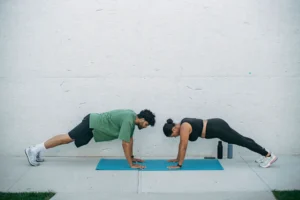
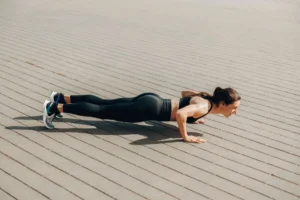
| Push-up | 5–7 | Chest, shoulders, triceps | Knee push-up |
| Glute bridge | 4–5 | Glutes, hamstrings | Hold at top for 2 sec |
| Plank | 3–4 | Core, obliques, shoulders | Knee plank |
*Estimated calorie burn per minute varies significantly by bodyweight, intensity, and fitness level. These ranges are indicative, not prescriptive.
The top four exercises (burpee, squat jump, mountain climbers, jumping lunges) are the calorie-burning workhorses of home fat-loss training. The bottom four (high knees, push-up, glute bridge, plank) add strength stimulus and core work that preserves muscle mass during a calorie deficit — an essential function because losing muscle alongside fat during weight loss lowers your resting metabolic rate and makes maintaining the deficit progressively harder.
Related Reading
Beginner Bodyweight Workout: The Complete 20-Minute Circuit →
A Sample 20-Minute HIIT Circuit
Perform each exercise for 40 seconds at maximum effort, followed by 20 seconds of rest. Complete the full circuit, rest 90 seconds, then repeat for 2–3 rounds.
| Exercise | Work | Rest |
|---|---|---|
| Jumping jacks (warm-up) | 40 sec | 20 sec |
| Squat jumps | 40 sec | 20 sec |
| Push-ups | 40 sec | 20 sec |
| Mountain climbers | 40 sec | 20 sec |
| Jumping lunges | 40 sec | 20 sec |
| Burpees | 40 sec | 20 sec |
| Plank hold | 40 sec | 20 sec |
| High knees | 40 sec | 20 sec |
One round = approximately 9 minutes. Two rounds = 18–20 minutes including the rest interval. Three rounds is appropriate once you can complete two rounds without significantly reducing intensity in the final two exercises.
A 7-Day Home Weight-Loss Plan
| Day | Session | Duration |
|---|---|---|
| Monday | HIIT circuit (2 rounds) | 20 min |
| Tuesday | Strength: push-ups, squats, glute bridges, plank | 20 min |
| Wednesday | Active recovery — walking | 30 min |
| Thursday | HIIT circuit (2–3 rounds) | 20–25 min |
| Friday | Strength: lunges, push-up variations, single-leg bridges, mountain climbers | 20 min |
| Saturday | Optional: HIIT or long walk | 20–30 min |
| Sunday | Rest | — |
This structure provides two dedicated HIIT sessions, two strength sessions, one active recovery day, and two rest or optional days per week. The combination is important: HIIT drives calorie burn, strength training preserves muscle and elevates basal metabolic rate, and rest days allow the hormonal response to exercise (growth hormone release, cortisol reduction) to complete. Eliminating rest to “burn more calories” consistently backfires — elevated cortisol from insufficient recovery promotes fat retention and muscle breakdown.
The Role of Diet in Home Workout Weight Loss
Exercise increases calorie expenditure but cannot compensate for a significant calorie surplus. A 20-minute HIIT session burns approximately 200–300 calories depending on bodyweight and intensity. A single high-calorie meal can eliminate that deficit in minutes. This does not mean exercise is unimportant — it plays a critical supporting role in weight loss by improving insulin sensitivity, preserving lean mass during a deficit, and supporting the hormonal environment that makes sustained fat loss possible. But the calorie deficit must come primarily from dietary intake, with exercise amplifying and maintaining the results.
The practical split most evidence supports: aim for a deficit of 400–600 calories per day from reduced food intake, and use exercise to add an additional 200–400 calories of expenditure. This produces a combined deficit of 600–1,000 calories per day — within the range associated with 0.5–1 lb of fat loss per week — without the unsustainable restriction that characterises crash dieting.
Get a Personalised Home Fat-Loss Plan
The home workout generator creates a complete weekly plan with the right balance of HIIT and strength training for your weight-loss goal, fitness level, and schedule — so you always know exactly what to do each day.