Last updated: June 2026
Hip measurement is one of the most commonly taken body measurements — and one of the most commonly taken incorrectly. The error usually comes down to placement: most people measure at the hip bone rather than at the widest point of the buttocks, which gives a reading that can be 2–4 inches too small. Getting this right matters whether you’re tracking your waist-to-hip ratio for health, sizing yourself for clothing, or monitoring body composition changes over time.
Calculate Your Waist-to-Hip Ratio
Once you have your hip and waist measurements, use our calculator to find your WHR and see how it compares to health thresholds.
What You’re Actually Measuring
Your hip circumference is the circumference of your body at its widest point in the lower half — typically at the fullest part of your buttocks. This is not the same as your hip bone (iliac crest), which sits several inches higher and is usually narrower. The hip bone is an easy landmark to feel with your fingers, which is why many people default to measuring there — but it’s the wrong spot.
The distinction matters because the hip measurement is used alongside your waist measurement to calculate your waist-to-hip ratio (WHR), a key health metric. A measurement taken at the hip bone instead of the widest point of the buttocks artificially inflates your WHR, making your reading look worse than it is.
What You Need
You only need two things:
- A soft measuring tape — a flexible cloth or plastic tape measure (the kind used in tailoring, not a rigid builder’s tape). It needs to wrap comfortably around your body without distorting your shape. If you don’t have one, a piece of string works — wrap it around, mark the point where it meets, then measure the string against a ruler.
- A full-length mirror — so you can check that the tape is sitting level all the way around, not dipping in the front or riding up in the back.
A second person can help if you find it difficult to keep the tape parallel to the floor while reading the number, but it’s not essential.
How to Measure Your Hips: Step by Step
Step 1: Strip down to underwear or fitted clothing
Clothing adds bulk and can bunch under the tape, skewing the reading by 1–2 inches. Take the measurement in your underwear or form-fitting leggings. Avoid wearing a pad or shapewear — you’re measuring the actual shape of your body, not the garment.
Step 2: Stand straight with feet together
Stand upright with your feet together or hip-width apart (the guides differ slightly on this, but together is slightly more consistent). Distribute your weight evenly. Don’t clench your glutes — that contracts the muscle and reduces the circumference reading; you want a relaxed measurement.
Step 3: Find the widest point
Look in the mirror from the front and the side. The widest point is where your buttocks protrude furthest — typically 7–9 inches below your natural waistline, though this varies by body type. It is almost always lower than your hip bone. If you run your hands down from your waist, you’ll pass the hip bone first (a bony ridge you can feel), then continue down until you reach the fullest part of the curve — that’s your measurement point.
Step 4: Wrap the tape and check the level
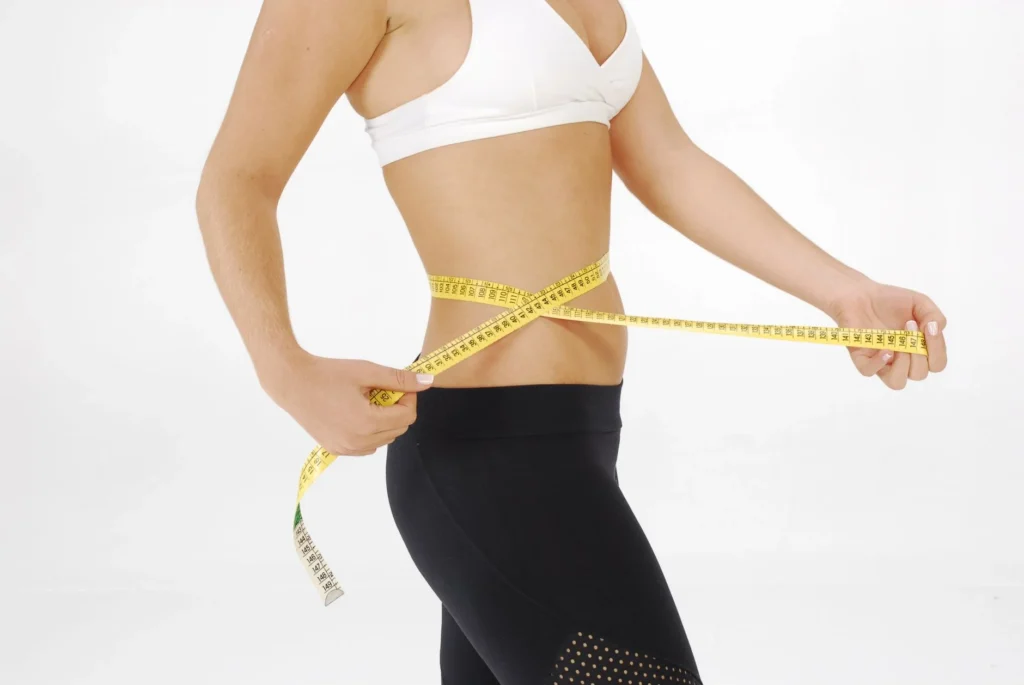
Hold the tape at the widest point on one side and wrap it around your body. Use the mirror to confirm the tape is parallel to the floor all the way around — it should be at the same height at your front, sides, and back. A tape that dips or twists in any direction will give an inaccurate reading.
Step 5: Read and record
The tape should sit snugly against the skin — touching the surface without pressing into it. If it’s tight enough to leave a mark or indent, it’s too tight. Breathe out normally and take the reading. Record the number. For accuracy, measure twice and use the average if the two readings are within 1 cm (0.5 inch) of each other.
How This Differs from Measuring Your Waist
Your waist and hip measurements are taken at completely different locations:
- Waist: Measured at the narrowest point of your torso — typically just above the belly button and below the lowest rib. This is a concave point on most bodies.
- Hips: Measured at the widest point of the lower body at the fullest part of the buttocks. This is a convex point.
These two measurements are used together in your waist-to-hip ratio (WHR), which is calculated simply by dividing waist circumference by hip circumference. A woman with a 30-inch waist and 40-inch hips has a WHR of 0.75.
Related Reading
Common Mistakes That Skew the Reading
| Mistake | Effect on Reading |
|---|---|
| Measuring at the hip bone instead of widest point | Reading is 2–4 inches too small |
| Tape not parallel to floor (dips in front or back) | Reading is 1–3 inches too small |
| Tape too tight (pressing into skin) | Reading is 1–2 inches too small |
| Tape too loose (sagging away from body) | Reading is 1–2 inches too large |
| Measuring over jeans or a thick skirt | Reading is 1–3 inches too large |
| Clenching glutes during measurement | Reading is slightly too small |
What Your Hip Measurement Is Used For
Waist-to-hip ratio (WHR): The primary health application. The World Health Organization uses WHR to assess abdominal obesity risk. A WHR above 0.85 for women or 0.90 for men indicates elevated health risk — but only if both the waist and hip measurements are accurate.
Clothing and sizing: Hip measurement is used in sizing for trousers, skirts, jeans, and underwear. Because there is no standardised sizing across brands, the raw centimetre or inch figure is more useful than a labelled size — comparing your measurement directly to a brand’s size chart gives a more accurate fit than guessing by size number.
Body composition tracking: Hip measurement on its own doesn’t indicate body composition, but as part of a set of measurements taken consistently over time, it can reflect changes in fat distribution. The hip measurement typically changes more slowly than the waist when someone reduces body fat.
Related Reading
Where Is Your Waist? How to Find the Right Spot to Measure →
How Often to Remeasure
If you’re tracking body composition changes, measure every 2–4 weeks at the same time of day (morning, before eating). Hip circumference changes slowly — you’re unlikely to see meaningful movement week to week, and daily fluctuations from hydration and digestion can make short-interval measurements misleading.
For consistent comparison, always measure in the same conditions: same time of day, same level of clothing, same posture, same position of the tape. A 1 cm (0.5 inch) difference between readings is within normal daily variation and shouldn’t be over-interpreted.
Related Reading
Attractive Waist to Hip Ratio: What Research Actually Shows →
Calculate Your Waist-to-Hip Ratio
Enter both measurements into our free calculator to instantly get your WHR score and see where you fall relative to WHO health thresholds.