Last updated: October 2026
How to Measure Muscle Mass: At-Home and Clinical Methods
The most important thing to understand about measuring muscle mass is that most methods don’t measure muscle directly — they estimate it. A DEXA scan measures lean soft tissue (which includes muscle, organs, and water, but excludes fat and bone). A BIA smart scale estimates skeletal muscle mass using electrical conductivity equations. The numbers they produce are not interchangeable. Here’s what each method actually measures, how accurate it is, and when to use it.
Quick Lean Body Mass Estimate
Before investing in a DEXA scan, get a formula-based lean body mass estimate from your height and weight as a starting reference.
Understanding the Terminology First
Different tools report different things. Confusing them leads to wrong comparisons:
| Term | What It Includes | Which Tool Reports It |
|---|---|---|
| Lean body mass | Everything except fat: muscle + organs + water + bone | Formulas (Boer, James, Hume) |
| Lean soft tissue | Muscle + organs + water (excludes bone and fat) | DEXA (reported by region) |
| Skeletal muscle mass (SMM) | Only the muscles attached to your skeleton | MRI; estimated by BIA devices |
| Appendicular lean mass (ALM) | Lean tissue in arms and legs only | DEXA |
| ALMI | ALM ÷ height² (kg/m²) — sarcopenia screening metric | DEXA |
When a smart scale reports your “muscle mass,” it is estimating skeletal muscle mass. When a DEXA scan reports lean tissue, it includes organs and water as well as muscle. Neither is wrong — they’re measuring different components. Never compare a DEXA lean mass number to a BIA muscle mass number and assume they should match.
Clinical Methods
DEXA Scan
Dual-energy X-ray absorptiometry is the most widely used clinical reference method for body composition. A 6–10 minute scan separates your body into fat mass, lean soft tissue, and bone mineral content — for the whole body and by region (arms, legs, trunk). A single scan also provides appendicular lean mass index (ALMI) for sarcopenia screening and a visceral fat estimate.
| Accuracy vs. MRI | Typical Cost | What You Get | Best For |
|---|---|---|---|
| Close (small differences) | ~$40–$150 | Regional lean mass, fat mass, visceral fat, bone density | Quarterly progress tracking |
Test–retest precision under consistent conditions is approximately ±0.5 percentage points for body fat percentage, which means real changes between scans are distinguishable from measurement noise. DEXA overestimates true skeletal muscle mass slightly compared to MRI (because organ mass is included in the “lean” figure), but it is far more consistent between individuals than BIA.
MRI and CT (Research Grade)
MRI can quantify skeletal muscle volume with high anatomical precision and is used in research to establish reference norms. CT provides similar detail. Neither is practical for routine fitness tracking due to cost, radiation exposure (CT), and limited availability outside medical centers.
D3-Creatine Dilution (Emerging)
D3-creatine dilution is the only method that directly estimates total skeletal muscle mass — via a harmless tracer drink followed by a urine sample. It strongly predicts functional outcomes in older adults but is not yet available outside specialized research settings.
At-Home Methods
BIA Smart Scales
Bioelectrical impedance analysis works by sending a low electrical current through the body. The current passes more easily through water-rich muscle than through fat. The device uses the measured resistance (impedance) to estimate body composition. Consumer smart scales and professional multi-frequency devices like the InBody both use this principle.
| Device Type | Typical Accuracy vs. DEXA | Typical Cost |
|---|---|---|
| Consumer smart scale (2-electrode) | ±4–6% | $20–$150 one-time |
| Multi-frequency BIA (InBody, 8-electrode) | ±2–3% | Gym or clinic fee |
BIA devices often read skeletal muscle mass a little differently from DEXA, and the gap varies by device and person. More critically, they are sensitive to hydration status, recent meals, exercise, and temperature — which creates substantial day-to-day variation. Their strength is in tracking trends over weeks and months, not in providing accurate absolute readings on any single measurement.
For consistent BIA results, keep these conditions identical every time you test:
- Same time of day — morning on an empty stomach works best
- Bladder emptied before stepping on
- No exercise in the prior 12 hours
- No large meals or alcohol in the prior 4 hours
- Consistent hydration routine in the 24 hours prior
- Same device every time — different brands use different equations and produce different absolute numbers
Skinfold Calipers
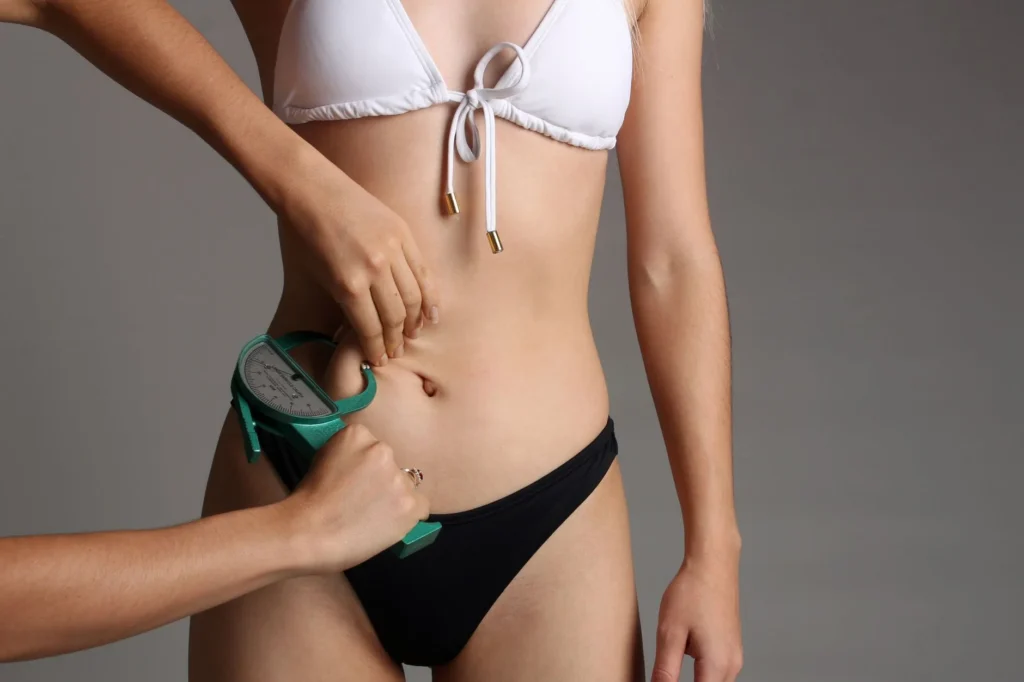
Calipers measure subcutaneous fat thickness at specific anatomical sites. A validated equation converts those measurements into a body fat percentage. You then derive lean mass as: total body weight × (1 − body fat fraction). Accuracy depends heavily on the measurer’s skill and consistency; typical error is ±3–4%. For ongoing tracking with the same trained measurer using the same protocol and sites, calipers can track trends reliably at a low cost. A decent pair of skinfold calipers is a one-time purchase that pays for itself within a couple of months of tracking.
Mid-Upper Arm Circumference (MUAC)
A measuring tape at the midpoint of the upper arm (between shoulder tip and elbow tip, arm relaxed at the side) provides a MUAC measurement. Research confirms that MUAC correlates meaningfully with appendicular muscle mass in older adults. It is used primarily to screen for low muscle mass when more advanced tools aren’t available — not to replace DEXA for clinical diagnosis. Record to the nearest 0.1 cm and use the same arm each time.
Which Method Should You Use?
| Goal | Best Method |
|---|---|
| Accurate baseline before starting a program | DEXA scan |
| Weekly progress tracking at home | BIA smart scale (consistent protocol) |
| Low-budget gym tracking with a partner | Skinfold calipers (consistent measurer and sites) |
| Screening older adults for sarcopenia risk | DEXA for ALMI; MUAC as initial flag |
| Confirming body recomposition results | DEXA every 8–12 weeks |
The most effective approach combines a BIA scale for weekly trend-watching with a DEXA scan every 8–12 weeks to verify that the trends are real. Use BIA to catch direction; use DEXA to confirm magnitude. Never cross-compare numbers between the two methods.
Frequently Asked Questions
Why does my BIA reading change so much day to day?
BIA is highly sensitive to hydration. Even modest changes in hydration can shift estimated body fat by a point or more in either direction. This is why identical testing conditions every time are essential — and why a single BIA reading without a consistent protocol tells you almost nothing.
Is a DEXA scan worth it?
For anyone serious about tracking body composition — whether for fat loss, muscle building, or health monitoring — yes. At roughly $40–$150 per scan (prices vary by location) with results that include lean mass by region, visceral fat, and bone density, a DEXA scan provides more actionable data than months of smart-scale measurements.
Related Reading
Skeletal Muscle Mass Chart: Normal Ranges and How to Read Them →
Related Reading
Related Reading
Estimate Your Lean Body Mass
Get a formula-based lean body mass estimate from your height and weight while you plan your next DEXA scan.