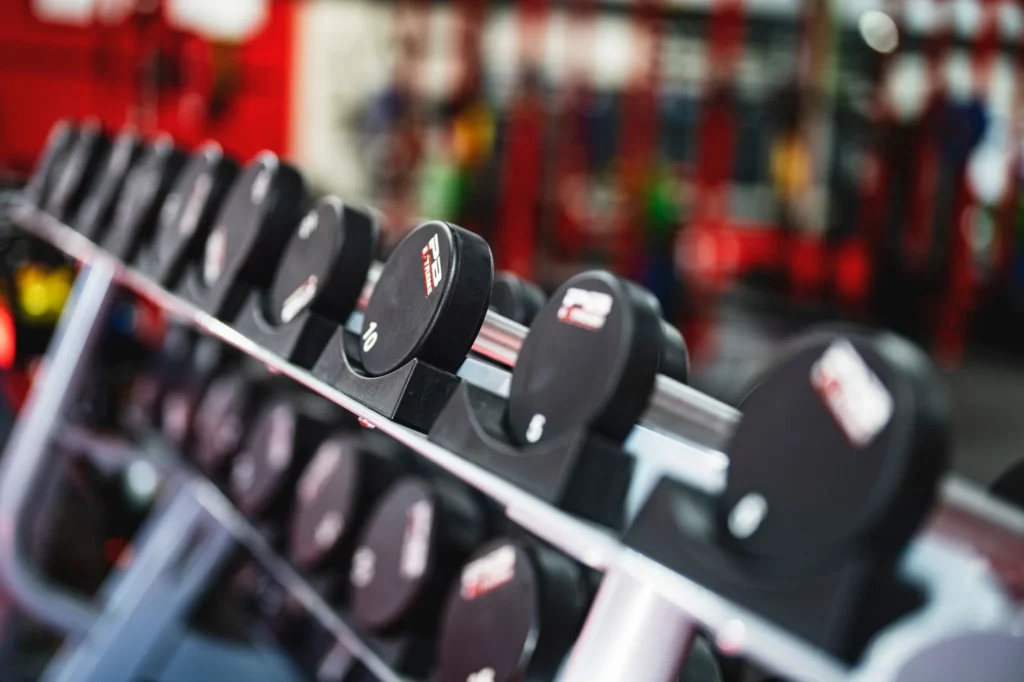
Your dumbbell bench press and barbell bench press numbers don’t translate directly. The two movements use the same muscles but differ enough in stability demands and mechanics that most lifters press noticeably more with a barbell than with dumbbells — even when both exercises are trained regularly. Knowing the conversion helps you set realistic expectations when switching between the two.
The Dumbbell to Barbell Conversion Formula
As a rule of thumb that matches the standards table below, most lifters can press roughly 20–30% more weight with a barbell than the combined weight of both dumbbells.
Estimated barbell bench = total dumbbell weight × 1.2–1.3
Example: Using 50 lb dumbbells in each hand = 100 lb total. Estimated barbell bench: 100 × 1.2–1.3 = 120–130 lbs.
This is an estimate, not a guarantee. The actual ratio varies based on how often you’ve trained each lift and your experience level. Beginners who’ve only used dumbbells will often find the barbell feels awkward at first and perform closer to their dumbbell weight. Experienced barbell lifters who rarely use dumbbells often outperform this ratio in the other direction.
Dumbbell vs Barbell Bench Press Standards by Experience Level
The table below gives approximate benchmarks for where typical lifters land on both exercises across experience levels. Dumbbell weight listed is per hand (one dumbbell). Barbell is the total bar weight.
Men:
| Level | Dumbbell (per hand) | Barbell (total) |
|---|---|---|
| Beginner | 18 lbs each | 103 lbs |
| Novice | 30 lbs each | 154 lbs |
| Intermediate | 45 lbs each | 217 lbs |
| Advanced | 65 lbs each | 291 lbs |
| Elite | 86 lbs each | 372 lbs |
Women:
| Level | Dumbbell (per hand) | Barbell (total) |
|---|---|---|
| Beginner | 6 lbs each | 38 lbs |
| Novice | 13 lbs each | 69 lbs |
| Intermediate | 23 lbs each | 111 lbs |
| Advanced | 36 lbs each | 164 lbs |
| Elite | 51 lbs each | 223 lbs |
Why the Barbell Bench Is Higher Than Dumbbells
The barbell bench press is mechanically easier in a specific way: both hands are fixed on the same bar, which means the bar itself provides stability between them. You only have to control the bar’s path — not the independent movement of two separate loads.
With dumbbells, each arm works alone. The stabilizing muscles of the shoulder — rotator cuff, serratus anterior, and the smaller deltoid heads — have to work harder to keep each dumbbell from drifting. This extra stabilization demand reduces how much force can be directed into the actual press. The heavier the dumbbells, the more significant this stabilization tax becomes.
There’s also a range of motion difference. With dumbbells you can go slightly deeper at the bottom of the press, which increases the stretch on the pecs but also the challenge out of the hole. Most people push slightly less from a deeper starting position.
Converting Barbell to Dumbbell
Going the other direction — estimating your dumbbell weight from a known barbell max — use the inverse:
Estimated dumbbell (per hand) = barbell weight ÷ 2.4 to 2.6
Example: You bench 225 lbs. Estimated dumbbell weight: 225 ÷ 2.5 = 90 lbs per hand.
This is a starting estimate only. Start conservatively on your first dumbbell session — 5–10 lbs below the estimate — since the stability demands of dumbbells may catch you off guard if you’ve been primarily barbell training.
When to Use Each
Barbell bench: Better for building raw pressing strength. The fixed bar allows you to overload the pecs and triceps with heavier weight. It’s also the competition lift, so if powerlifting is a goal, barbell benching should be your primary pressing movement.
Dumbbell bench: Better for correcting asymmetries — each arm has to work independently, which exposes and corrects side-to-side strength imbalances. Many lifters also find dumbbells more comfortable on the shoulders, since the dumbbells can follow a more natural arc. Many experienced benchers use dumbbell pressing as a secondary movement to build the pecs from a different angle.
For most lifters, both belong in the program. The barbell builds the strength; the dumbbell work fills in the gaps.
Calculate Your Barbell Loading
Once you know your target barbell weight, use this calculator to find the exact plates to load on each side.
Use the Barbell Calculator →Related Reading
How Much Does a Barbell Weigh? (Every Bar Type Explained) →