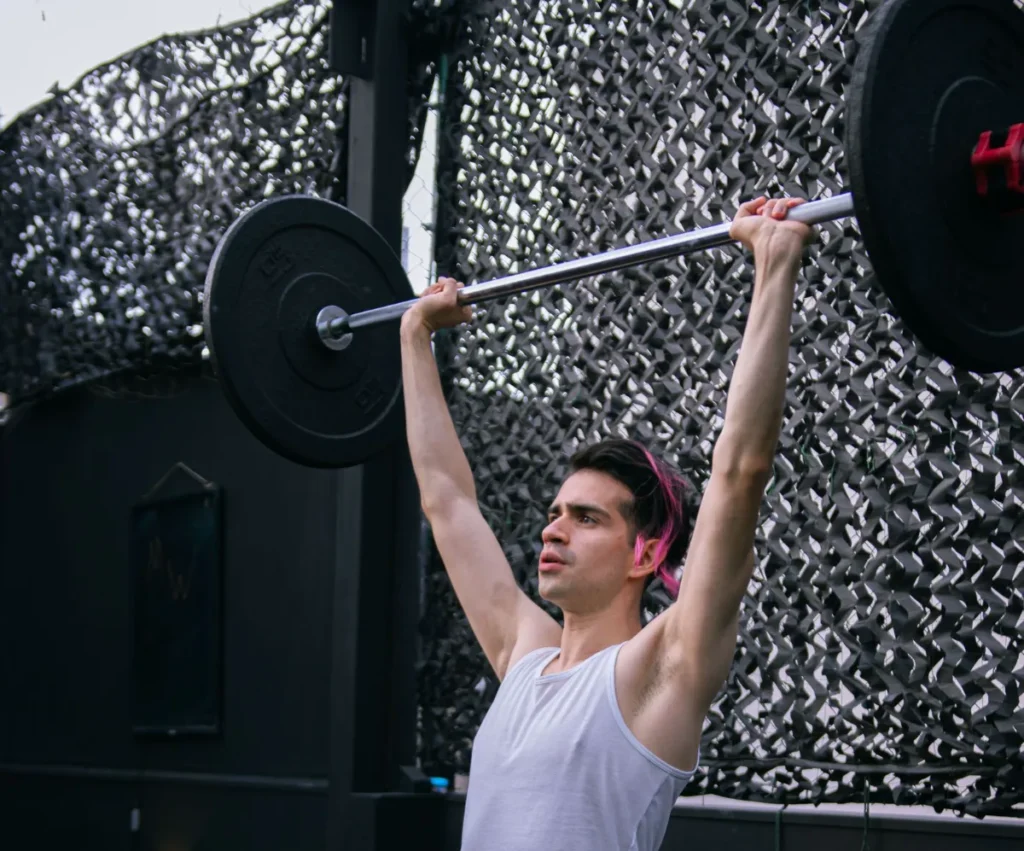
The overhead press is the most honest upper body strength test you can do with a barbell. Unlike the bench press, you can’t cheat it with a big arch, leg drive, or a spotter touch. You stand up straight and push the bar from your shoulders to lockout above your head — either you can do it or you can’t.
That honesty makes it one of the best indicators of true shoulder strength and upper body stability. Here are the current standards for men and women, sorted by bodyweight and experience level, along with what they mean and how to progress through them.
Overhead Press Standards at a Glance
The OHP is harder relative to bodyweight than any other barbell lift. Pressing your own bodyweight overhead puts a man just short of the advanced standard (1.1×) and a woman at elite — a milestone that takes most lifters years of dedicated training. Use these multipliers to locate yourself quickly:
| Level | Men (× bodyweight) | Women (× bodyweight) |
|---|---|---|
| Beginner | 0.35× | 0.2× |
| Novice | 0.55× | 0.35× |
| Intermediate | 0.8× | 0.5× |
| Advanced | 1.1× | 0.75× |
| Elite | 1.4×+ | 1.0×+ |
Men’s Overhead Press Standards by Bodyweight
These numbers assume a strict standing overhead press — barbell starts at shoulder level, no leg drive, locked out overhead. All figures are one-rep max.
| Bodyweight | Beginner | Novice | Intermediate | Advanced | Elite |
|---|---|---|---|---|---|
| 130 lbs | 50 lbs | 79 lbs | 115 lbs | 158 lbs | 201 lbs |
| 150 lbs | 55 lbs | 87 lbs | 127 lbs | 174 lbs | 222 lbs |
| 170 lbs | 60 lbs | 95 lbs | 138 lbs | 189 lbs | 241 lbs |
| 190 lbs | 65 lbs | 102 lbs | 148 lbs | 204 lbs | 259 lbs |
| 210 lbs | 69 lbs | 109 lbs | 159 lbs | 218 lbs | 277 lbs |
| 230 lbs | 74 lbs | 116 lbs | 168 lbs | 232 lbs | 295 lbs |
| 250 lbs | 78 lbs | 122 lbs | 178 lbs | 245 lbs | 312 lbs |
For example, an intermediate 190-pound man should be pressing around 148 lbs — 0.8× bodyweight, adjusted slightly down for his weight (the tables below use the same bodyweight adjustment as our strength ratio calculator).
Women’s Overhead Press Standards by Bodyweight
| Bodyweight | Beginner | Novice | Intermediate | Advanced | Elite |
|---|---|---|---|---|---|
| 100 lbs | 22 lbs | 38 lbs | 55 lbs | 82 lbs | 110 lbs |
| 115 lbs | 24 lbs | 42 lbs | 60 lbs | 90 lbs | 120 lbs |
| 130 lbs | 26 lbs | 46 lbs | 65 lbs | 98 lbs | 131 lbs |
| 150 lbs | 29 lbs | 50 lbs | 72 lbs | 108 lbs | 144 lbs |
| 165 lbs | 31 lbs | 54 lbs | 77 lbs | 115 lbs | 153 lbs |
For example, an intermediate 130-pound woman targeting the 0.5× standard should be pressing about 65 lbs.
OHP to Bench Press Ratio
A common coaching rule of thumb (not a research-derived standard) is that for balanced lifters the OHP sits at roughly 60–65% of your bench press. If you bench 200, your overhead press should be around 120–130 lbs.
When the OHP falls significantly below 60% of your bench, it usually indicates:
- The bench is being trained far more frequently than the OHP
- Poor overhead positioning — a mobility or technique issue, not just weakness
When the OHP is unusually close to the bench (80%+ of bench press), it sometimes means the bench press is underperforming.
Related Reading
8 Best Front Delt Exercises for Size & Strength →Common Overhead Press Mistakes That Kill Progress
Bar path too far forward: The bar should travel in a slight S-curve — back slightly on the way up as the head moves out of the way, then finishing directly over the midfoot. Pressing straight up with the bar in front of the face creates a longer moment arm and cuts strength significantly.
Not getting the bar out of the front rack correctly: The press starts with elbows slightly in front of the bar, not directly under it. Elbows directly below forces the bar backward and kills the pressing angle. Think “elbows forward” at the start position.
Flaring the elbows too wide: Elbows should track about 45–75° from the torso, not straight out to the sides. Wide flare puts the shoulder in a weaker, less comfortable position.
Not locking out: A full lockout at the top of the press means the bicep is next to the ear, not in front of it. Partial-range pressing caps how much you can lift and doesn’t train the strength through full shoulder flexion that makes the OHP valuable.
How to Actually Improve Your Overhead Press
The OHP responds best to frequency. Most programs that prioritize the bench only schedule the OHP once per week, which severely limits progress. Moving to two pressing sessions per week — one heavy, one moderate — often helps intermediates get the OHP moving again.
The most effective accessory work for the OHP:
- Push press: Use leg drive to overload the top third of the press. Handling heavier weight above your strict press ceiling builds upper pressing strength.
- Dumbbell overhead press: Each arm has to work independently, which exposes and corrects asymmetries. Often you’ll find your dominant side has compensated for years.
- Face pulls: Rear deltoids and external rotators. They aren’t prime movers in the press, but they keep the shoulder balanced when you press often.
- Lateral raises: Mid delt development. Don’t neglect this — the OHP relies on the mid delt for much of the drive off the shoulder.
See How Your OHP Stacks Up
Enter all your big lifts and bodyweight to get a complete strength profile with ratings for each lift — including the overhead press.
Use the Strength Ratio Calculator →