A good deadlift depends almost entirely on your bodyweight, not the raw number on the bar. A 150-pound lifter pulling 300 pounds is hitting the exact same relative standard as a 200-pound lifter pulling 400 pounds. That context is what makes flat-number comparisons useless — and why serious strength coaches use bodyweight multipliers instead.
Below you’ll find deadlift standards for men and women across five experience levels, sorted by bodyweight. They use the same bodyweight multipliers as our strength ratio calculator (based on Strength Level’s database of logged lifts). Treat them as practical benchmarks rather than precise population statistics.
Deadlift Standards at a Glance
The fastest way to gauge your deadlift is to divide your 1RM by your bodyweight. Here’s what each multiplier means:
| Level | Men (× bodyweight) | Women (× bodyweight) |
|---|---|---|
| Beginner | 1.0× | 0.5× |
| Novice | 1.5× | 1.0× |
| Intermediate | 2.0× | 1.25× |
| Advanced | 2.5× | 1.75× |
| Elite | 3.0× | 2.5× |
Level definitions:
- Beginner: Under 6 months of consistent training. Still ingraining the movement pattern.
- Novice: 6 months to 2 years. Solid technique, adding weight regularly with linear progression.
- Intermediate: 2–4 years. Progress has slowed and requires structured weekly programming.
- Advanced: 4+ years of dedicated training. Approaching genetic ceiling.
- Elite: Competitive-level strength.
Men’s Deadlift Standards by Bodyweight
These numbers assume a conventional or sumo deadlift from the floor with a lockout — no straps, no hitching. All figures are one-rep max (1RM).
| Bodyweight | Beginner | Novice | Intermediate | Advanced | Elite |
|---|---|---|---|---|---|
| 130 lbs | 145 lbs | 215 lbs | 290 lbs | 360 lbs | 430 lbs |
| 150 lbs | 160 lbs | 235 lbs | 315 lbs | 395 lbs | 475 lbs |
| 170 lbs | 170 lbs | 260 lbs | 345 lbs | 430 lbs | 515 lbs |
| 190 lbs | 185 lbs | 280 lbs | 370 lbs | 465 lbs | 555 lbs |
| 210 lbs | 200 lbs | 295 lbs | 395 lbs | 495 lbs | 595 lbs |
| 230 lbs | 210 lbs | 315 lbs | 420 lbs | 525 lbs | 630 lbs |
| 250 lbs | 225 lbs | 335 lbs | 445 lbs | 555 lbs | 670 lbs |
The intermediate column — roughly a 2× bodyweight deadlift, slightly less for heavier lifters and slightly more for lighter ones, matching our strength ratio calculator — is the standard most serious gym-goers are working toward. A 190-pound man hitting 370 pounds has cleared it. Most trained men who haven’t specifically focused on the deadlift tend to sit somewhere in the novice range.
Women’s Deadlift Standards by Bodyweight
Women’s absolute numbers are lower, but the progression curve is identical. Hitting 1.25× bodyweight as an intermediate woman is a genuine achievement that puts you well above the recreational average.
| Bodyweight | Beginner | Novice | Intermediate | Advanced | Elite |
|---|---|---|---|---|---|
| 100 lbs | 55 lbs | 110 lbs | 135 lbs | 190 lbs | 275 lbs |
| 115 lbs | 60 lbs | 120 lbs | 150 lbs | 210 lbs | 300 lbs |
| 130 lbs | 65 lbs | 130 lbs | 165 lbs | 230 lbs | 325 lbs |
| 150 lbs | 70 lbs | 145 lbs | 180 lbs | 250 lbs | 360 lbs |
| 165 lbs | 75 lbs | 155 lbs | 190 lbs | 270 lbs | 385 lbs |
| 185 lbs | 85 lbs | 165 lbs | 205 lbs | 290 lbs | 415 lbs |
See How All Your Lifts Compare
Enter your squat, bench, deadlift, and bodyweight to get a complete strength profile with ratings for each lift.
Use the Strength Ratio Calculator →Deadlift Standards by Age
Strength peaks in your late 20s to mid-30s. The standards above assume you’re between 18 and 35. After that, peak force production declines — but trained older lifters often outperform untrained younger ones because the skill and structural adaptation from years of training compounds.
| Age Range | Approximate Adjustment |
|---|---|
| 18–35 | Baseline — no adjustment needed |
| 36–45 | ~95% of peak |
| 46–55 | ~85% of peak |
| 56–65 | ~75% of peak |
| 65+ | ~65% of peak |
Example: a 52-year-old man at 190 lbs should target 85% × 370 = 315 lbs for intermediate. That’s not a concession — maintaining a 323-pound deadlift at 52 is a serious achievement. Competing in masters divisions, you’d stack up very well.
Why the Deadlift Is the Best Strength Test
Every other major lift has a significant learning curve that can mask true strength. The squat requires mobility and positional awareness. The bench press has a technique component that changes how much weight moves. The deadlift is different — everyone can pick a bar off the floor on their first attempt, which makes the numbers easier to compare across people.
It also trains more muscle at once than almost any other lift. Hamstrings, glutes, erector spinae, traps, lats, and grip all contribute meaningfully to a max deadlift. That breadth is why it’s one of the most useful single-number proxies for total-body strength.
Common Sticking Points
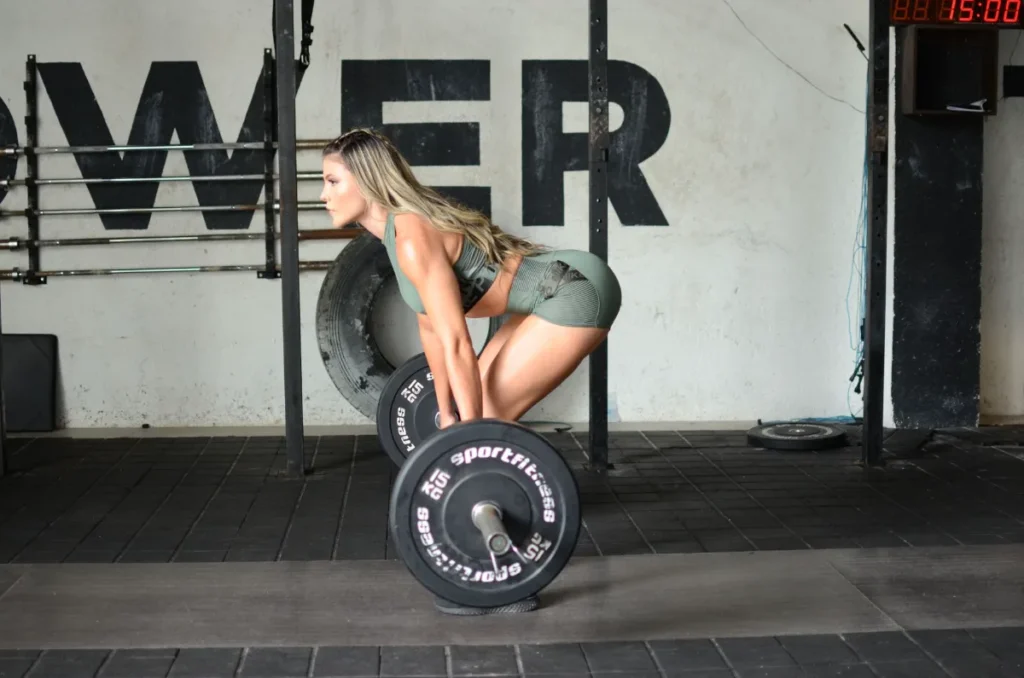
Below the knee: Usually hamstring weakness. The bar breaks off the floor but stalls before the knee. Romanian deadlifts and stiff-leg variations directly target this range.
At the knee: Often a positioning issue — the bar drifts away from the legs as it passes the knee, increasing the moment arm and multiplying the load. Keep the bar dragging your shins the whole way up.
Lockout: Hip extension is the limiting factor here. Heavy hip thrusts and rack pulls from just above the knee will train this specifically without the fatigue of a full-range pull.
Related Reading
RPE Training for Powerlifting: How to Program by Feel →How to Progress to the Next Standard
At beginner and novice, add weight every session. Linear progression — 3 sets of 5 with 10 pounds added each session — works until it doesn’t. Most people can run this for 3 to 6 months before stalling.
At intermediate, weekly progress replaces session-to-session gains. You need a program that periodizes volume and intensity — 5/3/1, Texas Method, or a dedicated powerlifting template. Contrary to popular belief, research suggests the deadlift doesn’t take longer to recover from than the squat or bench press [1], but many intermediates still do well pulling heavy once per week and doing speed or volume work on a second session.
The single highest-return change for most intermediates isn’t programming — it’s pulling more consistently. Missing sessions slows deadlift progress faster than any programming mistake.
Related Reading
Strength Standards: How Do Your Lifts Compare? →Sources: [1] Belcher DJ, et al. Time course of recovery is similar for the back squat, bench press, and deadlift in well-trained males. Appl Physiol Nutr Metab. 2019.