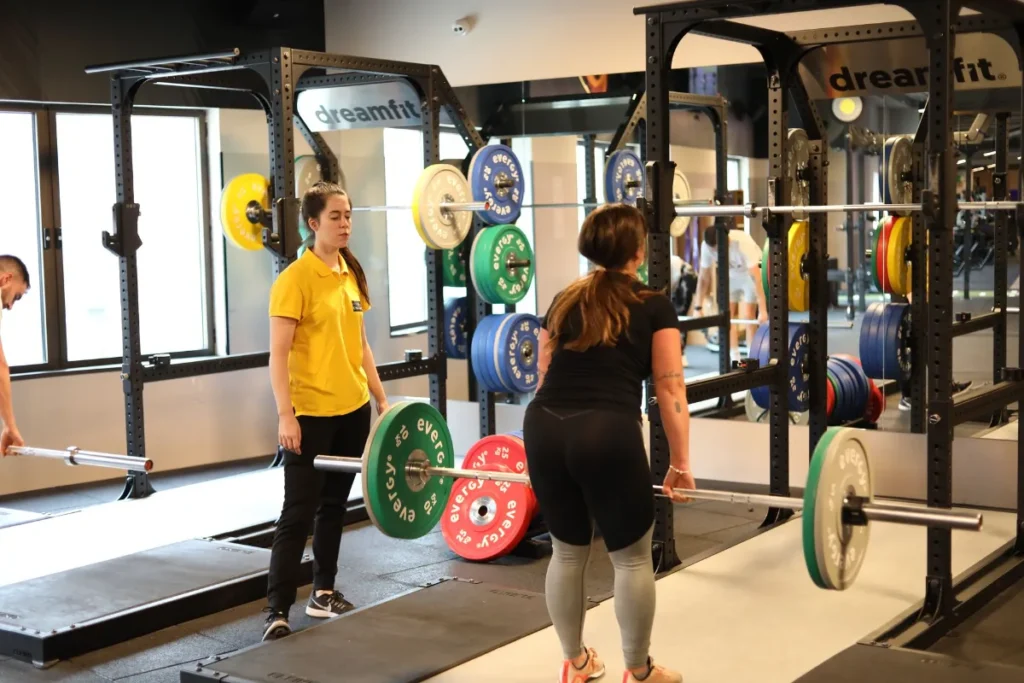
Powerlifting was the sport that popularized RPE-based training in Western strength circles. Mike Tuchscherer’s Reactive Training Systems (RTS) introduced systematic RPE programming to competitive powerlifters in the late 2000s, and the approach has since become standard in elite powerlifting programming.
The reason RPE works especially well for powerlifting is simple: the sport requires you to max out in competition. Training near your max regularly is necessary — but training at your actual max every week destroys recovery. RPE gives you a way to train near-maximal effort intelligently, with built-in autoregulation based on how you feel each day.
The Core Principle: Daily Readiness Varies
On any given training day, your actual strength capacity might be 95%, 100%, or even 105% of what you lifted last week. Sleep, nutrition, stress, and cumulative fatigue all shift this number. A fixed percentage program ignores this variation — RPE training embraces it.
If your program calls for 3×3 at RPE 8 on squat and today is an off day, your RPE 8 weight will be lower than last week. That’s fine — you’re still training at RPE 8. The stimulus is equivalent. No need to grind through a near-max effort on a bad day.
Conversely, on a day when everything clicks, your RPE 8 occurs at a higher weight than expected. The program auto-adjusts in both directions.
RPE Ranges for Powerlifting Training Phases
Accumulation / Volume Phase (RPE 6–8)
Early in a training cycle, the goal is to accumulate volume at submaximal intensities. Most sets fall at RPE 6–8, with higher rep ranges (4–8 reps per set). This builds the work capacity and hypertrophy base that supports later strength phases. Total volume is high; individual set intensity is moderate.
Intensification Phase (RPE 8–9)
As the meet approaches (typically 8–12 weeks out), weight increases and reps decrease. Sets shift to RPE 8–9 with 1–3 reps. The goal is to develop specific strength and neural efficiency at near-maximal loads. Volume decreases as intensity increases.
Peak Phase (RPE 9–9.5)
In the final 3–4 weeks before competition, training intensity peaks at RPE 9–9.5. Singles become frequent. Volume drops significantly to allow recovery, but each session includes at least one heavy single at a demanding RPE. This phase sharpens your ability to produce maximum force on command.
Taper Week (RPE 6–7)
The week before the meet, training dramatically reduces in volume and intensity. RPE 6–7 maintains neural activation and movement patterns without adding fatigue. Most programs include just one or two light sessions in the final 5–7 days, with emphasis on technique and confidence rather than intensity.
Related Reading
RPE Chart: Full 1–10 Scale + % of 1RM Table →Using RPE to Select Competition Openers
One of the most practical applications of RPE in powerlifting is selecting your opening attempt for a meet. The near-universal rule in competitive powerlifting:
Your opener should be a weight you can hit on the worst day of your life — around RPE 7–8 in training.
If in your last peaking cycle, 90% of your best training squat moved at RPE 7–8 consistently, that’s your opener. It should feel controlled and confident, not like a near-max grinder.
Why so conservative? Missed openers are more costly than they appear. A missed first attempt:
- Eliminates that exact weight from your total permanently for the session
- Disrupts warmup rhythm and confidence at the worst time
- Forces you into a second attempt at the same or higher weight under worse psychological conditions
The best powerlifters treat openers as formalities — something to get on the board with authority, not a max attempt. Many elite lifters could hit their opener for multiple reps and that’s by design.
Programming Second and Third Attempts with RPE
After a successful opener, you use your actual performance to gauge second and third attempts:
- Opener felt like RPE 7: Jump aggressively (5–8% increase for second attempt)
- Opener felt like RPE 8: Moderate jump (3–5% increase)
- Opener felt like RPE 9: Conservative jump (2–3% increase; recalibrate for third)
The same logic applies from second to third attempt. This approach to attempt selection is more accurate than pre-planned jumps because it incorporates real-time performance data from inside the meet. Many powerlifters have bombed out by ignoring how their opener felt and taking a pre-planned aggressive second.
Calculate Attempt Weights with RPE
Enter your warmup or training weights to estimate what percentages align with different RPE levels for meet day planning.
Use the RPE Calculator →A Sample RPE-Based Powerlifting Week
Here’s what a weekly structure might look like during a 10-week peaking cycle, 6 weeks out from a meet:
Monday — Squat Primary
- Squat: Work up to 1×1 @ RPE 8, then 3×3 @ −5%
- Pause Squat: 3×3 @ RPE 7
- Leg Press: 3×8–10 @ RPE 8
Wednesday — Bench Primary
- Bench Press: Work up to 1×2 @ RPE 8, then 4×2 @ same weight
- Close-Grip Bench: 3×4 @ RPE 7
- Dumbbell Press: 3×10 @ RPE 8
Friday — Deadlift Primary
- Deadlift: Work up to 1×2 @ RPE 8, then 3×2 @ −3%
- Romanian Deadlift: 3×5 @ RPE 7
- Pull-ups: 3 sets to RPE 8
The RPE targets stay consistent across the week, but the lifter adjusts weight daily based on readiness. A strong Monday squat might use 400 lbs at RPE 8. A tired Friday might put RPE 8 at 385 lbs. Both are valid — the training stimulus is the same.
Tracking e1RM Over a Training Cycle
One of the most powerful features of RPE-based powerlifting programming is the ability to track your estimated 1RM (e1RM) every session without ever maxing out.
Formula: e1RM = Weight ÷ (% from RPE chart ÷ 100)
If you squat 365 lbs × 2 @ RPE 8, and 2 reps @ RPE 8 = 89.2% of 1RM:
e1RM = 365 ÷ 0.892 = ~409 lbs
Tracking this number week over week shows you if you’re getting stronger (rising e1RM at the same RPE) or if fatigue is accumulating (same weight at higher RPE = lower implied e1RM).
This feedback loop eliminates guesswork from programming. When e1RM is rising, add volume or intensity. When it plateaus or drops, recover before adding more work.
Related Reading
How to Calculate RPE: Step-by-Step Guide →Common RPE Mistakes in Powerlifting Programming
Training at RPE 10 Too Often
True RPE 10 training — going to absolute maximum effort — should happen rarely in training. Even peak cycles rarely require more than one or two true RPE 9.5–10 sessions in the final weeks. Frequent RPE 10 work burns out the central nervous system faster than it can adapt and significantly increases injury risk on the three big lifts.
Bench Press RPE Calibration Issues
Bench press is notoriously difficult to accurately assess RPE compared to squat and deadlift. Many lifters chronically underestimate bench RPE — calling an RPE 8.5 an RPE 7 — because the movement feels more “comfortable” even near failure. Lean toward conservative (higher) RPE estimates on bench until you’ve tested your actual failure point.
Ignoring Meet-Day Variables
Competition conditions — singlet, competition belt, chalk, crowd energy, and heightened adrenaline — can all affect performance. Most lifters find competition conditions add 1–3% to their performance vs. normal training. Account for this when using training RPE data to project competition maxes and select openers.
Reactive Training Systems: The Foundation
The RTS system developed by Mike Tuchscherer is the most systematized RPE-based powerlifting methodology. Its core contributions to the field:
- e1RM tracking: Calculating estimated 1RM every session from RPE data and tracking the trend over time
- Fatigue management: Using RPE trends to identify accumulated fatigue (e1RM dropping across multiple sessions) and adjusting volume before performance degrades
- Volume landmarks: MEV (minimum effective volume), MAV (maximum adaptive volume), and MRV (maximum recoverable volume) defined in terms of RPE and weekly set counts
Even if you’re not following a formal RTS program, understanding these principles improves how you use RPE in any powerlifting context.
Frequently Asked Questions
What RPE should my competition opener be at in training?
Your opener should be a weight that consistently moves at RPE 7–8 in training. This ensures it’s heavy enough to count but well within your capacity even on a bad day. Many elite lifters target RPE 7 for openers — that’s 3 reps left, which means a miss is essentially impossible under normal conditions.
How do I know when to increase weights in RPE programming?
When the same RPE target starts occurring at progressively higher weights over multiple sessions (rising e1RM trend), you’re getting stronger and ready to push more. If the e1RM trend plateaus or drops, address volume, intensity distribution, or recovery before adding weight.
Is RPE programming appropriate for beginner powerlifters?
Beginners can use RPE, but their calibration will be imprecise for the first 3–6 months. For true beginners, linear progression models that use simple weight increases each session tend to work just as well and require less self-monitoring. RPE becomes significantly more valuable when linear gains slow and autoregulation provides a meaningful edge.
Can I combine RPE with percentage-based programming?
Yes, and many effective programs do exactly this. A common hybrid: percentages set the baseline structure (e.g., “squat at 80% today”) while RPE acts as a ceiling (“but don’t go above RPE 8”). This gives predictability while preventing overexertion on bad days.
RPE Calculator for Powerlifting
Calculate your estimated 1RM from any training set, find target weights for any RPE, and plan your next training block.
Use the RPE Calculator →