
Last updated: August 2026
Gym anxiety — sometimes called “gymtimidation” — is one of the most common reasons people avoid starting or restarting a training routine, and one of the least talked about, because it feels embarrassing to admit. It shouldn’t. It’s an extremely common response, and it’s almost entirely fixable with a few specific strategies rather than just “getting over it” through willpower.
What Is Gym Anxiety?
Gym anxiety is the nervousness, self-consciousness, or outright dread some people feel about going to or being in a gym — worrying about being watched, judged, or not knowing what to do with equipment. It ranges from mild pre-workout nerves to anxiety severe enough to stop someone from going at all.
Signs You Might Have Gym Anxiety
Gym anxiety shows up in two main ways: physical/emotional symptoms and avoidance behavior. Recognizing the pattern is often the first step to addressing it.
- Racing heart, sweating, or shortness of breath before you’ve even started exercising
- Muscle tension or a knot in your stomach when thinking about going
- Difficulty concentrating on your workout because you’re preoccupied with how you look or who’s watching
- Repeatedly finding reasons to skip a planned session, or letting a membership go unused
- Feeling relief rather than accomplishment after leaving, because the anxiety is over rather than because the workout went well
None of this means something is wrong with you — it’s a very common, well-documented response, not a sign you don’t belong in a gym.
Why Gym Anxiety Happens
Feeling Watched
The most common driver — the sense that everyone in the gym is paying attention to how you move, how you look, or how much weight you’re lifting. In reality, most people at the gym are focused on their own workout, not evaluating anyone else’s.
Not Knowing How to Use Equipment
Unfamiliar machines, uncertainty about proper form, or not knowing gym etiquette (how to ask to work in, where to put weights back) all contribute to feeling out of place, particularly for beginners.
Social Anxiety in a Public Setting
For people with broader social anxiety, a gym — a public space with strangers, sometimes mirrors, sometimes crowded — can trigger the same discomfort as other public settings, amplified by the physical vulnerability of exercising in front of others.
Body Image Concerns
Worrying about how your body looks compared to others in the gym is a common, specific driver of gym anxiety, particularly for beginners or anyone returning after a long break.
How to Get Over Gym Anxiety
1. Go at Off-Peak Hours
Early morning, mid-afternoon, or late evening are typically far less crowded than the after-work rush. A quieter gym gives you room to learn equipment and find your routine without an audience, real or perceived.
2. Have a Plan Before You Walk In
Not knowing what to do next is one of the biggest amplifiers of gym anxiety — it forces you to stand around, visibly uncertain, which is the exact feeling most people are trying to avoid. Walking in with a specific plan (exercises, sets, reps already decided) removes that uncertainty entirely.
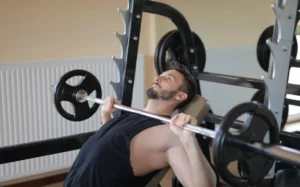
Walk in knowing exactly what you’re doing
A structured plan removes the guesswork that makes gym anxiety worse — know your exercises before you get there.
3. Learn Equipment at Home First
Watching a couple of short tutorial videos on how a specific machine or movement works before you go, so you’re not learning it for the first time in public, meaningfully reduces the “everyone can tell I don’t know what I’m doing” feeling.
4. Remember Most People Genuinely Aren’t Watching
This is repeated often because it’s true and because it doesn’t feel true in the moment: most gym-goers are focused inward, on their own workout, their own fatigue, their own form. The sense of being watched is almost always much stronger than the reality.
5. Start With a Smaller or Less Crowded Space
If a large commercial gym feels like too much at first, a smaller studio, a home gym setup, or a quieter corner of a bigger facility can be a reasonable stepping stone rather than an all-or-nothing choice.
6. Bring a Friend
Training with someone else, even just for the first several sessions, reduces the self-consciousness that solo gym visits can amplify — and gives you someone to ask basic questions to instead of guessing.
7. Reframe Anxious Thoughts as They Come Up
Gym anxiety is driven as much by what you’re telling yourself as by what’s actually happening around you. Catching and swapping the thought makes a real difference: instead of “everyone’s staring at me and thinks I don’t belong here,” try “everyone here is focused on their own workout, same as I’m about to be.” Instead of “I have no idea what I’m doing,” try “I’m learning something new, and that’s normal for the first few sessions.” This isn’t about forcing false positivity — it’s about replacing an assumption with a more accurate one.
8. Use the 3-3-3 Grounding Technique in the Moment
If anxiety spikes while you’re actually at the gym, a quick grounding exercise can interrupt it: name three things you can see, three things you can hear, and three physical sensations you can feel (your feet on the floor, the weight in your hands, your breath). Shifting attention to concrete sensory details for a few seconds pulls focus away from anxious thoughts and back into the present moment, which is often enough to let the spike pass.
When Gym Anxiety Might Be Something More
Occasional nerves before a gym session are normal and usually fade with repeated exposure. If the anxiety is severe, panic-level, or part of a broader pattern of social anxiety that’s affecting other areas of life, that’s worth discussing with a mental health professional rather than only relying on gym-specific strategies — gym anxiety can be one symptom of a larger anxiety pattern, not always an isolated issue.
Related Reading
FAQ
How do I stop a panic attack at the gym?
Step away from what you’re doing and find a quieter spot — outside, a hallway, or even just a corner away from the main floor. Use the 3-3-3 grounding technique above, and focus on slow, deep breathing rather than trying to push through the workout. Once the acute spike passes, it’s fine to end the session early; there’s no requirement to finish once a panic attack has started. If panic attacks are happening regularly, not just occasionally, that’s worth discussing with a doctor rather than managing alone each time.
Does gym anxiety go away over time?
For most people, yes — repeated exposure is one of the most effective ways to reduce it. The first few visits tend to be the hardest; familiarity with the space, the equipment, and the routine steadily reduces the anxiety over subsequent visits.
Is it normal to feel anxious about going to the gym as a beginner?
Extremely normal — beginner gym anxiety is one of the most common experiences reported by people starting a fitness routine, precisely because everything (equipment, etiquette, routine) is unfamiliar at once.
Does exercise help with anxiety generally, or make gym anxiety worse?
Regular exercise is well-supported as a general anxiety-reduction tool over time — the anxiety specific to the gym setting itself is a separate, situational response that tends to fade with familiarity, even as the exercise itself provides broader anxiety benefits.
Gym anxiety is common enough to have its own shorthand term for a reason — you’re not the only person who’s felt it, and it’s not a sign you don’t belong there. It fades with a plan, familiarity, and repeated exposure, not with waiting until you feel confident enough to start.