Last updated: October 2026
Powerlifting and bodybuilding both revolve around lifting heavy things in a gym, which is why they get confused constantly. But the two sports are judged on completely different criteria — one on a number, the other on an appearance — and that single difference in goal reshapes almost everything about how each group actually trains.
What Is Powerlifting?
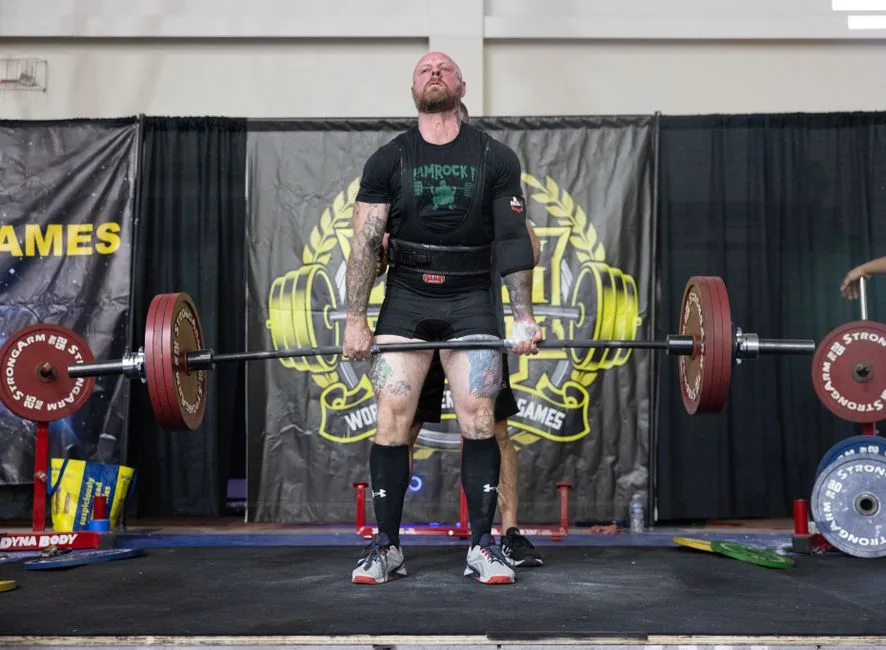
Powerlifting is a strength sport built around three lifts — the squat, bench press, and deadlift — where the goal is simple: lift the most weight possible for a single rep in each one. Competitors get three attempts per lift, and the best successful attempt from each is added together for a “total.” Highest total in your weight class wins. Judges score technique on a pass/fail basis (did the lift meet the rules), not on how the lift looked.
Because the entire sport is one number, powerlifting training is built around getting stronger in those three specific movements — heavy loads, low reps (typically 1–5), and long rest periods to allow full recovery between attempts.
What Is Bodybuilding?
Bodybuilding is a physique sport. Competitors pose on stage and are judged on muscle size, symmetry, definition, and conditioning (how lean they are) — not on how much they can lift. A bodybuilder who benches 135 lbs but has the most impressive physique on stage wins; a powerlifting-style bench max means nothing to the judges.
Bodybuilding training reflects that goal: higher rep ranges (typically 6–15), more isolation work targeting individual muscles, shorter rest periods to maximize the muscle-building stimulus per session, and a much more rigid diet aimed at building muscle while stripping body fat down for competition day.
Powerlifting vs. Bodybuilding: The Core Differences
| Factor | Powerlifting | Bodybuilding |
|---|---|---|
| Judged on | Weight lifted (1RM total across 3 lifts) | Physical appearance on stage |
| Main lifts | Squat, bench press, deadlift only | Wide variety across all muscle groups |
| Rep range | 1–5 reps, heavy loads | 6–15 reps, moderate-to-heavy loads |
| Rest between sets | 3–5+ minutes | 1–2 minutes |
| Exercise style | Compound lifts + accessory work supporting them | Compound lifts + heavy isolation work |
| Diet focus | Enough fuel to lift heavy and hit a weight class | Strict surplus/deficit cycles to build muscle, then strip fat pre-competition |
| Typical physique | Strong-looking, not necessarily lean | Lean, symmetrical, highly defined |
Training Style in Practice
The clearest place the difference shows up is a normal training session. A powerlifter’s squat day might be three or four heavy sets of the competition squat at 80–90% of their max, followed by one or two accessory movements (like leg press or good mornings) to shore up a specific weakness — then done. A bodybuilder’s leg day looks different even if it also starts with squats: more total sets, higher reps, then several isolation exercises (leg extensions, leg curls, calf raises) specifically to target muscles the squat alone doesn’t fully develop.
Rest periods reflect the same split in priorities. Powerlifters rest long — often 3 to 5 minutes between heavy sets — because full strength recovery between near-maximal attempts matters more than session efficiency. Bodybuilders rest shorter, often 60–90 seconds, because keeping the muscle under repeated stress (and maintaining the “pump”) is part of what drives the hypertrophy they’re training for.
Know your numbers before you pick a lane
Whether you’re chasing a heavier total or a bigger lift for more reps, start from an accurate current 1RM.
Related Reading
Powerbuilding: Training for Both
You don’t have to pick a side. “Powerbuilding” is a hybrid approach that structures a session around heavy, low-rep work on the three main lifts first — chasing genuine strength the way a powerlifter would — then adds bodybuilding-style accessory and isolation work afterward to build muscle size and address weak points. It’s a popular middle ground for lifters who want to get stronger and look more muscular without fully committing to either sport’s competition demands.
In practice, this often means periodizing your training: a block of weeks emphasizing lower reps and heavier loads on the big three, followed by a block emphasizing higher-rep hypertrophy work, cycling between the two rather than trying to maximize both every single session.
Which One Should You Choose?
The honest answer depends on what actually motivates you to keep training. If you like the objective feedback of a number going up — more weight, more reps at that weight, a heavier total — powerlifting-style training tends to hold motivation better long-term. If you’re more driven by visible physical changes and want a structured plan for building a more muscular, defined physique, bodybuilding-style training fits that better.
Neither is more “legitimate” than the other, and neither requires actually competing — plenty of people train like a powerlifter or bodybuilder purely for the training style itself, with no intention of stepping on a platform or a stage.
Each does come with a real trade-off worth knowing going in. Powerlifting’s singular focus on the three lifts can mean cardio and general balanced fitness get neglected if it’s your only training — worth adding back in deliberately if you’re not competing. Bodybuilding’s focus on appearance and extreme leanness for competition carries a documented risk of muscle dysmorphia and disordered eating patterns for some competitors, particularly around contest prep; if pursuing a leaner physique starts affecting your mental health rather than just your training, that’s worth addressing directly rather than pushing through it.
FAQ
Is it better to be a powerlifter or a bodybuilder?
Neither is objectively better — they’re built around different goals. Powerlifting is better suited to people motivated by measurable strength progress; bodybuilding is better suited to people motivated by visible physique changes. Many lifters also do a hybrid (“powerbuilding”) approach without ever competing in either sport.
Are powerlifters stronger than bodybuilders?
Generally, yes, in the specific lifts powerlifters train for — their entire program is built around maximizing the squat, bench, and deadlift. But high-level bodybuilders are still exceptionally strong; building the muscle mass their sport requires demands lifting serious weight, even though raw 1RM strength isn’t what they’re training to maximize.
Was Arnold Schwarzenegger a powerlifter?
Arnold Schwarzenegger is famous as a bodybuilder (seven-time Mr. Olympia), but early in his career he also competed in weightlifting and powerlifting, including winning a German powerlifting title in 1968. His heavy lifting background helped build the mass that made him successful on stage, which is part of why the two disciplines get conflated.
Can you do powerlifting and bodybuilding training at the same time?
Yes — this is essentially what “powerbuilding” is. You won’t optimize for elite-level performance in either sport simultaneously, since each benefits from focused, specialized training, but for general strength and physique goals, combining heavy compound work with bodybuilding-style accessory and isolation work is a well-established and effective approach.
Powerlifting and bodybuilding share the same basic tool — a barbell — but they’re answering different questions. One is asking how much weight you can move; the other is asking how you look moving it. Pick based on which question actually motivates you to keep showing up, or borrow from both and let the results speak for themselves.