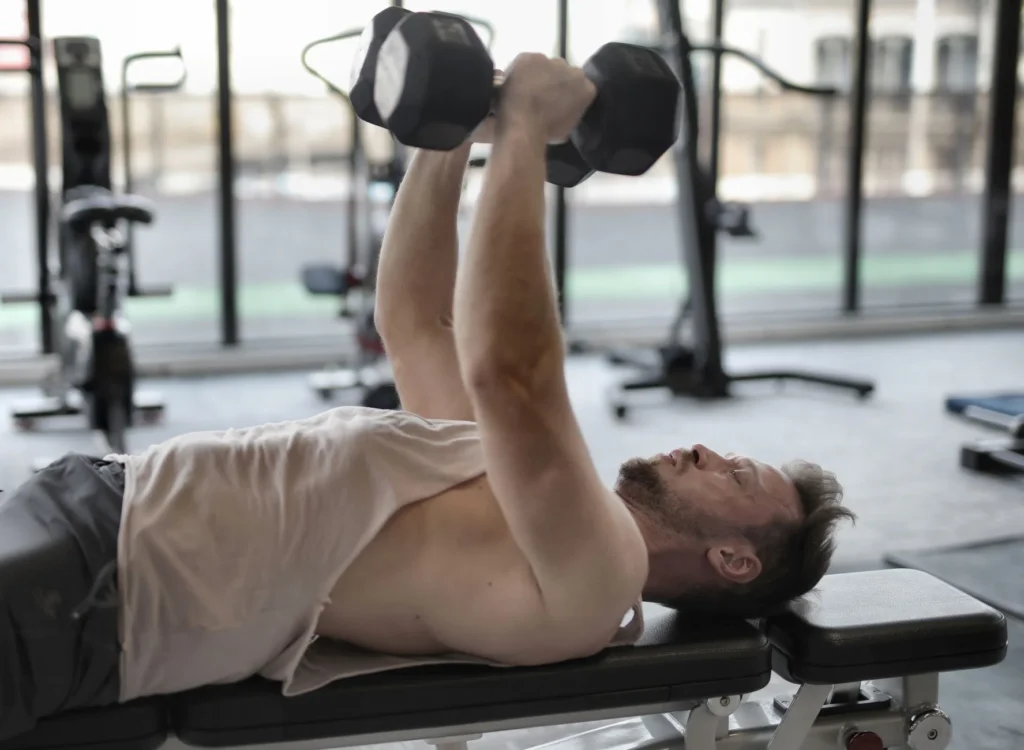
Dumbbell Bench Press: How to Do It and What Weight to Use
The most common mistake on the dumbbell bench press is loading weight by feel rather than by goal. Lifters picking up the same dumbbells they use for other exercises, or simply matching a training partner’s weights, consistently land in a grey zone: too heavy to hit target reps cleanly, too light to drive meaningful adaptation. The fix is straightforward — select weight based on your training objective and experience level, then adjust from there.
Find Your Dumbbell Bench Press Starting Weight
The dumbbell weight calculator gives you a target weight based on your goal, experience, and the specific exercise — so you’re not guessing at the rack.
Calculate My Starting Weight →How to Perform the Dumbbell Bench Press
The dumbbell bench press requires more shoulder stability than the barbell equivalent because each arm moves independently. Getting this right matters both for safety and for actually loading the chest.
Setup: Sit on the bench with dumbbells resting on your thighs. Use your legs to kick the dumbbells into position as you lie back — don’t try to pick them up from the sides once you’re already flat. Plant your feet firmly on the floor, retract your shoulder blades to create a stable base, and maintain a slight natural arch in the lower back.
Starting position: Hold the dumbbells at chest level, elbows at roughly 45–75° from your torso (not flared straight out to the sides). A 45° angle reduces anterior shoulder stress; a wider flare increases it.
The press: Exhale and press both dumbbells upward and slightly inward — they should follow a slight arc, not a straight vertical line. Stop short of lockout to keep tension on the pecs. Lower slowly under control until the handles are level with or just below your chest, pausing briefly before the next rep.
Key form points that exercise databases consistently underemphasise:
- Tilt the dumbbells at roughly 45° (thumbs higher than pinkies) to keep the shoulder in a neutral, packed position throughout the press
- Squeeze the handles hard — grip tension radiates through the shoulder and increases stability under heavy loads
- Shoulders should drive down into the bench as you press up, not shrug forward
- If you feel the exercise in your front delts rather than your chest, narrow your elbow angle and focus on squeezing the pecs at the top of each rep
How to Choose the Right Weight for Your Goal
Weight selection for the dumbbell bench press should be driven by your training goal, not by what looks respectable. Here’s how to match load to objective:
| Goal | Rep Target Per Set | How the Last Reps Should Feel | Practical Weight Selection |
|---|---|---|---|
| Hypertrophy (muscle building) | 8–12 | Reps 10–12 feel hard; form stays intact | Start light enough to hit 12 clean; increase when 12 becomes easy |
| Strength | 4–6 | Rep 5–6 is a genuine grind | Requires 85–90%+ of dumbbell 1RM; technique must be solid first |
| Muscular endurance | 15–20 | Manageable throughout; burnout on final 2–3 reps only | 50–60% of 1RM; fatigue should come from volume, not load |
| Beginner / learning movement | 10–15 | Controlled and smooth throughout | Go lighter than you think — prioritise form over weight for the first 6–8 weeks |
The fail point to watch for: if your back arches excessively off the bench, your elbows flare wide, or you need momentum to get the dumbbells moving on the first rep, the weight is too heavy for productive training reps.
Dumbbell Bench Press Weight Standards by Experience Level
These are approximate typical working weights (per dumbbell, for a set of 8–10 reps) for adults with no medical history affecting upper body strength. Women’s standards are approximately 55–65% of male values at comparable experience levels.
| Experience Level | Training History | Men (per hand) | Women (per hand) |
|---|---|---|---|
| Beginner | Under 6 months consistent training | 15–25 lb | 8–15 lb |
| Novice | 6 months – 1 year | 25–40 lb | 15–25 lb |
| Intermediate | 1–3 years consistent | 40–65 lb | 25–40 lb |
| Advanced | 3+ years progressive training | 65–90 lb | 40–60 lb |
| Elite recreational | 5+ years, well-programmed | 90 lb+ | 60 lb+ |
These are not prescriptions — they are descriptive benchmarks. Your starting point depends on individual factors including body weight, limb length, prior physical history, and how much upper-body pressing work you do in other forms.
How to Progress Dumbbell Bench Press Weight Over Time
Dumbbell bench weight typically increases in 5 lb increments per hand for beginner and novice lifters, dropping to 2.5 lb increments as you become more advanced. A good pair of adjustable dumbbells covers this entire progression without you needing to buy new weights every few weeks. Use this progression framework:
- First 6 months: Increase weight as soon as you can complete the top end of your rep target (e.g., 12 reps) with clean form on all working sets. This can happen every 1–2 weeks at the beginner stage.
- 6 months – 2 years: Expect to add weight every 2–4 weeks. Some sessions may involve adding reps rather than weight — this is normal.
- 2+ years: Monthly or even less frequent weight increases are normal. Focus on technique refinement, set volume, and rep quality rather than constantly chasing heavier dumbbells.
A useful rule of thumb: when you can complete every planned rep of every working set with 1–2 reps clearly left in reserve, increase the weight at the next session.
Related Reading
How Many Plates Is 225? Barbell Weight Quick Reference Guide →Why Dumbbell Bench Press Weight Differs from Barbell Bench Press Weight
Lifters who switch from barbell to dumbbell bench press often make the mistake of attempting to replicate barbell numbers. This is a reliable path to failed reps and shoulder strain. On average, most lifters use dumbbells totalling 70–80% of their barbell bench press weight — meaning a 200 lb barbell bench corresponds to roughly 70–80 lb per hand on dumbbells.
There are two reasons for this gap. First, dumbbell pressing requires each shoulder to independently stabilise its load, recruiting more stabiliser muscle and leaving less capacity for the primary movers (pec major, anterior deltoid, triceps). Second, getting heavy dumbbells into pressing position and safely lowering them demands more control than racking a barbell.
This doesn’t make dumbbell pressing inferior — it makes it different, with advantages including greater range of motion at the bottom, independent arm movement that corrects strength imbalances, and a more comfortable pressing path on the shoulders for many people.
Calculate Your Dumbbell Bench Press Weight
Stop guessing at the rack. The dumbbell weight calculator gives you a specific starting weight and progression target for the dumbbell bench press based on your training history and goal.
Get My Weight Recommendation →