Last updated: October 2026
You can calculate VO2 max without a lab using a field test. The two simplest: the Cooper 12-minute run, where VO2 max = (distance in metres − 504.9) ÷ 44.73, and the heart-rate ratio method, where VO2 max = 15.3 × (max heart rate ÷ resting heart rate). The Rockport 1-mile walk, a 1.5-mile run and a 2,000 m indoor row also work. All five are explained step by step below.
VO2 max is the gold standard measure of cardiovascular fitness — it tells you the maximum volume of oxygen your body can use per minute per kilogram of bodyweight. Lab testing is the most accurate method, but five well-validated field tests let you calculate VO2 max at home, on a track, or in a gym with nothing more than a stopwatch.
What VO2 Max Actually Measures
VO2 max is expressed in milliliters of oxygen per kilogram of bodyweight per minute (ml/kg/min). A higher number means your cardiovascular system can deliver and your muscles can extract more oxygen during hard effort — which translates directly to better endurance performance.
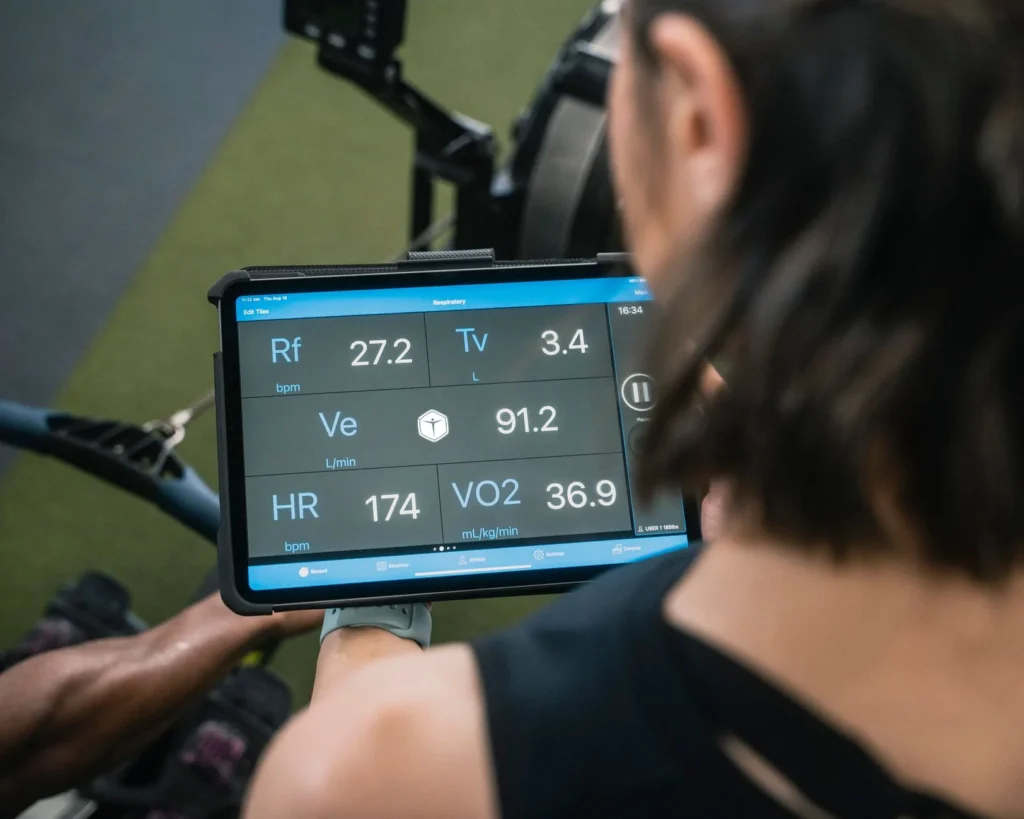
Lab testing uses a metabolic cart (a mask connected to gas analyzers) on a treadmill or cycle ergometer while intensity ramps until exhaustion. The machine measures exactly how much oxygen you consume at each stage. Field tests estimate the same number using heart rate ratios, performance times, or distance covered.
VO2 Max Calculator
Enter your field test result and get your VO2 max score instantly — no lab required.
Method 1: Heart Rate Ratio Method (Uth Formula)
The simplest estimate uses only your maximum and resting heart rates. It comes from the heart rate ratio method developed by Uth and colleagues [1]:
VO2 max = 15.3 × (HRmax ÷ HRrest)
Measure resting HR first thing in the morning before getting out of bed — count beats for 60 seconds over three consecutive days and average the result. For HRmax, use 208 − (0.7 × your age) if you have not recently done a true all-out effort.
Example: A 32-year-old with resting HR of 52 bpm.
HRmax = 208 − (0.7 × 32) = 185.6 ≈ 186
VO2 max = 15.3 × (186 ÷ 52) = 15.3 × 3.58 = 54.7 ml/kg/min
This method carries the highest margin of error because predicted HRmax varies widely between individuals. Use it only as a rough benchmark.
Method 2: Rockport 1-Mile Walk Test
Walk exactly one mile as fast as possible on a flat surface, then record your time and heart rate immediately at the finish. The Rockport formula:
VO2 max = 132.853 − (0.0769 × weight lbs) − (0.3877 × age) + (6.315 × sex) − (3.2649 × time minutes) − (0.1565 × HR finish)
Where sex = 1 for male, 0 for female. This test is well-suited for beginners or anyone returning from injury because it requires no running.
Method 3: 1.5-Mile Run Test
Run 1.5 miles (six laps on a standard 400 m track) as fast as possible on a flat surface. Time yourself in decimal minutes (e.g., 12 minutes 30 seconds = 12.5).
VO2 max = 483 ÷ time (minutes) + 3.5
Example: 1.5 miles completed in 11 minutes 20 seconds (11.33 min).
VO2 max = 483 ÷ 11.33 + 3.5 = 42.6 + 3.5 = 46.1 ml/kg/min
Run at an even effort you can sustain for the full distance — going out too fast causes early fade and underestimates your true score.
Method 4: Cooper 12-Minute Run Test
Run as far as possible in exactly 12 minutes on a flat surface. Measure total distance in meters.
VO2 max = (distance in meters − 504.9) ÷ 44.73
Example: 2,600 m covered in 12 minutes.
VO2 max = (2,600 − 504.9) ÷ 44.73 = 2,095.1 ÷ 44.73 = 46.8 ml/kg/min
The Cooper test correlates at r = 0.90 with laboratory VO2 max — making it one of the better-validated field tests. See the dedicated article below for full norms and protocol details.
Related Reading
Method 5: Indoor Rowing 2000 m Test
Row 2,000 m on a Concept2 ergometer at maximum effort. Record your 2,000 m time in decimal minutes. Concept2’s estimator first calculates Y (litres of oxygen per minute) — for example, for a highly trained man over 75 kg: Y = 15.7 − (1.5 × 2,000 m time in minutes) — and then converts it [2]:
VO2 max (ml/kg/min) = Y × 1000 ÷ body weight (kg)
Concept2 uses different constants for women, lighter rowers, and rowers who are not highly trained, so use their calculator for your category. This method is particularly useful for athletes who row regularly or who have a lower-body injury that rules out running tests.
Estimating VO2 Max From Race Times
If you have a recent race result (5K, 10K, half-marathon, or marathon), Jack Daniels’ VDOT system provides an “effective VO2 max” — the aerobic capacity implied by your race performance. A 20-minute 5K corresponds to a VDOT of about 50 ml/kg/min; a 40-minute 10K maps to roughly 52 ml/kg/min.
VDOT accounts for running economy as well as raw oxygen uptake, so it reflects real-world performance better than most field tests. Athletes with poor running economy can test high in a lab but underperform in races; VDOT captures both factors together.
Lab Test vs Field Test: Which Should You Use?
| Method | Equipment | Accuracy | Best For |
|---|---|---|---|
| Lab VO2 max test | Metabolic cart, treadmill | Highest (direct) | Elite athletes, clinical settings |
| Cooper 12-min run | Track, stopwatch | High (r = 0.90) | Fit runners |
| 1.5-mile run | Track, stopwatch | Good | Military, general fitness |
| Rockport walk | Flat course, HR monitor | Moderate | Beginners, injury rehab |
| HR ratio (Uth) | HR monitor only | Rough estimate | Quick screening |
For most recreational athletes, the Cooper test or 1.5-mile run produces a result accurate enough to guide training decisions. Retest every 8–12 weeks under identical conditions (same time of day, same surface, same warm-up) to track progress reliably.
Related Reading
How to Improve VO2 Max
VO2 max is trainable. Most untrained individuals can improve by 15–20% within 8–12 weeks of structured aerobic training. The most effective methods:
- High-intensity intervals (HIIT): 4 × 4 minutes at 90–95% HRmax with 3-minute recovery. Run three sessions per week.
- Threshold runs: 20–40 minutes at comfortably hard effort (lactate threshold pace). Builds aerobic base without excessive fatigue.
- Easy volume: 80% of weekly mileage at conversational pace builds capillary density and mitochondrial density over time.
Genetics account for 43–72% of VO2 max ceiling, but training determines how close you get to that ceiling. Even highly genetically gifted athletes plateau without consistent structured work.
Track Your Progress
Enter your field test result into the VO2 max calculator and see where you stand against age and sex norms.
Related Reading
Sources: [1] Uth N, et al. Estimation of VO2max from the ratio between HRmax and HRrest — the Heart Rate Ratio Method. Eur J Appl Physiol. 2004. [2] Concept2. VO2 Max Calculator.