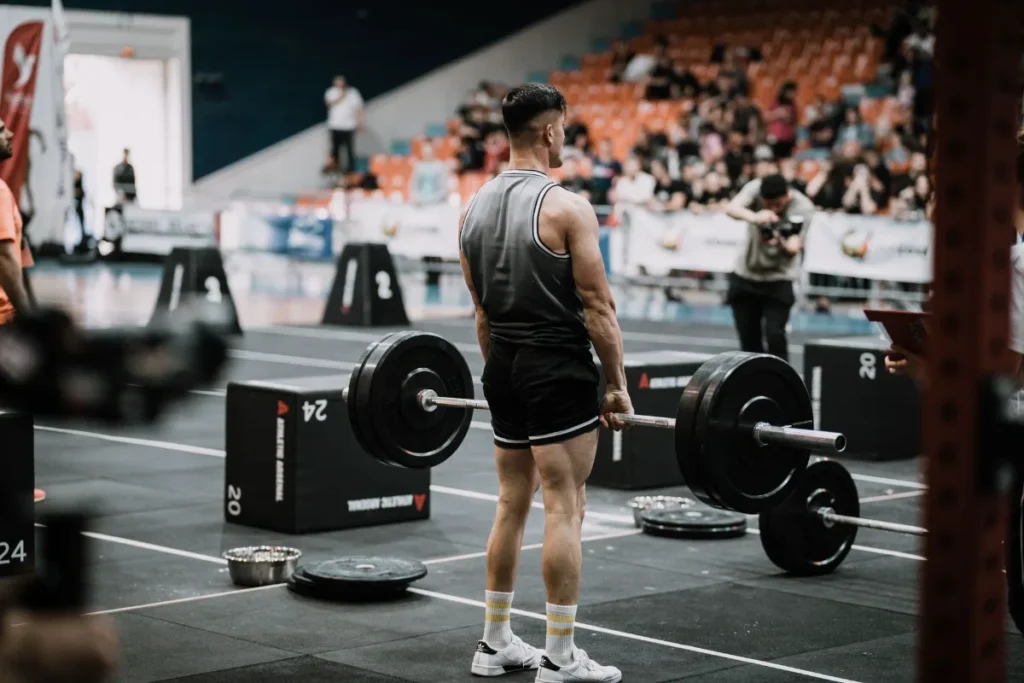
RPE stands for Rate of Perceived Exertion. In weightlifting, it’s a number from 1 to 10 that describes how hard a set was relative to your absolute maximum. RPE 10 means you gave everything you had. RPE 8 means you had 2 reps left.
Calculating RPE is straightforward once you understand how it connects to reps in reserve, estimated 1RM, and your training percentages. This guide walks through the entire process.
How RPE Maps to Reps in Reserve
The most practical way to calculate RPE during a set is to count reps in reserve (RIR) — how many more reps you could have done before reaching absolute failure.
| RPE | Reps in Reserve (RIR) |
|---|---|
| 10 | 0 — nothing left |
| 9 | 1 — could have done exactly one more |
| 8 | 2 — two clear reps remaining |
| 7 | 3 — three reps remaining |
| 6 | 4 — four reps remaining |
| 5 | 5+ — very comfortable |
The formula: RPE = 10 − RIR. If you finished a set with 2 reps clearly left, your RIR is 2 and your RPE is 8.
Half-points (RPE 8.5, RPE 9.5) represent uncertainty. If you finished a set and you’re not sure whether you had 1 or 2 reps left, that’s RPE 8.5.
Related Reading
RPE Chart: Full 1–10 Scale + % of 1RM Table →How to Assess RPE During a Set
The key is to rate RPE at the end of a set, not during it. Here’s the mental process:
1. Finish the prescribed reps. Don’t stop to assess mid-set — complete the full set first.
2. Ask: how many more reps could I have done? Be honest. Not “with perfect form on a good day,” but right now with that weight. If you’d have had to fight for your life to get one more rep, that’s 1 RIR. If you feel like you could rip off 3 more easily, that’s 3 RIR.
3. Use the RIR formula. RPE = 10 − RIR. If 3 more reps were clearly available, RPE = 7.
4. If unsure, use a half-point. Uncertainty between RPE 8 and RPE 9? Call it 8.5.
Using Bar Speed as an RPE Cue
One of the most reliable RPE cues is bar speed. As load approaches your maximum:
- RPE 6–7: Bar moves quickly and consistently on all reps
- RPE 8: Bar noticeably slows on the last rep or two
- RPE 9: Significant deceleration on the final rep; you’re working hard to lock it out
- RPE 10: Bar barely moves through the sticking point
If you’re new to RPE and struggling to assess reps in reserve accurately, bar speed is a more objective cue you can use as a cross-check.
How to Calculate Estimated 1RM from RPE
Once you know your RPE and the reps performed, you can calculate your estimated one-rep max using the RPE percentage chart.
The formula:
e1RM = Weight Lifted ÷ (% from RPE chart ÷ 100)
Example: You bench pressed 135 lbs for 5 reps and rated the set RPE 8.
From the RPE chart: 5 reps @ RPE 8 = 81.1% of 1RM.
e1RM = 135 ÷ 0.811 = ~166 lbs
This means your estimated one-rep max for bench press is approximately 166 lbs based on that set.
Calculate Your Estimated 1RM
Enter your weight, reps, and RPE rating to get your estimated 1RM and target weights for any RPE level.
Use the RPE Calculator →How to Calculate Target Weight from RPE
You can also work in reverse: given an RPE target and rep count, calculate what weight to use.
The formula:
Target Weight = e1RM × (% from RPE chart ÷ 100)
Example: Your estimated 1RM is 200 lbs. Your program calls for 3 reps at RPE 8.
From the chart: 3 reps @ RPE 8 = 86.3% of 1RM.
Target weight = 200 × 0.863 = 172.6 lbs → round to 170 or 175 lbs.
This gives you a starting point. Warm up to this weight, assess how it feels, and adjust if needed. If it moves easily with 4+ reps left, add 5–10 lbs. If it’s a grinder, drop slightly.
The RPE Percentage Chart
This table shows the % of 1RM for any combination of reps and RPE. Use it alongside the formulas above:
| Reps | RPE 10 | RPE 9 | RPE 8 | RPE 7 | RPE 6 |
|---|---|---|---|---|---|
| 1 | 100% | 95.5% | 92.2% | 89.2% | 86.3% |
| 2 | 95.5% | 92.2% | 89.2% | 86.3% | 83.7% |
| 3 | 92.2% | 89.2% | 86.3% | 83.7% | 81.1% |
| 4 | 89.2% | 86.3% | 83.7% | 81.1% | 78.6% |
| 5 | 86.3% | 83.7% | 81.1% | 78.6% | 76.2% |
| 6 | 83.7% | 81.1% | 78.6% | 76.2% | 73.9% |
| 8 | 78.6% | 76.2% | 73.9% | 70.7% | 68% |
| 10 | 73.9% | 70.7% | 68% | 65.3% | 62.7% |
Session RPE: Measuring Total Training Load
Individual set RPE is one thing, but measuring the total load of an entire training session requires a different approach. Sports scientist Carl Foster’s Session-RPE method does exactly this.
Protocol (Foster 2001) [1]:
- Complete your training session
- Wait 30 minutes
- Rate the overall session with a single number from 1 to 10
- Multiply that number by the session duration in minutes
Formula: Training Load (AU) = Session RPE × Duration (minutes)
Example: You trained for 75 minutes and rate the overall session an RPE 7.
Training Load = 7 × 75 = 525 AU (arbitrary units)
The 30-minute delay is important — it removes the bias of the last exercise. If you ended with an intense superset, rating immediately after would inflate the session RPE. Waiting 30 minutes allows a more accurate reflection of the overall session.
Session-RPE is used in research and by coaches to quantify weekly training load, monitor athletes for overreaching, and adjust programming based on cumulative stress.
RPE vs Percentage-Based Programming
The core advantage of RPE-based calculation is that it accounts for day-to-day variation in your actual strength capacity.
On a bad day, your actual 1RM might be several percent lower than your tested maximum. A fixed percentage program would have you working at a relatively higher RPE than intended — potentially at RPE 9 when you programmed RPE 8. Over time, this accumulates as unplanned fatigue.
RPE-based programming auto-corrects. If you’re fatigued, your RPE 8 occurs at a lower weight, and you lift less that day. The training stimulus — the actual physiological effort — stays consistent.
Tips for Accurate RPE Calculation
- Rate the set, not a single rep. RPE is about how many more reps you had after finishing, not how the last rep felt mid-way through.
- Practice on known sets. Occasionally go to true failure (with a spotter and safety equipment) to calibrate what RPE 10 actually feels like.
- Be consistent across lifts. RPE 8 on squat may feel different than RPE 8 on bench press. Calibrate for each movement separately.
- Write it down. Log your RPE alongside weight and reps every session. Trends over time reveal patterns in your readiness and recovery.
Frequently Asked Questions
How long does it take to accurately assess RPE?
Most lifters develop reasonably accurate RPE assessment after 3–6 months of consistent training. Research suggests experienced lifters rate reps in reserve more accurately than novices, especially on sets close to failure [2]. Beginners should treat their first few months as a calibration period and expect some imprecision.
Is RPE different for every exercise?
Yes. RPE is specific to each movement. Your familiarity with a lift affects how accurately you can assess it. You’ll likely be more accurate on the squat if you’ve squatted for years than on a Romanian deadlift you’ve only done for months.
Can I calculate RPE from heart rate?
Not directly for strength training. Heart rate is a poor proxy for intensity on barbell lifts because it responds to factors like breath-holding and the Valsalva maneuver. For cardio training, heart rate and RPE align more closely — but for weightlifting, count reps in reserve instead.
What’s the difference between RPE and RIR?
RIR (Reps in Reserve) and RPE are two ways to express the same thing. RIR counts reps left; RPE is a 1–10 rating. They’re directly linked: RPE = 10 − RIR. A set at RIR 2 is a set at RPE 8. Some coaches prefer one over the other, but the training stimulus is identical.
Related Reading
RIR vs RPE: What’s the Difference and Which Should You Use? →RPE Calculator for Weightlifting
Put the formulas above to work instantly — enter any weight and rep count to get your estimated 1RM and target weights for any RPE.
Open the RPE Calculator →Related Reading
RPE Training for Powerlifting: How to Program by Feel →Sources: [1] Foster C, et al. A new approach to monitoring exercise training. J Strength Cond Res. 2001. [2] Zourdos MC, et al. Novel resistance training-specific rating of perceived exertion scale measuring repetitions in reserve. J Strength Cond Res. 2016.